
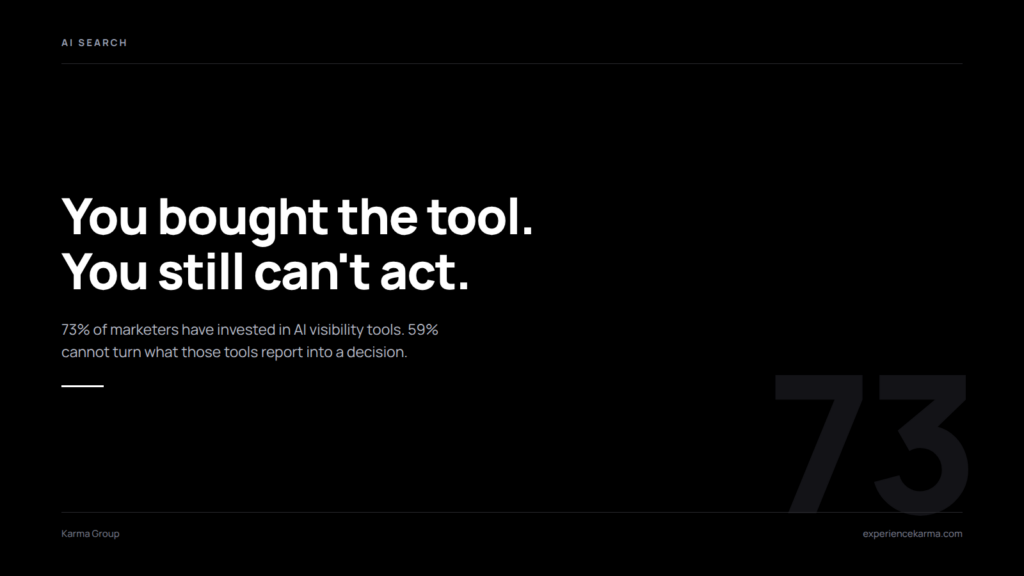
73% of marketers have already bought AI visibility tools. But 59% cannot turn what those tools report into a decision. That pair comes from a survey of 602 US marketing and PR pros, fielded 19 May to 2 June 2026. So AI visibility measurement is no longer a data problem. The data sits in dashboards nobody acts on. Instead the failure is upstream, because almost no team has picked the handful of numbers it will defend each month. Here is what three 2026 datasets show, and what to change this week.
Everyone bought the tool. Most cannot act on it.
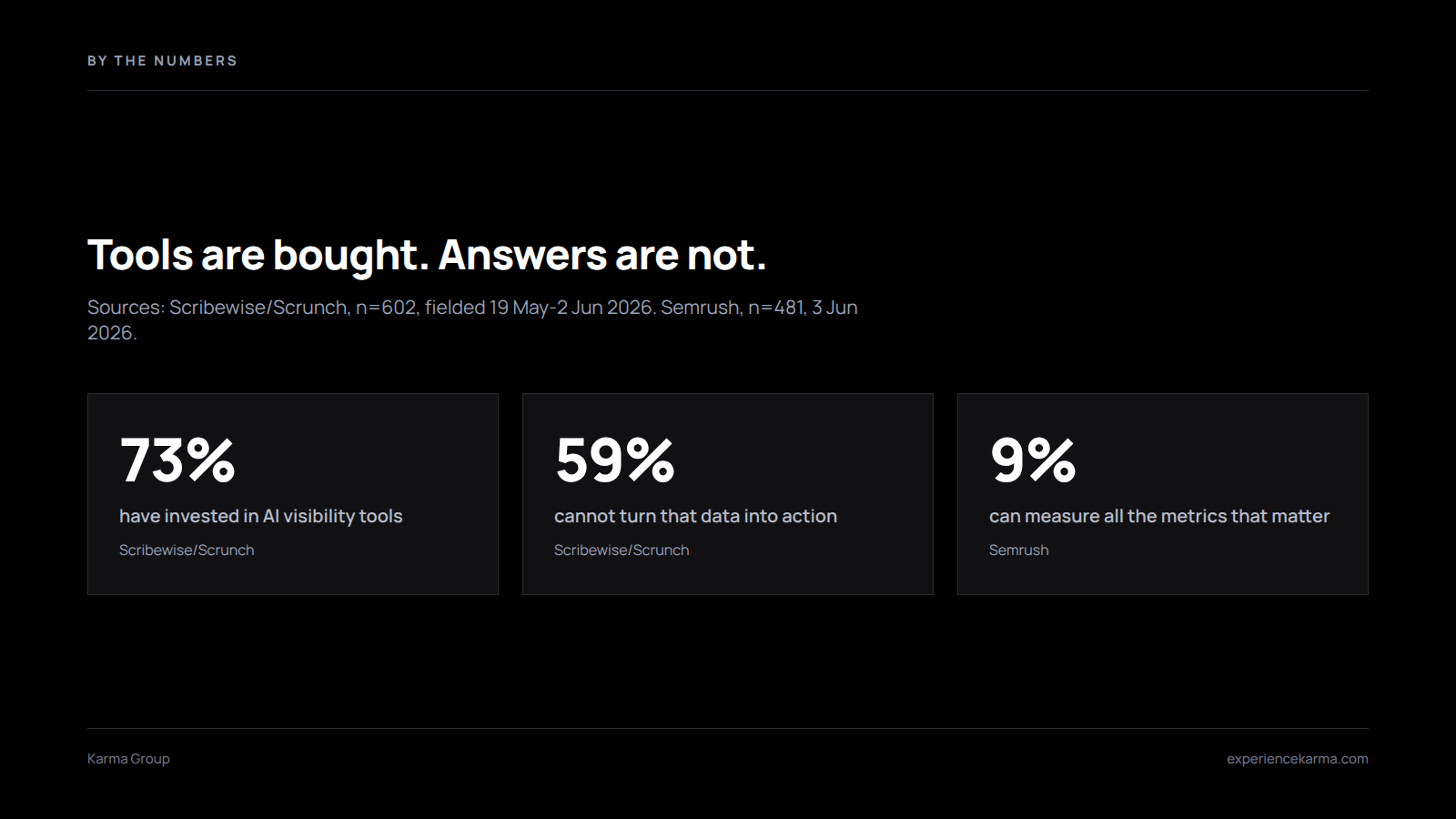
Scribewise and Scrunch surveyed 602 full-time US marketing and PR professionals across 44 states, with a ±4% margin of error at 95% confidence. Their headline finding is blunt. 73% have invested in AI visibility tools. Yet only 41% can turn that data into action. So most of the money in this category is buying dashboards, not decisions.
Semrush found the same shape from a different angle. It surveyed 570+ marketers and filtered to 481 with an attention check. Just 9% say they can measure all the metrics that matter. Meanwhile only 14% plan to invest in analytics at all, the lowest of every category it asked about.
The spending behind this is not small. A third survey, of 343 marketing decision-makers, puts an average of 24% of search and content budgets into AI visibility work. 82% allocate at least something, and 43% now spend more than a fifth of the budget there. So this is a real line item on real plans. Yet the same market cannot say what it bought.
AI visibility measurement is not a tooling problem
Read those numbers together and the diagnosis changes. Teams are not blind because the market lacks tools. They are blind because 40% still rely on typing prompts by hand to check whether their brand shows up, Semrush found. That is a spot check, not AI visibility measurement. You cannot trend it, staff it, or defend it in a budget meeting.
The tell is what teams plan to fund next. Analytics ranks last at 14%, behind content creation at 49% and brand visibility at 46%. So the budget flows toward making more, while the ability to judge any of it stays flat. In fact the one line item that would settle the argument is the one nobody funds.
Confidence is running 33 points ahead of proof
84% of the Scribewise and Scrunch sample say they are confident they can shape AI answers. But 51% are not sure their approach is correct. Those two numbers describe the same people. In fact the survey title, “Moving fast, flying blind,” is the honest reading of its own results.
It gets more specific. 56% are unsure how AI search work differs from SEO. Another 47% do not know what content AI platforms actually use. So more than half the market is optimizing against a mechanism it cannot describe. Meanwhile 62% are still judged on old SEO metrics, which means the reporting has not caught up either.
The skills picture matches. 87% feel rising pressure to build technical skills, though 58% say their training has not kept up. Agencies feel it from the other side: 80% report that clients still read all of this through an SEO lens. So the vocabulary problem and the AI visibility measurement problem are the same problem.
Four numbers almost nobody tracks
The survey asked what teams monitor. The gaps are large and consistent:
- 71% do not track competitive share of voice in AI answers.
- 70% do not monitor brand sentiment in AI responses.
- 67% do not look at AI bot traffic hitting their own site.
- 60% do not check which sources the AI platforms cite.
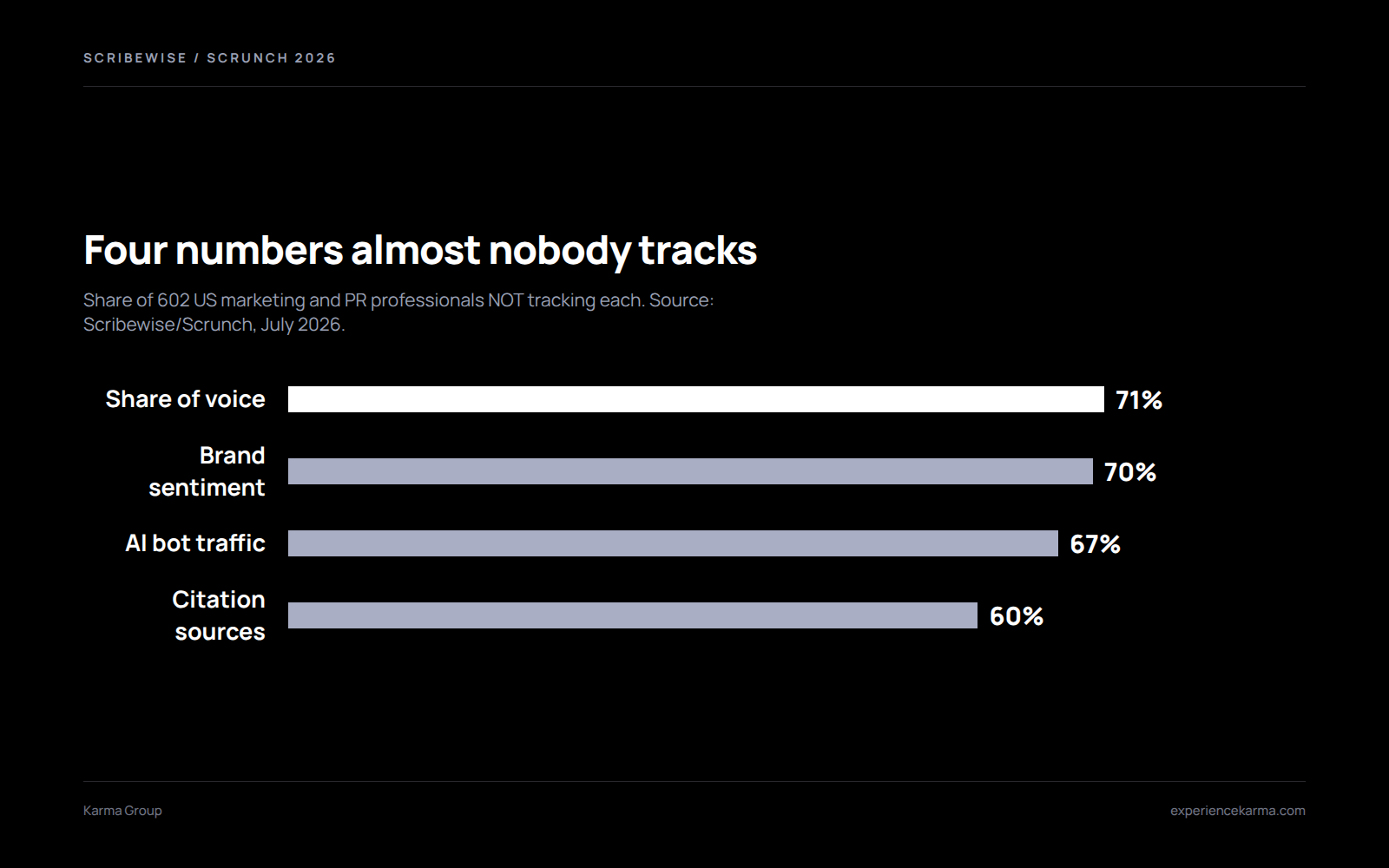
Only 45% test how they appear in AI answers at all. Notice what those four have in common. Each one needs a baseline and a repeat. A spot check gives you neither. Still, the thing most teams do measure, whether they showed up today, is the least useful item on the list.
Share of voice is the costliest omission of the four. 37% of the Semrush sample say rivals get mentioned more often than they do in AI answers. But without a tracked share of voice, that is a feeling rather than a finding. You cannot bring a feeling to a budget meeting. Our work on AI citations versus brand mentions covers why those two signals need separate columns.
More content will not close the AI visibility measurement gap
Here is the costliest habit in the data. 42% are scaling content production for AI visibility. Only 23% are working on content they already own. So 77% leave their existing pages untouched while they publish more.
That is backwards on cost alone. Those pages already carry links, history and rankings. Still, the instinct is to add. We made the case against volume in our piece on blocking AI crawlers, and nothing since has moved us off it. Publishing more while measuring nothing just raises the cost of being wrong.
Split teams lose, and the split shows up in the report
Semrush found the sharpest outcome gap in any of this data. 81% of teams with fully integrated SEO and AI search execution report more traffic or leads from AI platforms. For teams running the two completely separately, that figure is 36%. Only 22% are fully integrated across strategy, execution and reporting.
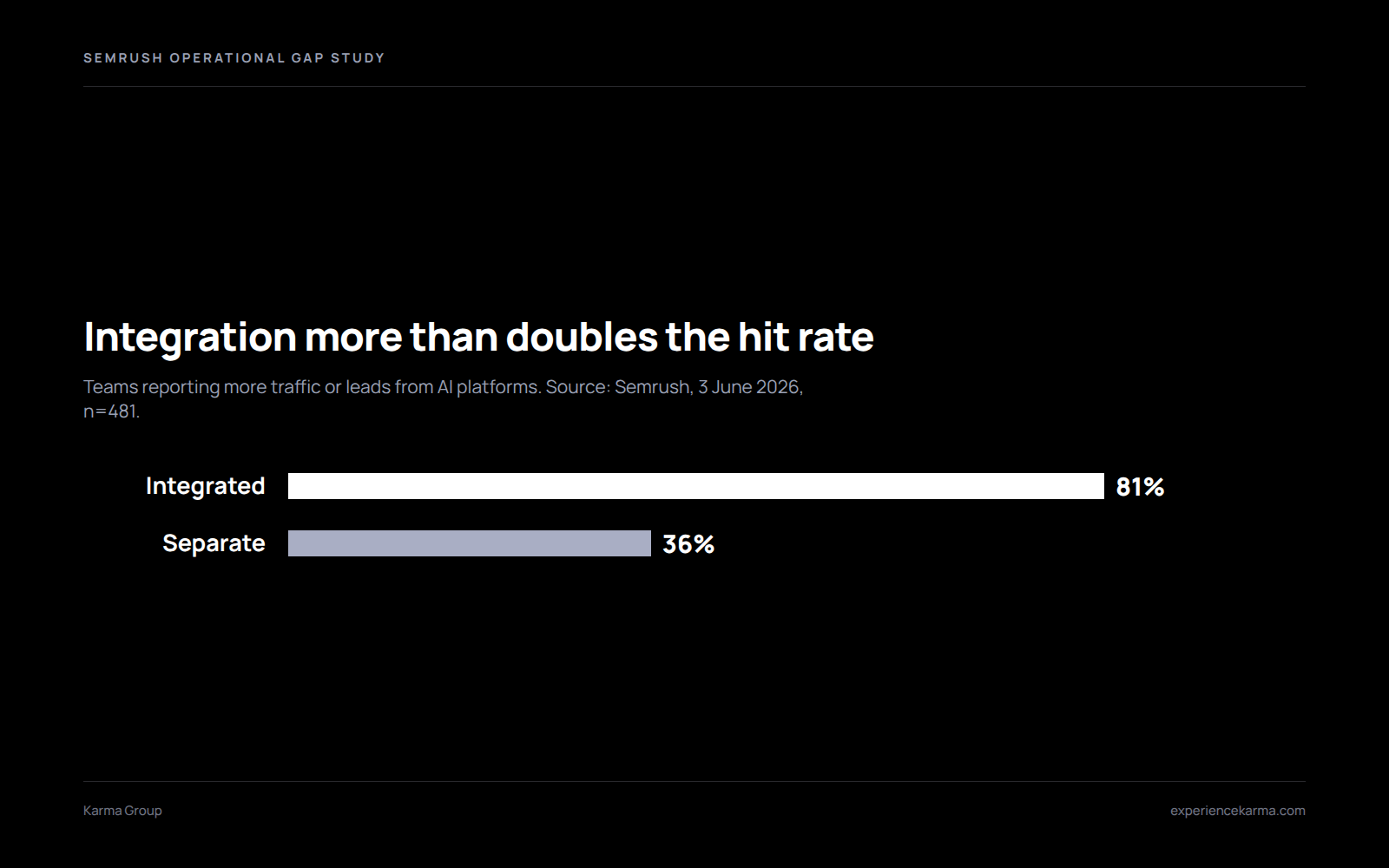
Be careful with that gap, though. It is a correlation from a self-reported survey, so the arrow could point either way. Teams already winning may simply find it easier to merge. Still, the reporting effect is real: one team files one number, so the argument about whether AI search works happens once instead of every quarter.
Every one of these datasets is sold by someone
Now the caveat most write-ups skip. Scrunch sells AI visibility software. Semrush sells AI visibility software. Both published research concluding that a visibility gap exists, so read the framing with that in mind.
But one finding cuts against the seller’s own interest, which is why it is the most credible number here. 73% already bought tools, and 59% still cannot act on them. A vendor reporting that its own category is not the bottleneck is testifying against itself. That is the number to trust. Treat the rest as direction, not precision. A third survey of 343 decision-makers, reported by PPC Land, points the same way: buyers rank case studies with measurable results as the top credibility signal at 34%, against 9% for fluency in the jargon.
Fix your AI visibility measurement this week
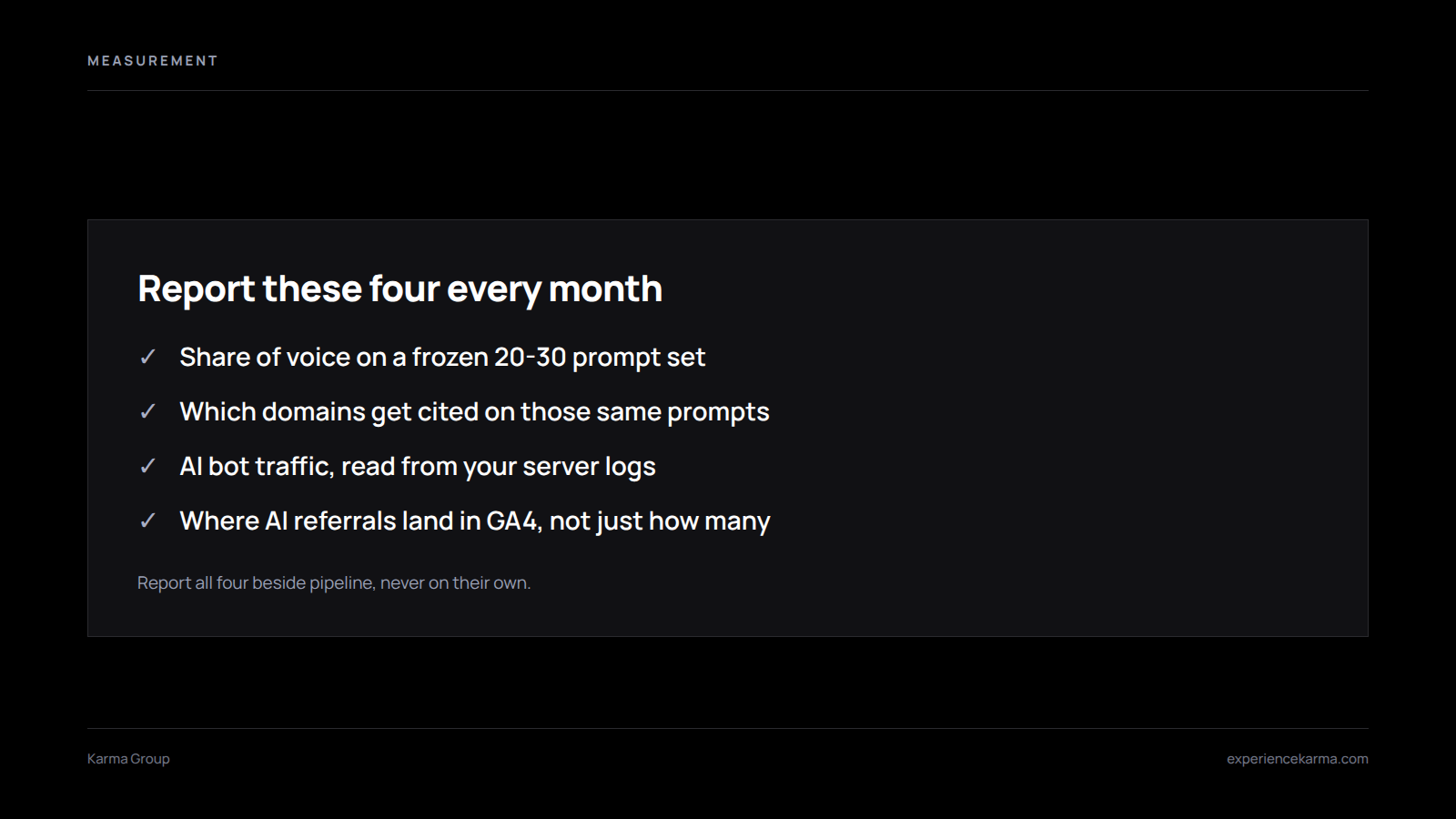
Pick four numbers and report them monthly. Four, not forty.
- Share of voice. Run a fixed set of 20 to 30 buying-intent prompts, then record how often you appear against three named rivals.
- Citation sources. Log which domains get cited on those same prompts, because that tells you where to go earn a placement.
- AI bot traffic. Read your server logs for the AI crawlers. Two-thirds of teams never open this file.
- Landing behavior. Track AI referrals in GA4 and watch where they land, not just how many arrive.
Then freeze the prompt set. A shifting prompt list produces a shifting number, so you will never know what actually moved. Run it the same day each month and keep the history. On the fourth number, our data on AI homepage traffic explains why the landing page matters more than the total.
One more rule. Report the four beside pipeline, never alone. 49% of the Semrush sample struggle to connect AI search to revenue, and a metric that never sits next to money eventually loses its budget.
Want help with AI visibility measurement?
Karma Group builds AI visibility measurement that survives a budget conversation. We set the prompt set, baseline the four numbers, and report them against pipeline every month. Get in touch and we will show you what your current baseline looks like.

Written by
Founder and CEO, Karma Group
Brendan Cogbill is the founder and CEO of Karma Group. He has run paid media and search for trade show, experiential and industrial brands since 2019, and now focuses on how brands earn visibility inside AI search. He holds a BBA and an MBA from Grand Canyon University and works from Phoenix, Arizona.
More about Brendan Cogbill