
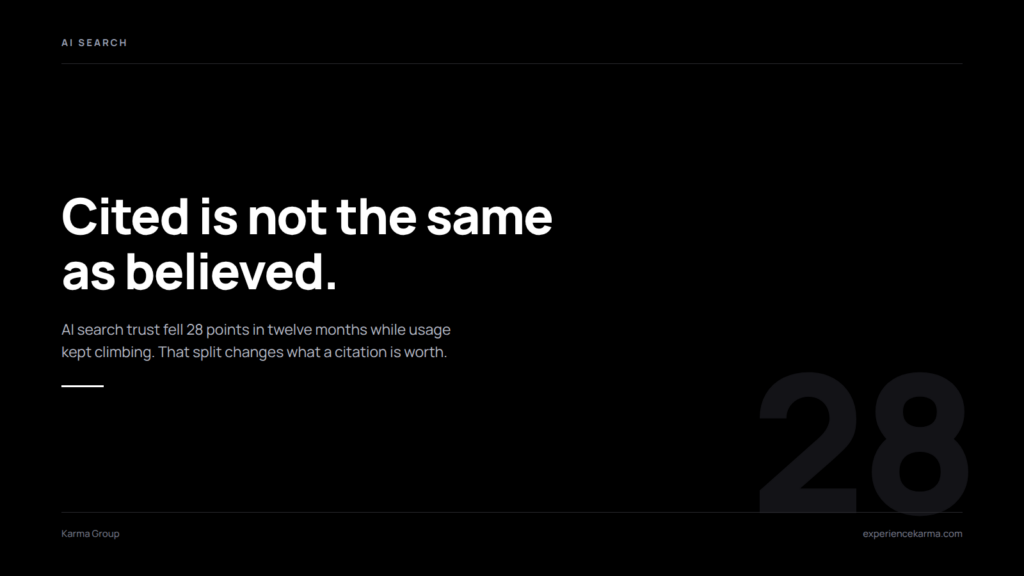
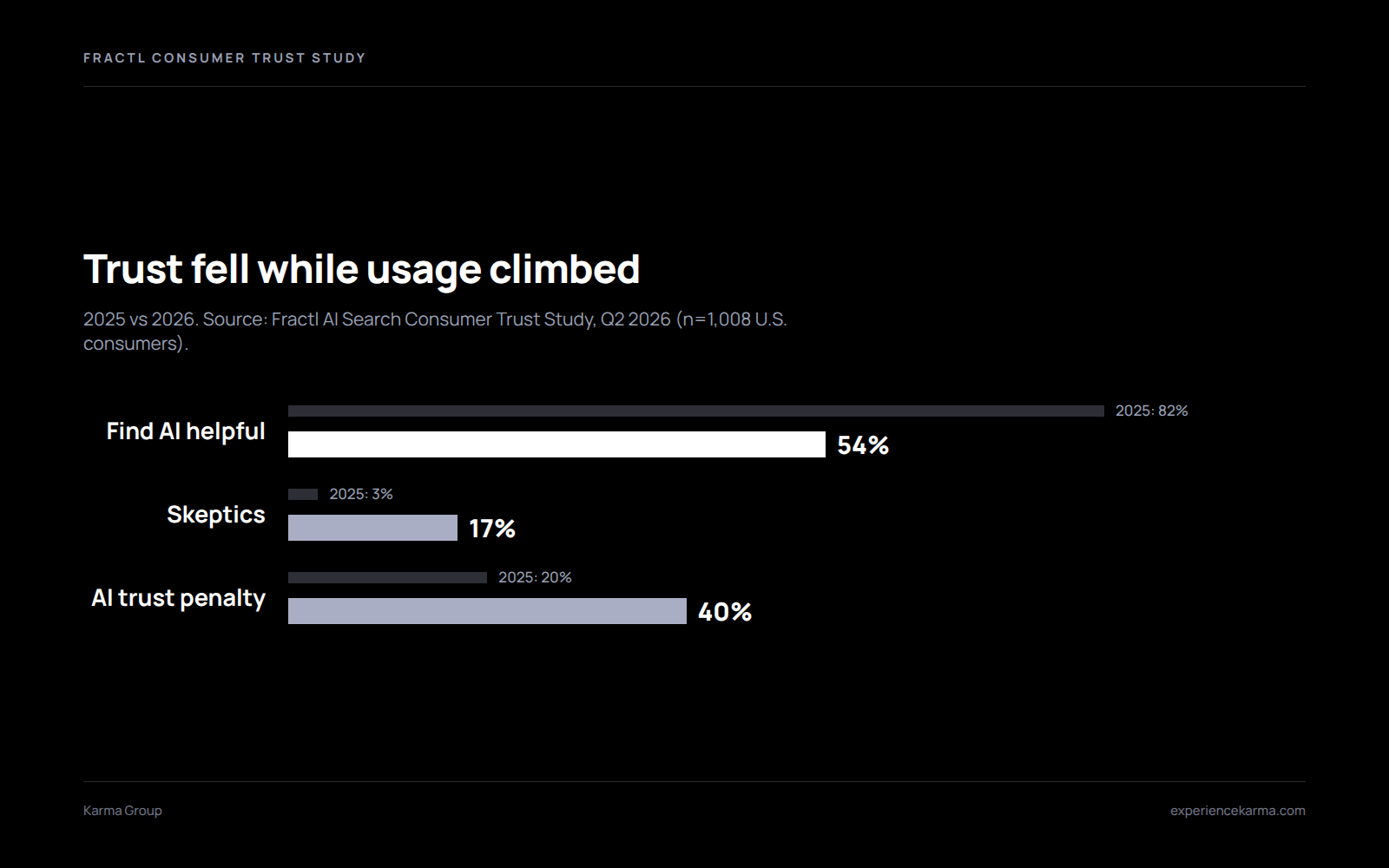
Fractl surveyed 1,008 U.S. consumers in Q2 2026 and found that AI search trust fell 28 points in a year. In 2025, 82% of them called AI-powered search more helpful than traditional search. Only 54% say so now. Yet usage went the other way: 70% search with AI tools more than they did a year ago. So people reach for AI more often while believing it less. That split matters more than any citation dashboard, because it changes what a citation is worth.
AI search trust fell 28 points in twelve months
The drop is not a rounding error. Fractl ran the same questions in 2025 and 2026, so the year-over-year comparison holds. Active skeptics, meaning people who call AI search less helpful than the old kind, went from 3% to 17%. That is close to a sixfold jump in twelve months.
Two forces pushed the AI search trust line down. First, enough people have now used these tools to catch one confidently making things up. Second, the novelty wore off. Early wonder turns into ordinary scrutiny once a tool joins the daily routine.
Notice what did not change. Fractl found 64% still expect AI to replace traditional search within five years, against 66% a year earlier. People have not stopped betting on the technology. They have simply stopped taking its answers at face value.
People use AI search more and believe it less
Adoption and belief now move in opposite directions, and most GEO advice ignores that. Only 4% of the people Fractl surveyed had never searched with an AI tool. Meanwhile 25% said their use rose sharply, and another 45% said it rose somewhat. So your audience is there. But it arrives skeptical, and it arrives ready to check your claim somewhere else.
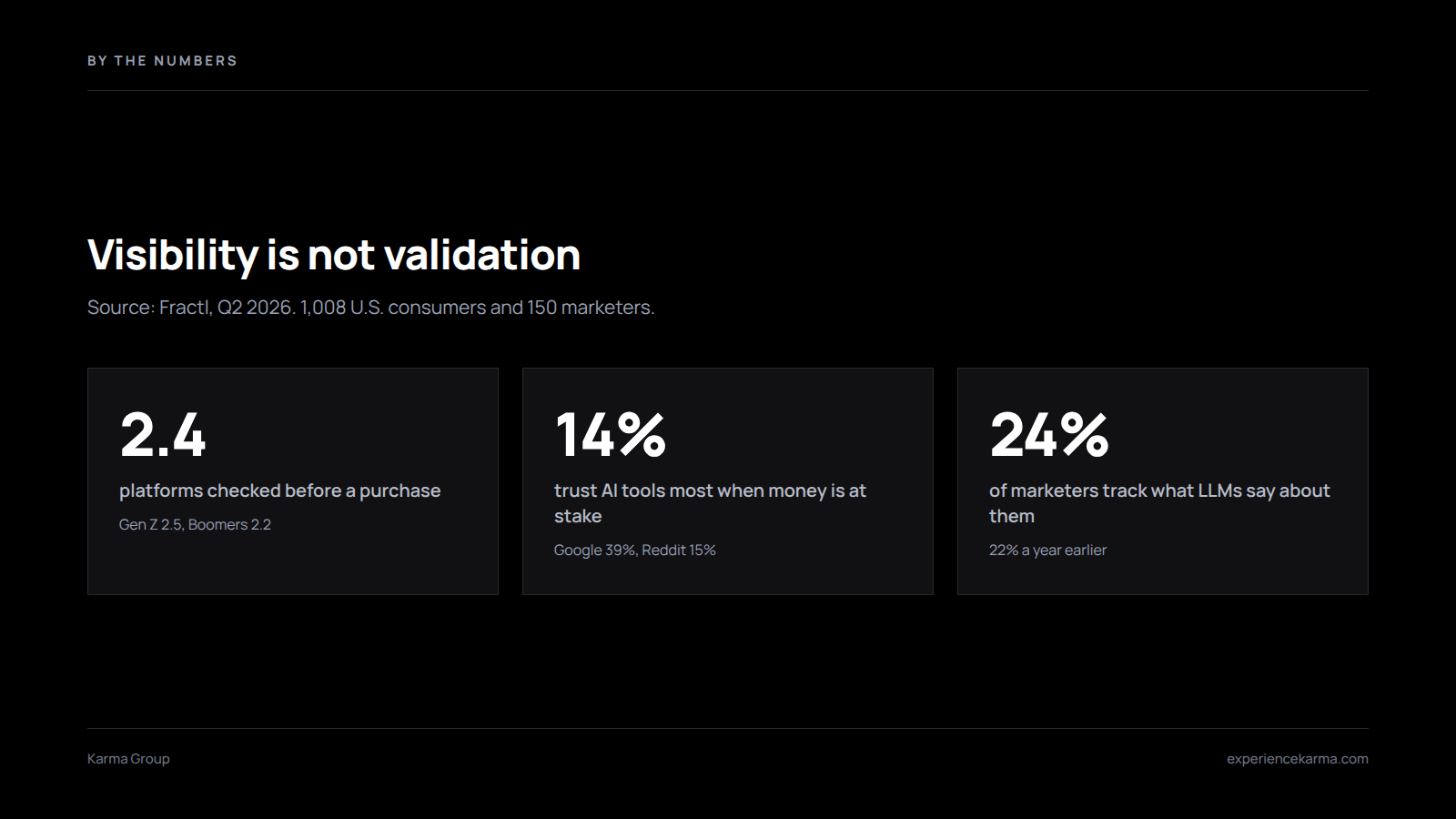
Search Engine Land reported the same pattern from the marketer side of the survey. Half of the 150 marketers polled have watched organic traffic fall since AI Overviews launched, and 61% blame AI for it. Still, only 24% track what large language models say about their brand. That number barely moved from 22% a year earlier.
The buying decision happens across 2.4 platforms
Here is the number that should change your plan. Before buying, the average consumer checks 2.4 platforms, and that figure barely moves by generation. Gen Z checks 2.5. Boomers check 2.2. So nobody reads one AI answer and reaches for a card.
Ask who earns trust when money is at stake and AI finishes near the bottom. Google takes 39%. Reddit takes 15%. AI tools take 14%, just ahead of review sites and friends at 11% each. Read that next to the adoption data and the picture gets clear. People use AI to build a shortlist. Then they verify it somewhere they trust more.
AI search trust varies by what you sell
Look at where people go by question type and the picture splits hard. Google still takes 74% of local business searches, 58% of product research, 57% of travel planning and 55% of health questions. YouTube leads how-to at 50%. ChatGPT ranks second in several of those categories, but second means 26% on health, 19% on product research and 18% on travel.
So the size of your AI search trust problem depends on your category. Sell something local and Google still owns the deciding moment. A considered purchase works differently, because AI shapes the shortlist weeks before anyone visits your site.
Your growth is showing up on social, not only in AI
Ask marketers where visibility actually grew this year and the ranking surprises people. Social platforms lead at 57%, counting TikTok, Reddit and YouTube. AI assistants come second at 40%. Direct and branded traffic follows at 31%, while 10% report no growth anywhere.
Read that alongside the 2.4-platform habit and it stops looking like a coincidence. The places buyers use to verify an AI answer are the same places showing growth. So a program that only chases citations covers about a third of the job.
AI search trust drops when your content reads like a machine
Fractl also asked how heavy AI use affects brand trust, and the answer doubled in a year. In 2025, 20% said their trust would fall if a favorite brand leaned hard on AI. In 2026, 40% said the same. Gen Z punishes it hardest at 54%, while Gen X and Boomers sit around a third.
Consumers want the label too. Fractl found that 84% want written AI content marked, rising to 87% for audio, 90% for images and 91% for video. Yet only 20% of organizations always disclose, and a third never do. That is a wide gap between what people ask for and what brands give them.
Marketers feel the drift from inside as well. Fractl found AI now touches 53% of marketing work, up from roughly 38% in 2025. Yet only 26% say the output got faster and better. Nearly half say it got faster and more average. Average is exactly what a skeptical buyer skips.
So the practical read is blunt. Chasing AI search trust with more AI-written pages works against you. Volume gets you indexed, but it never gets you believed, and belief is what closes the sale.
Most brands have no idea what AI says about them
Fractl found that 27% of marketers have already seen their brand described inaccurately in an AI answer. Worse, 14% say an AI error hit sales, a customer relationship or their PR. Even so, only 24% run any formal monitoring at all.
Compare that with rank tracking, where nobody would run a program blind for a quarter. The same standard has not reached AI answers yet. So the brands that adopt it early get an unusually cheap edge, and they get it before competitors think to look.
That is a cheap problem to fix and an expensive one to ignore. Run your ten most valuable buying questions through ChatGPT, Gemini, Perplexity and Google AI Mode once a month. Log what each one says about you. When a wrong claim shows up twice, go find the page it came from and correct the source.
Close your AI search trust gap in five moves
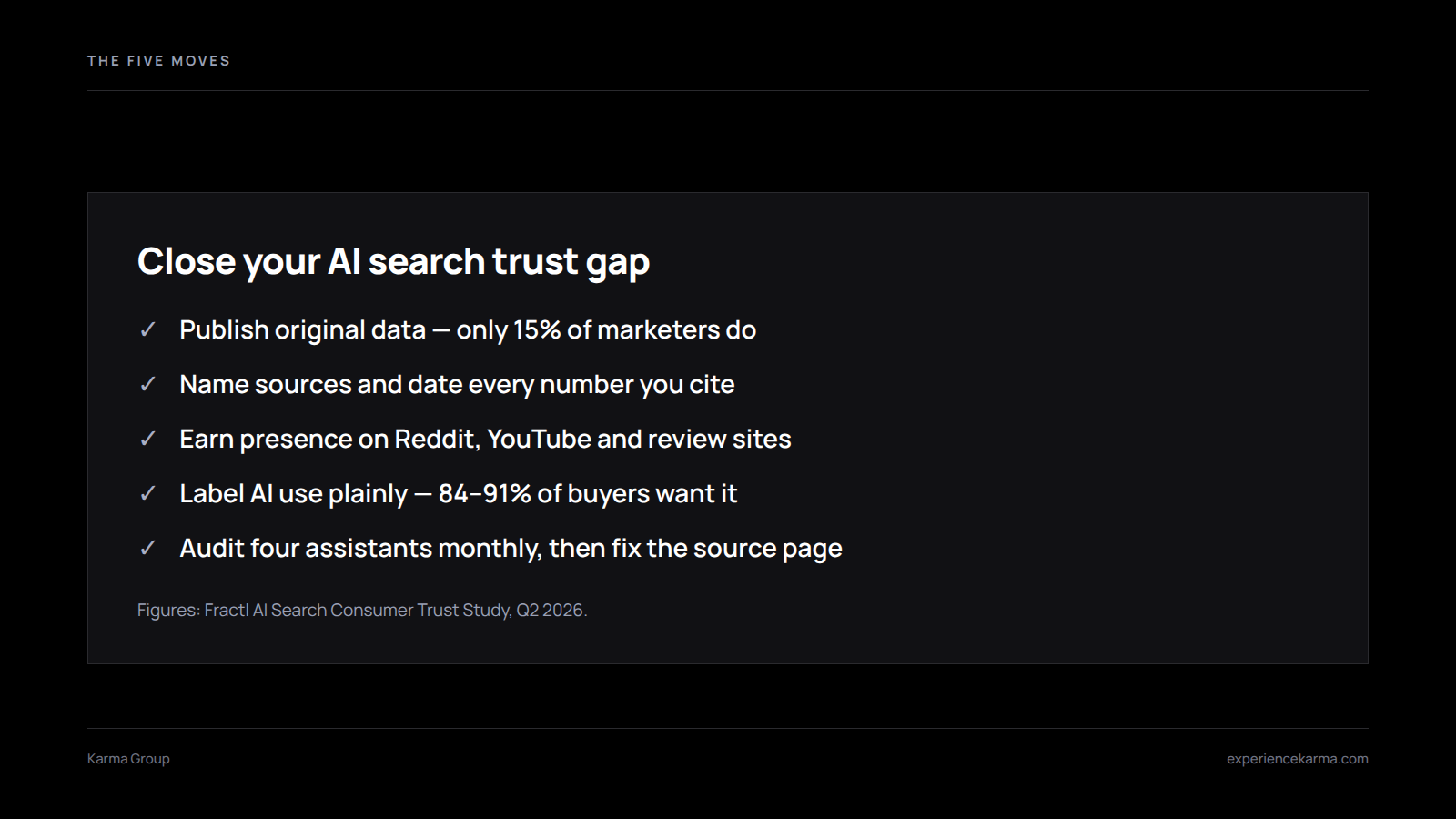
- Publish original data. Only 15% of marketers prioritize original research, so that lane stays wide open
- Show your work. Name your sources, date your numbers and link out, because a checkable page survives the 2.4-platform check
- Earn presence where people verify. Reddit, YouTube and review sites carry more trust than AI tools do, so treat them as search surfaces
- Label AI use plainly. Since 84% to 91% of buyers want disclosure, a one-line note costs you nothing
- Monitor monthly. Track what four assistants say about you, then fix the source page behind any wrong answer
None of that needs a bigger content budget. It needs a more defensible one. AI search trust gets earned on the second page a buyer checks, not the first one they read.
Want help closing the gap?
Karma Group builds AEO and GEO programs around evidence rather than volume. We audit what AI assistants say about you today, fix the source pages behind the wrong answers, and build the original research that earns citations worth having. Talk to us about your AI search trust gap.