
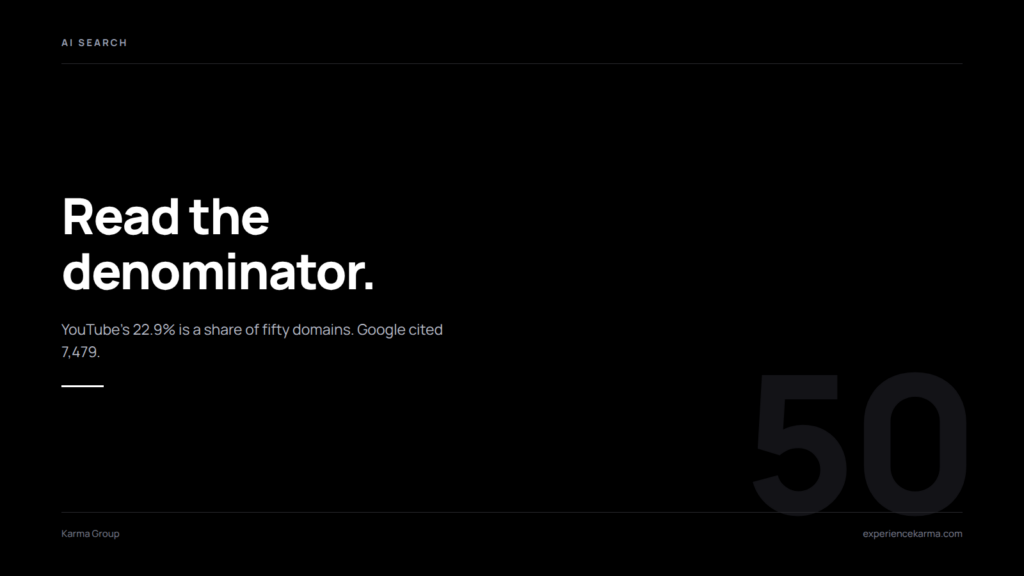
Ahrefs put YouTube at 22.9% of AI Overview citations in September 2026. Read the footnote first. That 22.9% is a share of fifty domains, not a share of the web. Measured against every link Google actually shows, AI Overview citations spread across 7,479 different hostnames. So the leaderboard everyone quotes is a leaderboard, not a market. Your page is not losing to YouTube. Instead it competes in a long tail that most coverage never counts.
The 22.9% figure ranks fifty domains, not the web
Ahrefs refreshes its list of the most-cited domains in Google AI Overviews every month. The September 2026 run covered more than 3 million US queries. YouTube took 22.9%, Reddit 18.5%, and Facebook 10.1%. Those shares look crushing. But Ahrefs defines mention share as a domain’s citations “as a percentage of the summed citations of the top 50 most-cited sources.”
So the denominator is the leaderboard itself. Add all fifty shares and you get 100%, because the metric works that way by design. Nothing outside the top fifty appears in the number at all. Even inside the winners’ circle, the drop-off gets steep fast. The twentieth domain already sits at 0.6%, and the thirtieth at 0.4%.
Look at who fills those lower slots, though. Edmunds, NerdWallet, Kelley Blue Book, WebMD, Consumer Reports. None of them run a social network. Each one answers a narrow question for a narrow audience, over and over. That is a far better model for your site than YouTube is.
That is still useful data. It just answers a narrow question: among the biggest winners, who wins most? It cannot tell you what share of every citation goes to a big platform. For that you need a study that counts the whole pool.
AI Overview citations came from 7,479 domains
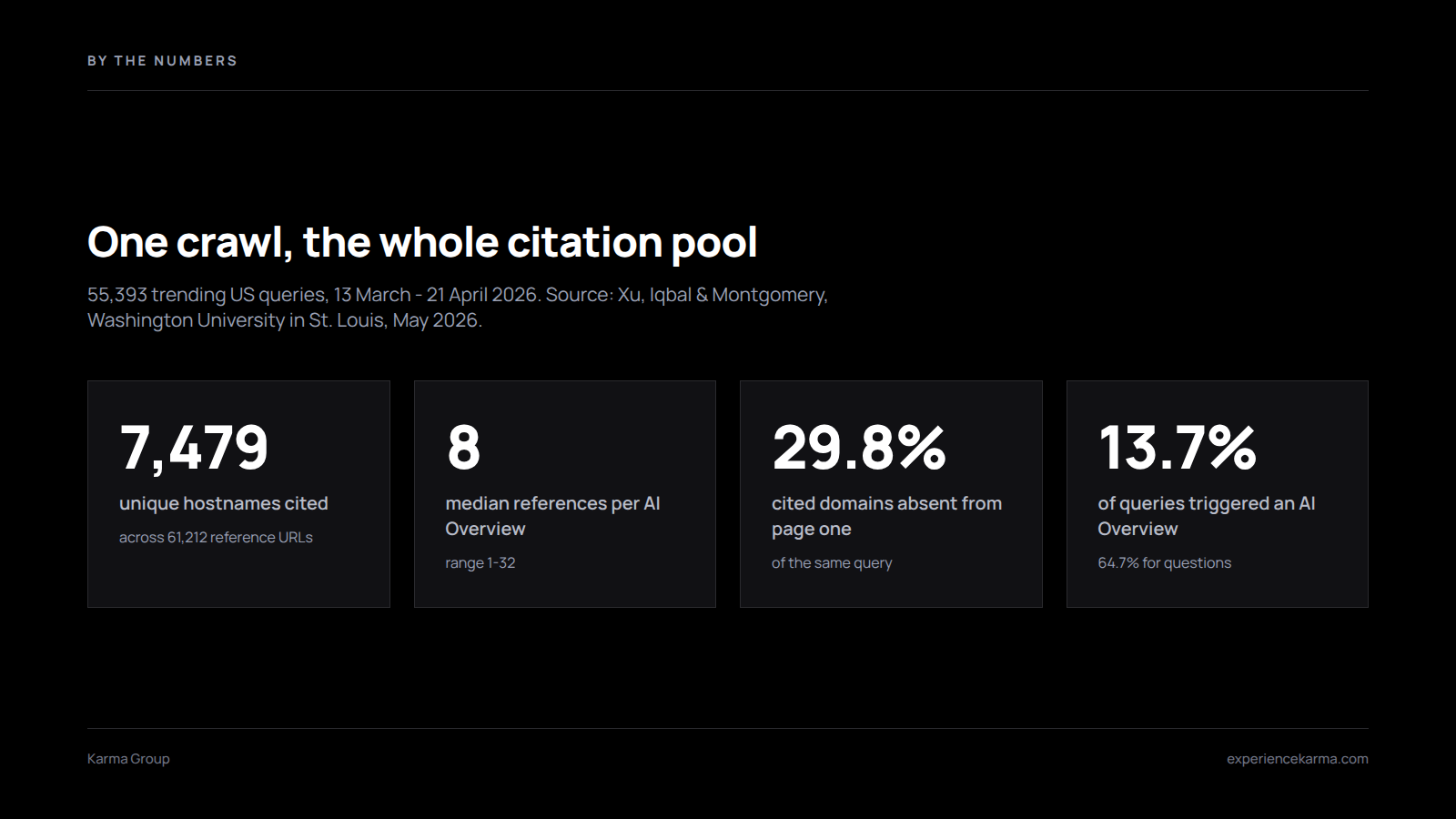
Three researchers at Washington University in St. Louis built one. They crawled 55,393 trending Google queries between 13 March and 21 April 2026, then logged every reference inside every AI Overview. Their preprint landed on arXiv in May 2026.
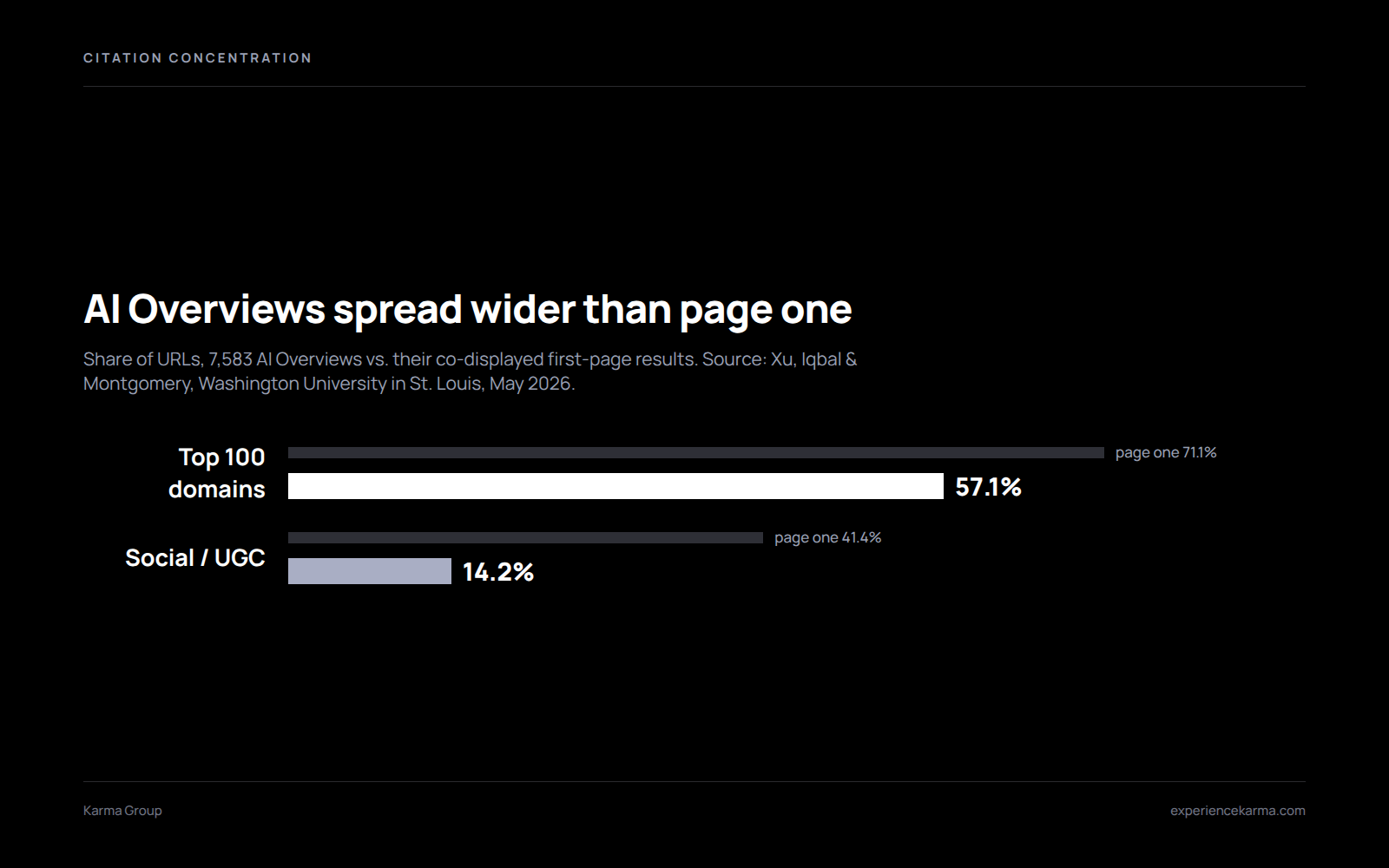
The crawl returned 7,583 AI Overviews holding 61,212 reference URLs. Those URLs came from 7,479 unique hostnames. The top 100 domains took 57.1% of AI Overview citations. So roughly 43% went to everybody else.
Now compare page one of ordinary search results. There the top 100 domains took 71.1%. AI Overview citations spread wider than the blue links do, not narrower. That is the reverse of what the leaderboard coverage implies.
Google’s AI cites social platforms less than page one does
The same paper grouped the usual suspects and counted them: Facebook, Instagram, LinkedIn, Pinterest, Quora, Reddit, Threads, TikTok, X and YouTube. Together they supplied 14.2% of AI Overview reference URLs. On the first page of results shown beside those answers, the same platforms supplied 41.4%.
Read that twice. Google’s AI leaned on user-generated content less than half as heavily as its own blue links did. Wikipedia sits outside that group, because the authors treated it as edited rather than user-generated.
Both findings hold at once. YouTube really does lead the leaderboard, and social platforms really do take a smaller slice of the whole pool than page one hands them. The two numbers answer different questions. Only one of them tells you where to spend.
Nearly a third of cited domains never rank on page one
Here comes the finding that should change your plan. Among domains cited in an AI Overview, 29.8% did not appear anywhere in the first-page results displayed alongside. So Google pulled almost a third of its sources from outside the top ten.
The cited domains also scored higher on the study’s credibility measure than page-one results did: 0.732 against 0.645. Google therefore does not simply summarise whatever ranks. It reaches for sources it trusts, and some of those never surface in the ten blue links at all.
That matters because it kills a common excuse. Teams stuck on page three assume the AI answer stays out of reach until they climb. Yet almost a third of the time, Google went looking outside the page it just built.
AI Overview citations follow questions, not keywords
Activation matters before citation does. Across those 55,393 queries, only 13.7% triggered an AI Overview at all. Split by query shape, though, the gap turns enormous. Question-form queries fired an AI Overview 64.7% of the time. Non-question queries managed 9.5%.
That is a 6.8x difference, and it tells you which pages to build. AI Overview citations cluster on pages that answer a question outright. So write the question as a heading, then answer it in the two sentences underneath. Vague thought-leadership pages never enter the pool.
Your category decides whether an answer appears at all
Activation swings hard by topic. The researchers split their queries into 19 categories and found politics at 7.5%, plus law and government at 9.6%. Both sit well under the 13.7% average. Google throttles the AI answer where a wrong sentence would cost it most.
So check your own category before you budget for this work. If AI Overviews rarely fire on your queries, rankings still deserve the bulk of your attention. Meanwhile a category that fires constantly deserves the opposite call, because every point of ranking progress gets filtered through an answer box first.
You no longer have to guess at this. Google introduced Search Generative AI performance reports in Search Console in June 2026. Pull yours before you plan the quarter, not after.
Eight slots decide the whole thing
Each AI Overview in the study carried a median of eight references, with a range of one to 32. Eight. That is your real competitive set, and it runs smaller than page one.
Eight slots also explain why breadth fails here. A page built to cover a topic gives Google forty shallow passages and no clean answer. A page built to settle one question gives it a paragraph worth lifting. Only the second kind survives the cut, so AI Overview citations reward depth over coverage.
Smaller sets reward specificity. A page that answers one question completely beats a page that covers a topic broadly. We hit the same tension in B2B AI citations, and again when we tested whether schema markup buys citations. Markup did not move the needle. Specific answers did.
How to earn AI Overview citations this quarter

- Open your Search Console generative AI report and list the queries where you already appear. Start there, because Google already trusts those pages.
- Rewrite your top ten pages so each H2 states a question a buyer asks. Then answer it in the first two sentences below the heading.
- Kill the preamble. Google lifts a passage, so the answer has to sit near the top of the section rather than after four paragraphs of setup.
- Pick eight questions per quarter and own them completely. Do not spread the same effort across eighty thin pages.
- Track cited domains, not rankings. When a competitor appears in the answer without ranking on page one, you have found a gap worth copying.
Notice what is missing from that list. There is no instruction to go post on Reddit, because the whole-pool data says user content already punches below its weight inside these answers. Build the community presence if it earns its keep on its own. Just stop calling it a plan for AI Overview citations.
Want help getting into the answer?
We audit the pages you already have, find the questions you nearly answer, and rewrite them so Google can lift a clean passage. No retainer for content nobody asked for. Talk to Karma Group and we will start with your Search Console data.