
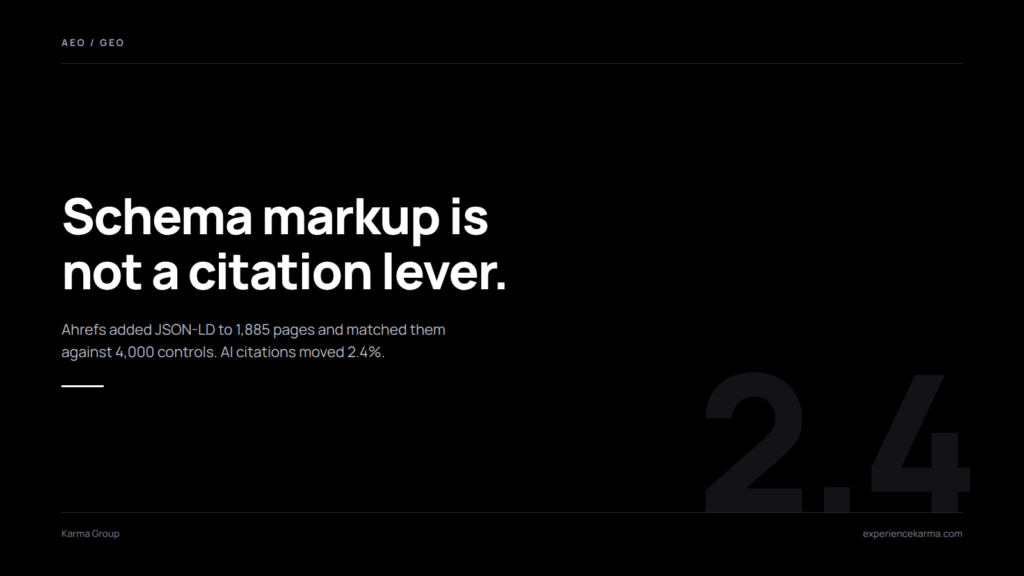
Ahrefs added JSON-LD to 1,885 pages and watched AI citations move 2.4%. That is noise, not a result. If someone has told you schema markup is how you get cited in ChatGPT or Google AI Overviews, the cleanest controlled test we have says otherwise. Schema markup still belongs on your site. But it is not a citation lever, and anyone selling it as one is selling you a placebo.
Schema markup moved AI citations by 2.4%
The Ahrefs study, published 11 May 2026 by Louise Linehan and Xibeijia Guan, tracked 1,885 pages that added JSON-LD between August 2025 and March 2026. Each page was matched against a pool of 4,000 controls. Then the team compared citation counts in the 30 days before and the 30 days after.
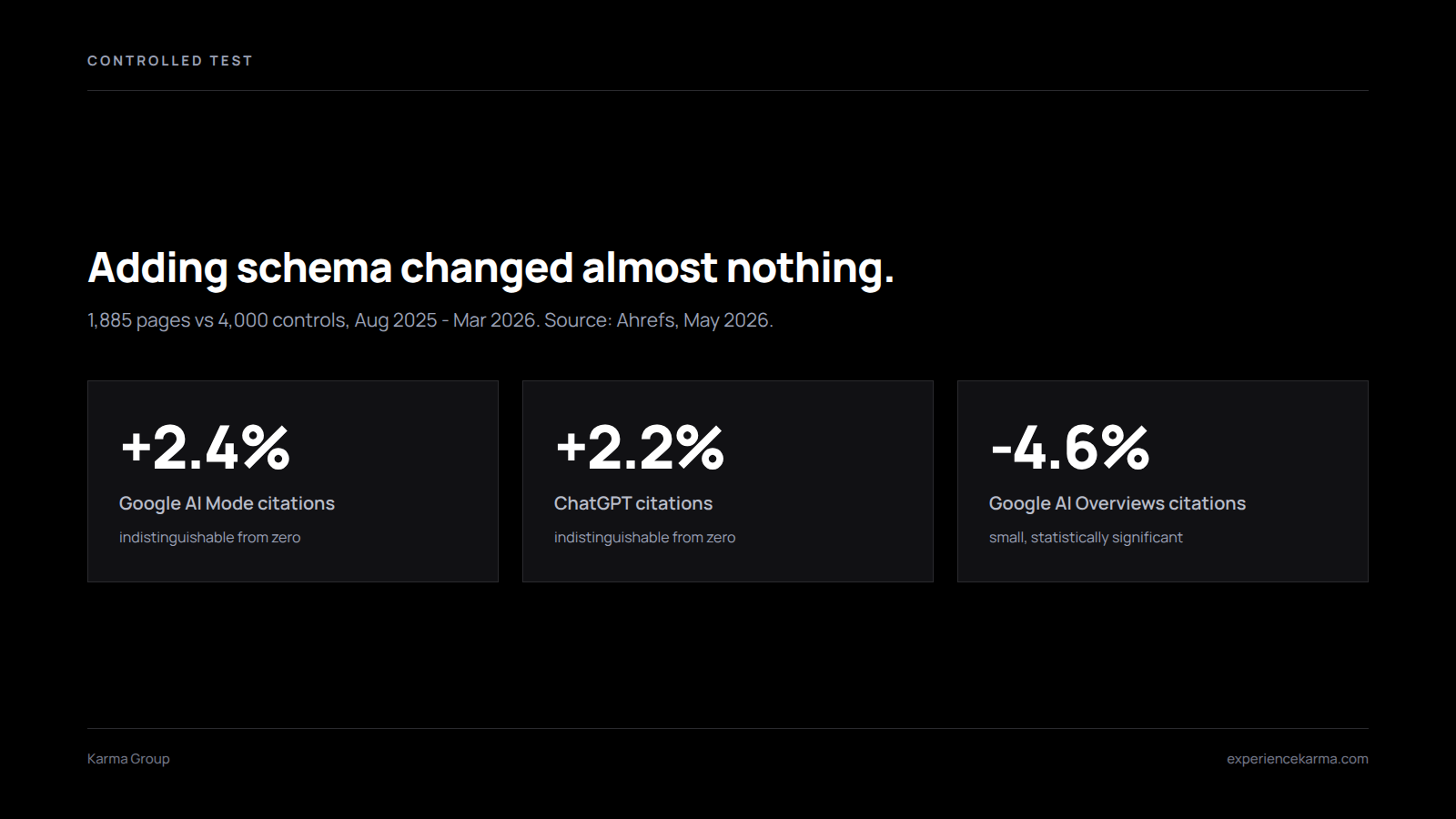
Results: AI Mode citations rose 2.4%. ChatGPT rose 2.2%. Both numbers sit indistinguishably close to zero. Google AI Overviews fell 4.6% — small, but statistically significant. So the only platform that really moved, moved the wrong way.
The team pooled Article, FAQ, Product, HowTo and Organization markup together. No schema type rescued the result. That matters, because most agency proposals lean on FAQ and Article markup specifically.
Why that 4.6% drop deserves a shrug, not a panic
A statistically significant negative sounds alarming. Still, hold the alarm. The effect is tiny, it appeared on one surface out of three, and a single field study rarely explains a mechanism.
The honest reading is narrow. Adding markup did not help, and on AI Overviews it very slightly tracked with fewer citations. Nobody should rip out working structured data because of one number. Meanwhile nobody should budget for it as an AI play either.
Treat the finding as a ceiling rather than a verdict. Whatever schema markup does for generative engines, it is too small to see against everything else moving at once.
The 41% number everyone quotes came from 50 domains
Where did the schema-gets-you-cited idea start? Mostly with one statistic. A vendor study by Relixir, recycled across marketing blogs since 2025, reported that pages carrying FAQPage markup were cited 41% of the time against 15% for pages without it. That is a 2.7x gap, so it travels well on LinkedIn.
But it covered 50 domains, and it was correlational. It compared pages that have markup to pages that do not. It never added markup to the same pages and measured what changed. Meanwhile, as Signals notes in its breakdown, pages carrying FAQ schema tend to be better resourced in every other way too.
Search Engine Land reached a similar conclusion in its own review of the evidence, pointing to earlier work that found no relationship between schema coverage and citation rates. So the contrarian position here is not really contrarian. It is just less profitable to sell.
Why schema markup looks like it works
Ahrefs also found that 53% of AI-cited pages carry schema markup. Read quickly, that sounds like proof. Read slowly, it is the same trap as noticing that most Olympic sprinters own running shoes.
Pages with markup are usually pages somebody cared about. They have editors, budgets, internal links and a brand behind them. Those qualities earn the citation. The markup simply rides along.
So the correlation is real while the causation is not. That gap is exactly why a controlled test beats any audit that counts how many cited pages happen to have markup. Whenever a deck opens with a percentage of cited pages that do X, you are looking at the shoes, not the sprinter.
What actually predicts whether AI names you
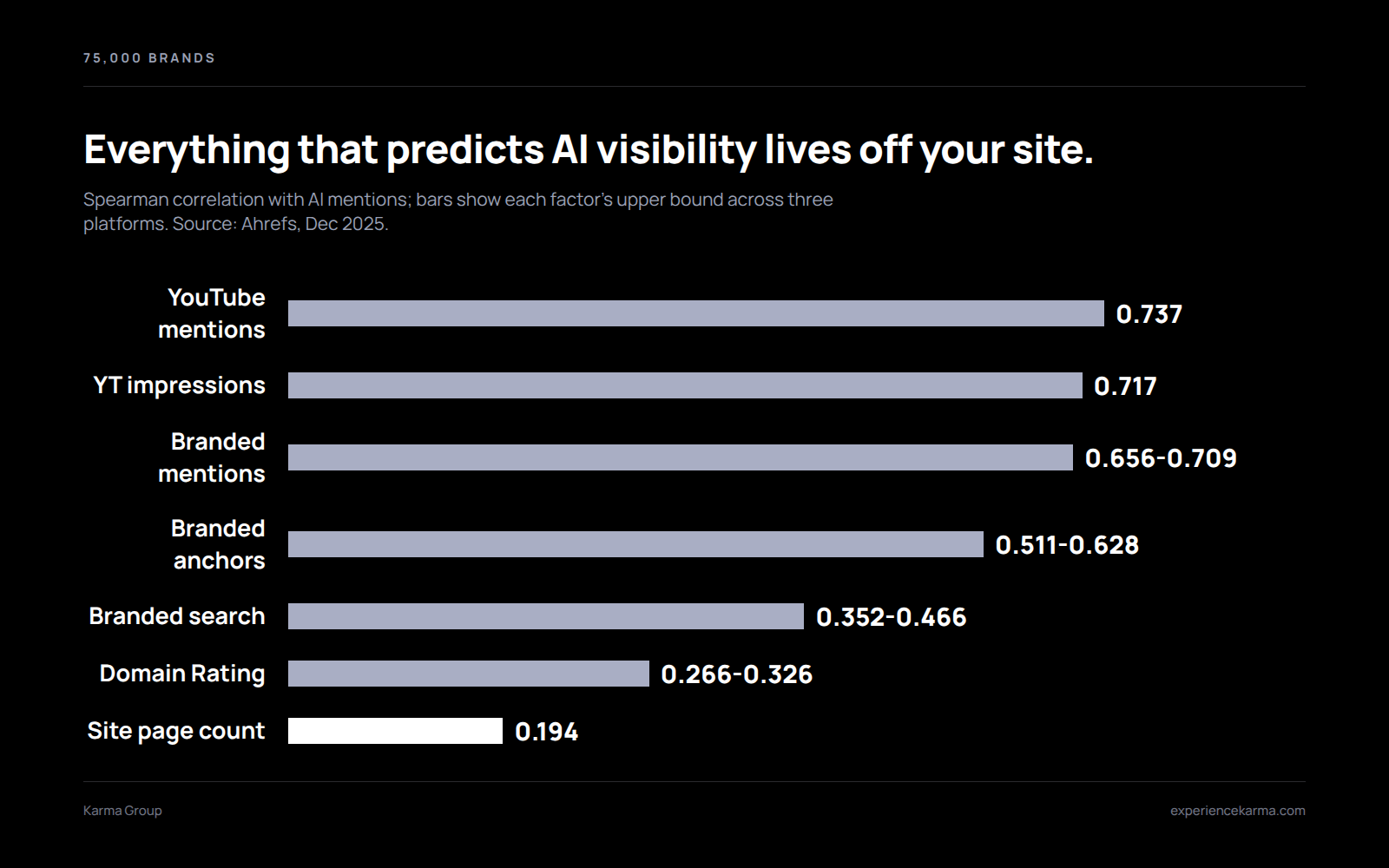
In December 2025 Ahrefs ranked visibility signals across 75,000 brands, using Spearman correlation against mentions in ChatGPT, AI Mode and AI Overviews. YouTube mentions came first at roughly 0.737. YouTube mention impressions followed at about 0.717. Branded web mentions landed between 0.656 and 0.709, then branded anchors between 0.511 and 0.628.
Now look at the bottom of that table. Branded search volume scored 0.352 to 0.466. Domain Rating scored 0.266 to 0.326. Number of pages on your site scored about 0.194.
Read that last one twice. Publishing more pages has almost no relationship to whether AI names your brand. Being talked about somewhere else is the strongest signal on the board.
Correlation is not proof here either, of course. Yet the ordering is stark enough to shape a budget. Every factor near the top lives off your site, while every factor near the bottom lives on it.
That reframes the work. You are not optimising a page so much as earning a reputation the models keep running into. A single podcast appearance that gets transcribed, quoted and indexed can outrank months of markup tidying. So the question stops being what to add to your HTML, and becomes who else is willing to say your name.
Schema markup still earns its place in Google Search
None of this makes structured data useless. Rich results in classic Google Search still depend on it. Product, Review, Event, Recipe and Breadcrumb markup drive the visual treatments that lift click-through, so they earn their keep on their own terms.
Keep your schema markup accurate and current. Just stop putting it in the AI visibility column of the deck. Its job is search appearance, not citation.
That distinction protects you twice. First, you keep a tactic that genuinely works where it works. Second, you stop measuring it against an outcome it was never going to deliver.
The one structured data job worth doing for AI
There is a narrow case where markup helps: making facts unambiguous. Prices, hours, authorship, dates and entity names should agree everywhere they appear. When your page says one thing while your markup says another, you have handed a model a reason to trust neither.
So treat structured data as fact hygiene. It will not buy you a mention. Still, it stops you from confusing the systems that might give you one. We made a similar argument about llms.txt files, and the logic holds here too.
How to test the next tactic somebody sells you
The Ahrefs method is worth stealing, because you can run a rough version yourself. Three things make it credible.
- It changed one variable on pages that already existed, rather than comparing different pages.
- A control group was held aside, so seasonal swings did not get counted as wins.
- The measurement window was fixed in advance at 30 days either side.
Ask any vendor for those three things. When the answer is a correlation across somebody else’s sample, you have a marketing asset rather than evidence.
You can run the same shape cheaply. Pick 30 comparable pages, change one thing on half of them, then watch citations for a month. The sample will be small and the noise will be loud. Even so, a rough in-house test beats a confident slide built on somebody else’s 50 domains.
Stop retrofitting schema markup and do this instead
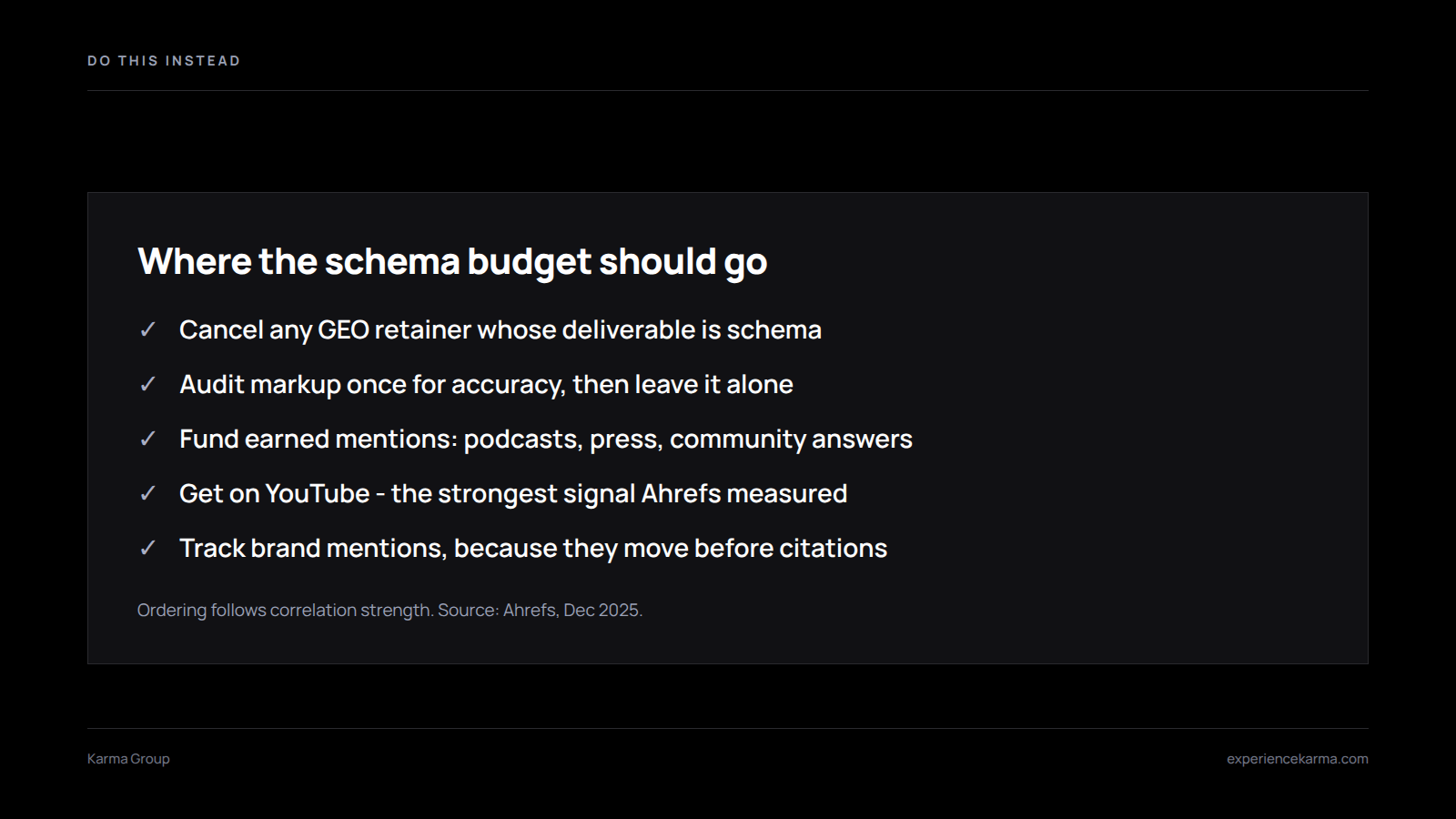
- Cancel any GEO retainer whose main deliverable is schema. The controlled data does not support it.
- Audit your markup once for accuracy, fix the conflicts, then leave it alone.
- Move that budget to earned mentions: podcasts, industry press, community answers, analyst lists.
- Get on YouTube. It correlated harder with AI visibility than any on-page factor Ahrefs tested.
- Track brand mentions alongside citations, because mentions move first.
None of these are quick. But they are the ones the evidence actually supports, and the ordering tells you where the first dollar goes.
Want help deciding what to cut?
Karma Group audits AI visibility for brands tired of paying for tactics nobody has tested. We will tell you what to stop doing before we tell you what to buy. Talk to us.