
Brands cited inside a Google AI Overview earn a 15.74% paid click-through rate. Uncited brands on the very same queries earn 11.19%. Those figures come from Seer Interactive’s study of 53 brands, 5.47 million queries and 296.9 million paid impressions, published 24 April 2026. So your AI Overview CTR is not one number. Instead it splits by citation status, and that split reaches into your Google Ads account. Most teams still measure AI Overview CTR against a no-AI baseline. But that comparison hides the only lever you can actually pull.
AI Overview CTR is really two numbers
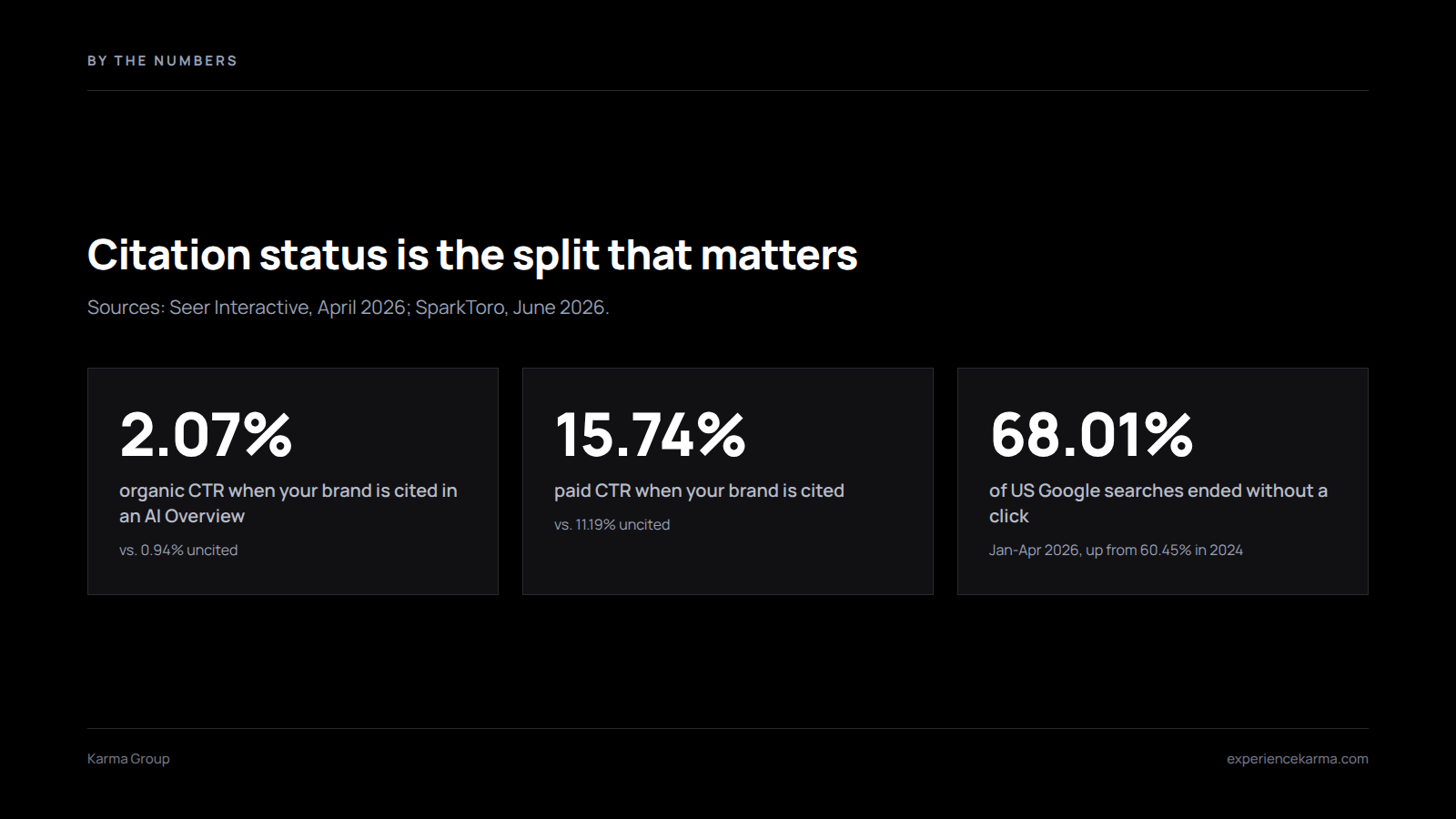
Seer split every AI Overview query by citation status. Cited brands earned a 2.07% organic CTR. Uncited brands earned 0.94%. So citation more than doubles clicks per impression on the same query, at the same intent, in the same result set. That is a bigger swing than most on-page work will ever deliver.
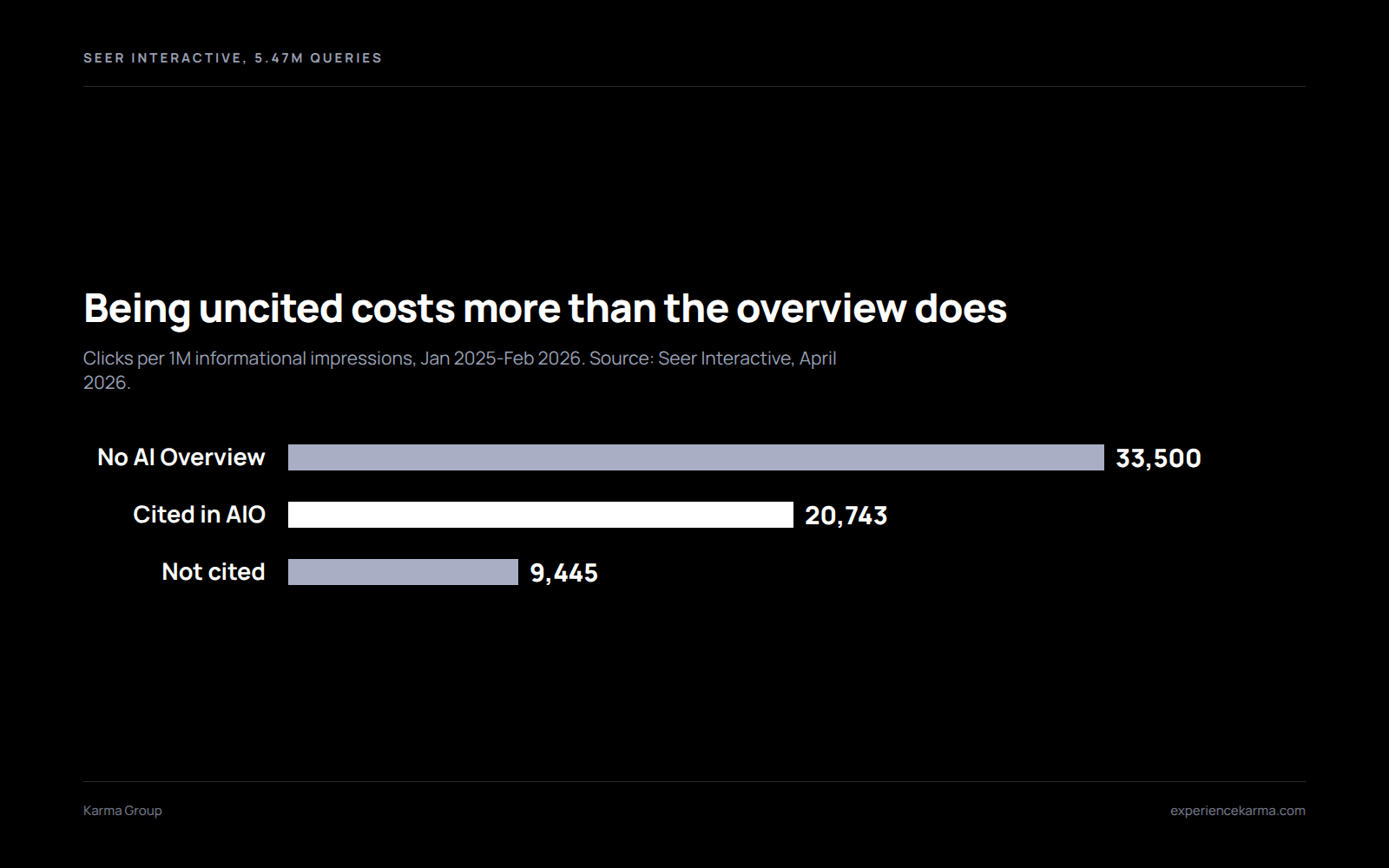
Per million informational impressions the gap gets concrete. A query with no AI Overview returned roughly 33,500 clicks. Cited brands returned about 20,743. Uncited brands returned about 9,445. In other words, the overview takes a third of your clicks up front. Then going uncited takes half of whatever is left.
Most benchmark decks stop at the first subtraction. They compare AI Overview queries against clean queries, report a scary percentage, and move on. Meanwhile the second subtraction is the one you control. You cannot stop Google from showing an overview, but you can change whether it names you.
Your paid clicks move with your citations
Here is the finding that should change how you budget. On queries where an AI Overview appeared, cited brands averaged a 15.74% paid CTR. Uncited brands averaged 11.19%. That is 4.55 percentage points of difference, and Seer notes the advantage held through 2025 rather than spiking once.
Read that next to what the ad data already told us: AI search ads do not buy citations. The relationship runs one way. Paying Google will not get you quoted, but getting quoted makes the ads you already run work harder. So earned visibility is now an input to paid performance, not a parallel track with its own budget line.
That reframes the business case. Nobody signs off on a GEO retainer to move a citation count. Plenty of people sign off on something that lifts paid CTR by four and a half points across every query where an overview fires.
AI Overview CTR is recovering, and few people noticed
The line everyone repeats is that AI Overviews destroyed click-through rates. That was true, and then it stopped being true. Organic CTR on AI Overview queries bottomed at 1.31% in December 2025. By February 2026 it had climbed back to 2.36%, an 85% rebound in two months.
Paid moved the same direction. On AI Overview queries, paid CTR rose from 14.64% in January 2025 to 16.21% in February 2026. Meanwhile paid CTR on queries with no AI Overview fell from 25.98% to 21.85%. So the two are converging from both ends. That is not the story the 2025 benchmark decks tell, and those decks are still circulating.
Users appear to be learning what the overview is for. They read it, they skip it, or they scroll past it, and the pattern is settling down. Any number you quote from twelve months ago now describes a market that no longer exists.
Clean results got better while AI results got worse
Organic CTR on queries without an AI Overview rose from 2.75% to 3.82% across the same fourteen months. On AI Overview queries it fell from 3.19% to 2.36%. Fewer searches send a click at all now, so the clicks that survive concentrate hard on the results people still look at.
That is the backdrop SparkToro measured in June 2026 using Similarweb clickstream data. Across January to April, 68.01% of US Google searches ended without a click, up from 60.45% in 2024. Yet AI Mode accounted for only 0.34% of searches in that window.
Take the second number seriously. AI Mode gets the headlines, but it is not what costs you clicks this quarter. AI Overviews are, and they have been for two years. So spend your attention where the volume already sits.
Track AI Overview CTR as its own segment
None of the numbers above show up in a default report. Search Console blends overview and non-overview impressions into one line, and Google Ads does the same on the paid side. As a result, a healthy blended CTR can hide a collapsed uncited segment underneath it.
Fix the reporting before you fix the pages. Tag your tracked queries by whether an overview fires, then split organic and paid performance along that line. Once you can see AI Overview CTR on its own, the citation gap stops being a theory and becomes a number with a dollar value attached.
Expect the split to be uncomfortable at first. Teams that run this exercise usually find a small set of high-volume informational queries carrying most of the loss. That is good news, because a short list is fixable within a quarter.
Comparison and question queries are where you lose
Overview coverage is wildly uneven, so any account-wide average will mislead you. Seer found overviews on 95.4% of comparison queries and 86.3% of review queries. Question-format queries triggered one 85.9% of the time, and “near me” queries 76.9% of the time. Single-word queries triggered one just 27.3% of the time.
The commercial end looks completely different. Informational queries triggered an overview 36% of the time. Commercial queries triggered one 8% of the time, and transactional queries only 5%. So audit by query shape rather than by search volume.
Run that audit and the picture usually resolves fast. Your money terms are often barely touched, while your top-of-funnel content bleeds quietly. Because those two problems need different fixes, averaging them together buys you nothing.
Cited brands still lose to a clean result
None of this makes a citation a win. Cited brands still underperform the same queries without an overview by 38%. So the honest framing here is damage control, not upside, and anyone selling you citations as growth is overselling.
Still, the arithmetic favors chasing them. Roughly 20,743 clicks beats roughly 9,445 every time, and the paid lift arrives at no extra cost. Treat citations as the floor you defend rather than the ceiling you chase.
This also sets a sane ceiling on spend. If a citation recovers half the clicks an overview took, then your AI Overview CTR work is worth roughly half of what the query was worth before. Price the effort against that, and walk away from vendors quoting anything larger.
How to raise your AI Overview CTR this quarter
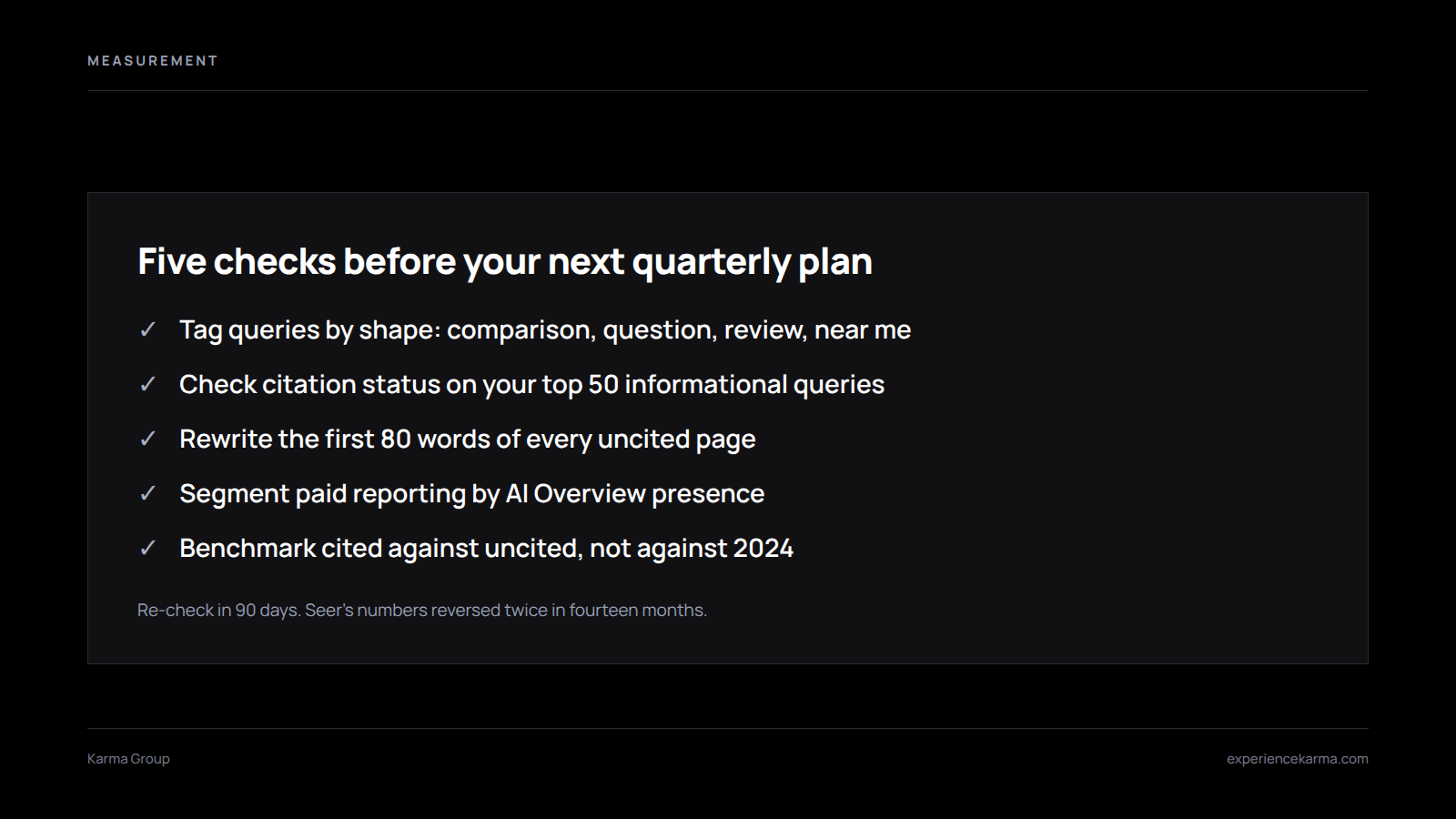
- Pull your Search Console queries and tag each one by shape: comparison, question, review, “near me”, or transactional. Start where coverage is highest.
- Check citation status on your top 50 informational queries. Cited or not cited is the only split that matters at this stage.
- Rewrite the first 80 words of every uncited page so it answers the query directly. Extractable passages get quoted, while preambles get skipped.
- Segment paid reporting by AI Overview presence. Otherwise 16.21% and 21.85% average into a single number that hides both problems.
- Stop benchmarking against your 2024 CTR. Benchmark cited against uncited instead, because that is the gap you can actually close.
Then re-check in ninety days. Seer’s numbers reversed direction twice in fourteen months, so treat any AI Overview CTR figure you lock in now as a snapshot rather than a rule. Because the platform keeps moving, the teams that re-measure quarterly will simply be right more often than the teams that do not.
Want help closing the citation gap?
We audit which of your queries carry AI Overviews, whether you get cited, and what that citation gap costs you in organic and paid clicks. Get in touch and we will start with your top 50 queries.