
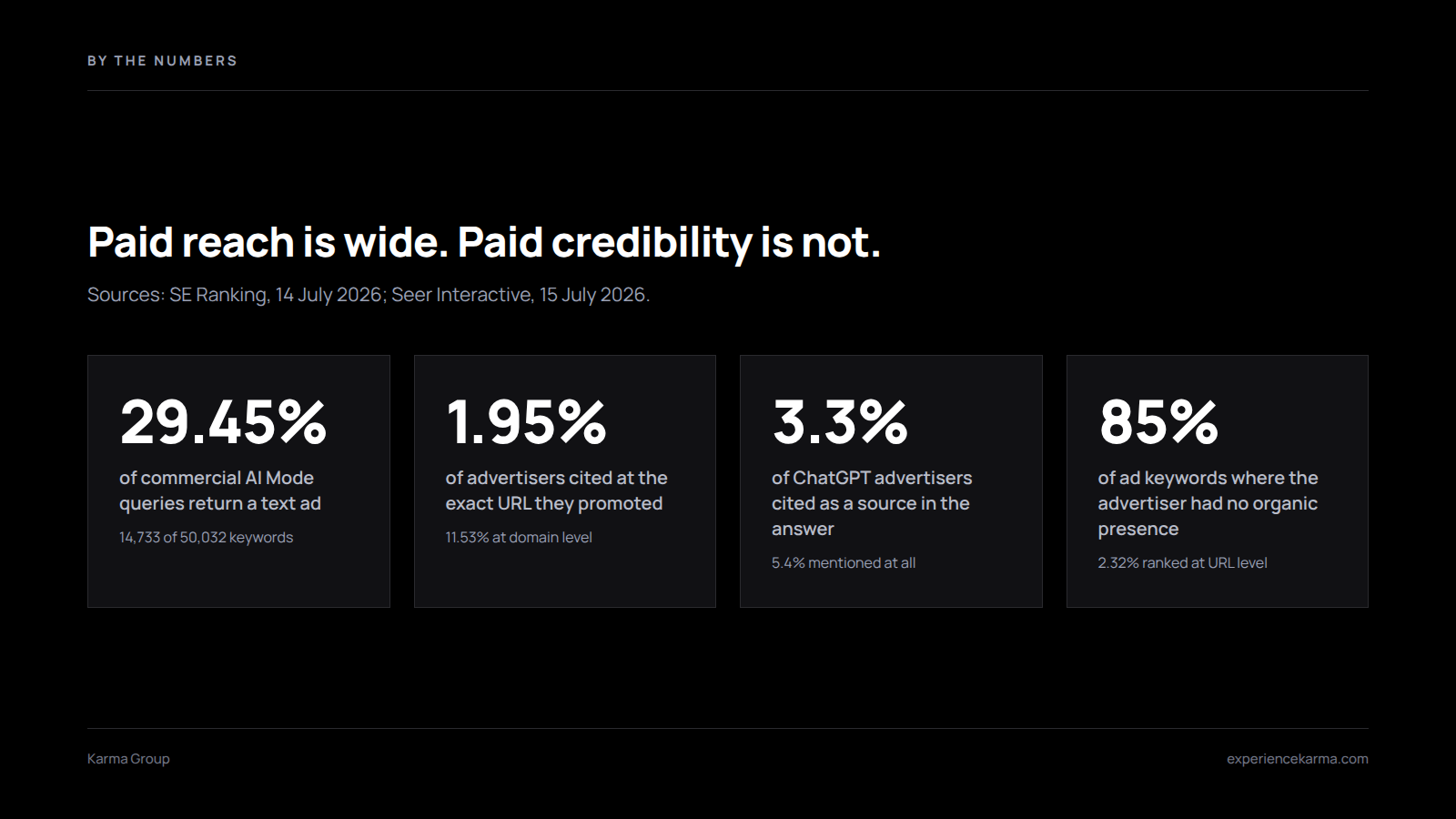
Google’s AI Mode now returns a text ad on 29.45% of commercial queries, yet only 1.95% of those advertisers get cited at the exact URL they paid to promote. That gap is the whole story of AI search ads. You can rent a slot beside the answer. You cannot buy your way inside it. SE Ranking found that pattern across 50,032 commercial keywords, and Seer Interactive found the same shape inside ChatGPT. So budget for AI search ads as a media buy, not as a visibility plan.
AI search ads now reach nearly a third of commercial queries
SE Ranking collected AI Mode results for 50,032 commercial keywords on 30 June 2026, split across 20 niches of roughly 2,500 keywords each. Of those, 14,733 returned a text ad. That is 29.45%, or nearly one in three. Most of those results were crowded too. In fact, 71.1% carried two competing ads, while 28.9% carried just one.
Coverage swings hard by category, though. Pets returned an ad on 72.38% of keywords. Healthcare returned one on 2.64%. So check your own niche before you model any spend. The average tells you almost nothing about what you will actually see in your market.
Paying for the slot does not put you in the answer
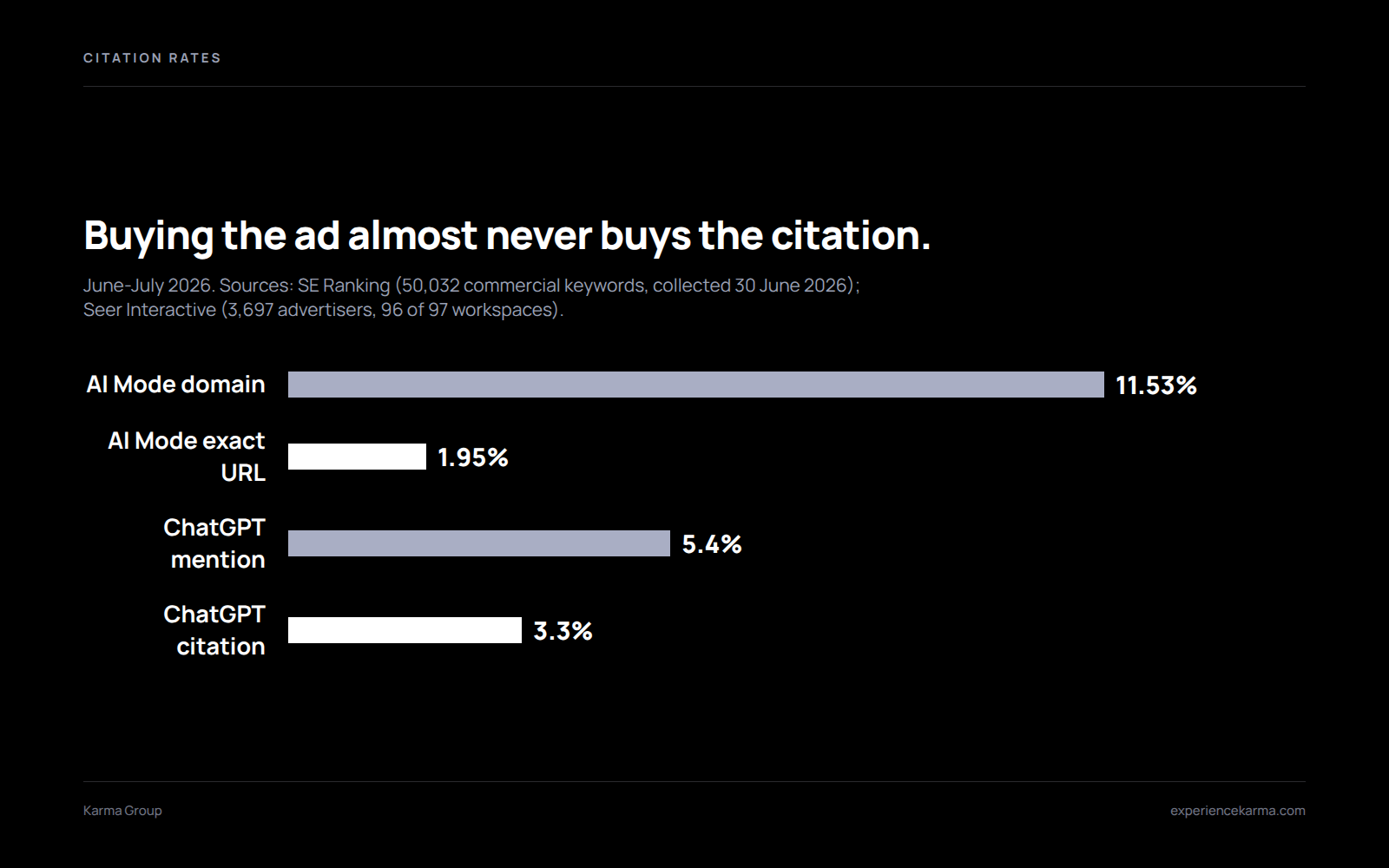
Here is the finding that should reset your expectations. Only 11.53% of advertiser domains showed up among the sources AI Mode cited. At the exact URL level, that fell to 1.95%.
Read those two numbers together. The ad and the citation are separate systems. One is sold by an auction, while the other is earned by the model deciding you are worth quoting. Buying the first does not deliver the second. In fact it barely moves it.
That distinction matters because the citation carries the authority. A cited source gets named inside the answer the user actually reads. An ad sits next to that answer, clearly labelled, competing for a glance. Users have spent twenty years learning to skip the labelled box, and nothing about AI Mode retrains them.
ChatGPT tells the same story
Seer Interactive tracked the ChatGPT side and landed in the same place. Their early analysis, published 15 July 2026 by Nick Haigler, covered 3,697 unique advertisers across 96 of 97 client workspaces.
The advertiser appeared in ChatGPT’s own response just 5.4% of the time. It was cited as a source only 3.3% of the time. So the ChatGPT figures are actually worse than the AI Mode figures, not better. Two independent datasets, two different platforms, one conclusion.
Relevance looks shaky as well. Seer scored ad alignment at 3.29 out of 5. Moreover, 58% of ads were category-adjacent rather than squarely on topic. Ad density also moved fast, climbing from 7.1% of tracked responses to 77% within roughly two weeks. Because inventory is filling that quickly, any benchmark you read this quarter will age badly.
AI search ads mostly run where the advertiser has no organic presence
This is the quiet finding, and it reframes everything above. Only 2.32% of advertised URLs also ranked organically for the keyword. At the domain level it rose to 15.35%. So for roughly 85% of ad keywords, the advertiser’s site did not appear in organic results at all.
In other words, most brands are using AI search ads to buy presence they never earned. That is a legitimate tactic, and sometimes it is the right one. Still, it is renting rather than owning. Stop paying and you vanish the same day.
Worth noting: the reverse case is rarer than you would guess. Few advertisers are strong organically and also bidding. So the channel is skewing toward brands with a gap to plug, which is exactly who should read the citation numbers most carefully.
The trap is subtle, because paid impressions look like progress in a dashboard. Your AI reporting line goes up. Your cited-source rate, however, stays flat, since nothing you did changed what the model knows. Report those two metrics side by side and the illusion disappears immediately.
Cost per click predicts the ad, not the answer
Ad presence tracks money almost perfectly. SE Ranking found ads on 24.33% of sub-$2 keywords, 32.45% in the mid range, and 53.56% on keywords at $10 and above.
So the auction behaves exactly like an auction. Expensive commercial intent draws ads, because that is where the margin sits. Meanwhile the citation layer ignores your bid entirely. It draws on what the model has already read about you, which no credit card changes this quarter.
There is a planning consequence here. Your cheapest keywords are the ones least likely to show ads at all, so paid coverage thins out exactly where budgets are smallest. Smaller advertisers therefore cannot buy their way to parity even if they want to. Instead, the only lever that scales down cleanly is being citable.
Your brand terms are still mostly unclaimed
Seer found that only 7.3% of branded responses included the brand’s own ad. Competitors have not moved in either. For now, then, branded prompts sit largely unbought.
Two things follow. First, defensive branded spend is cheap insurance while the auction stays thin. Second, that window closes, since every previous ad platform got expensive on brand terms once buyers noticed. Meanwhile aggregators and affiliates already account for 11.6% of tracked ads, so the intermediaries are moving faster than the brands are.
What AI search ads are actually worth
They are not worthless. Be honest about the job they do, though.
- Reach at a high-intent moment is real, and often worth paying for.
- Speed counts too, because a campaign goes live faster than any content programme.
- Citation, authority, and a named mention inside the answer are not included.
- Nothing you bought survives a paused budget.
Treat AI search ads the way you already treat paid search. That means a demand-capture line, measured on cost per lead. Do not let anyone file them under AI visibility. Those are different budgets solving different problems, and blurring them hides the fact that your earned presence never improved.
Seer’s intent data supports that framing. Evaluation prompts drew 38.7% of tracked ads, awareness 24.3%, advice 18.8%, and comparison 16.5%. Buyers are therefore deep in consideration when they see these ads, which is good for capture and irrelevant to whether the model trusts you.
Run this check before you buy AI search ads
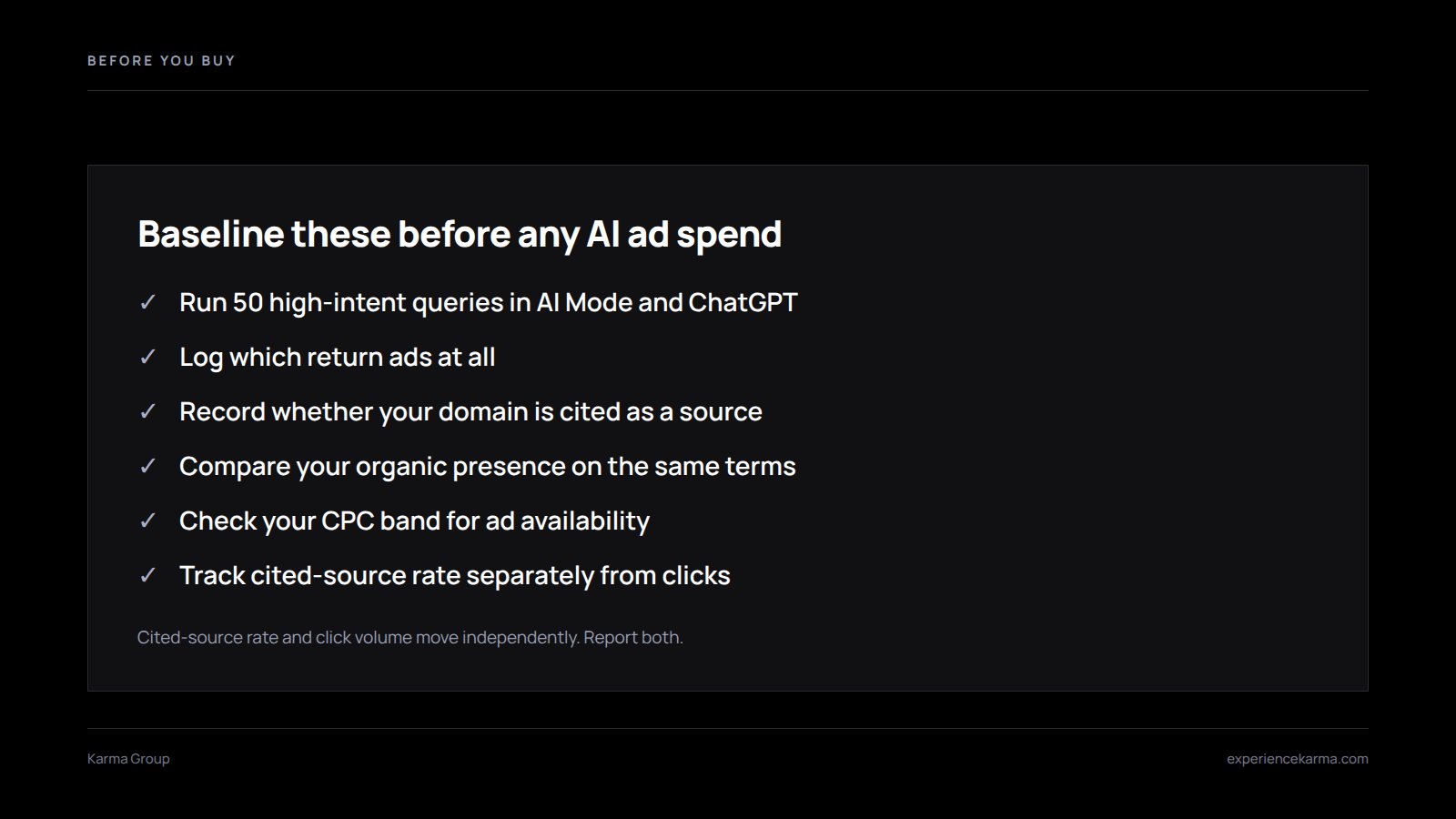
- Pull 50 of your highest-intent commercial queries and run them in AI Mode and ChatGPT. Log which ones return ads at all.
- For each, note whether your domain appears as a cited source. That is your real baseline.
- Compare your organic presence on the same terms. If you are absent, ads are patching a gap rather than amplifying strength.
- Check your CPC band. Cheap keywords may show no ads, so paid may not even be available to you.
- Price your branded terms now, while the auction is still thin.
- Split the budget deliberately. Fund capture with ads, but fund citation with earned visibility work.
- Re-measure in 30 days. Track cited-source rate separately from clicks, because the two move independently.
Do the baseline first. Otherwise you will credit ads for visibility you already had, or blame them for citations they were never able to buy. The brands getting named inside AI answers got there by being worth quoting, and that remains the only route in.
Want help earning citations instead of renting impressions?
Karma Group audits where your brand actually gets cited across AI Mode, ChatGPT, and the rest, then builds the earned presence that paid placement cannot reach. If you want your real baseline before the next budget cycle, get in touch.

Written by
Founder and CEO, Karma Group
Brendan Cogbill is the founder and CEO of Karma Group. He has run paid media and search for trade show, experiential and industrial brands since 2019, and now focuses on how brands earn visibility inside AI search. He holds a BBA and an MBA from Grand Canyon University and works from Phoenix, Arizona.
More about Brendan Cogbill