
ChatGPT recommendations now decide the vendor shortlist before a buyer ever opens your website. Instead of scanning ten blue links, your prospect asks one question and reads one answer. Consequently, the two or three brands named in that answer get the meeting. Everyone else stays invisible. However, most marketing teams still have no plan for earning those mentions.
This guide covers how the assistants choose names, which signals actually move them, and how to track your progress. Moreover, it flags the one mistake costing brands the most ground right now.
Why ChatGPT Recommendations Decide the Shortlist
The scale explains the urgency. Similarweb reports that monthly visits across generative AI platforms grew 70% year over year, reaching 9.5 billion. Furthermore, US ChatGPT citations climbed from 1.6% of responses in June 2025 to 6.8% in May 2026. In other words, the assistant now sends people to real websites far more often than it did a year ago.
Professional services, however, still sit under a 4% citation rate. Therefore, the category remains wide open. Early movers claim the mentions while their competitors argue about whether any of this matters. Better still, ChatGPT recommendations reward preparation rather than ad budget, a point we made in AI search visibility in 2026.
How the Assistants Actually Pick Names
Language models do not rank pages the way Google does. Instead, they assemble an answer from training data plus live retrieval. Two forces shape the outcome: consensus and clarity.
Consensus beats self-description
The model weighs what other sites say about you far more heavily than what you say about yourself. For example, an independent roundup naming your firm carries more weight than your own services page. Similarly, review platforms, industry directories, trade publications and podcast transcripts all feed the pattern. Consequently, a brand mentioned by fifteen credible third parties beats a brand with one beautiful website.
Clarity the model can quote
Assistants extract sentences, so write sentences worth extracting. State the answer first, then explain it. Additionally, use headings phrased as real questions, short definitional paragraphs, comparison tables and dated figures. For example, a page that names a price range in one clean sentence gets quoted. A page that hides pricing behind a form does not.
Specificity the model can trust
Vague marketing language gives an assistant nothing to work with. Therefore, replace it with numbers, names and dates. Say which industries you serve, which cities you cover and what a typical engagement costs. For example, a firm that says it builds trade show programs for medical device brands in Chicago beats one promising world-class experiences. Moreover, specific claims are far easier for a model to match against a specific prompt.
Five Steps to Earn ChatGPT Recommendations
- Map the prompts your buyers type. Skip keyword volume for a moment. Instead, write the twenty questions a prospect asks an assistant before they contact anyone.
- Audit the current answers. Run those prompts today and log who gets named. Consequently, you learn which competitors already own your category answer.
- Fix the quotable layer. Rewrite your top ten pages so each one leads with a direct, specific answer. Furthermore, add FAQ blocks and Organization schema.
- Build third-party consensus. Pursue directory listings, review profiles, expert quotes and guest contributions. In fact, this remains the single highest-leverage activity.
- Refresh on a schedule. Models favor current pages, so date your content and update it quarterly.
None of these steps require new technology. Rather, they require someone to own the work each month. Start with the first two, because once you can see the gap, the remaining work prioritizes itself.
Do Not Chase ChatGPT Recommendations Alone
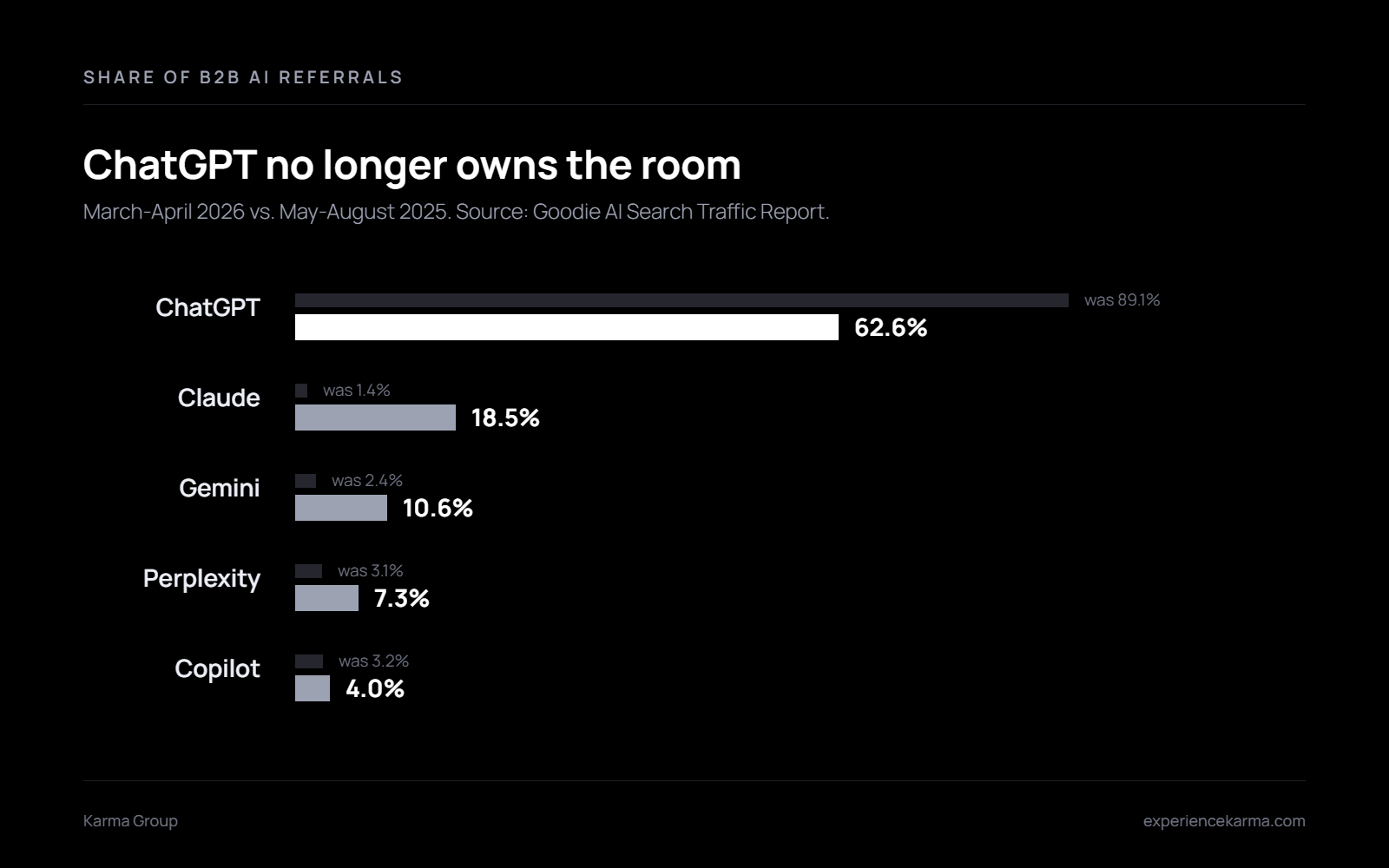
Here is the expensive mistake. ChatGPT dominance is loosening quickly. Goodie found its share of B2B AI referrals fell from 89.1% to 62.6% in eight months. Meanwhile, Claude climbed from 1.4% to 18.5%, and Gemini reached 10.6%. Similarweb tells a similar story, placing ChatGPT near 53% of generative AI web traffic in May 2026, down from roughly 76% a year earlier.
Consequently, a plan built only around ChatGPT recommendations leaves a third of your audience unserved. Fortunately, the work transfers. Every assistant rewards the same fundamentals: credible outside coverage, clean structure and specific, current answers.
Practically, that means checking your core prompts across all four assistants rather than one. Additionally, watch Claude closely if you sell to other businesses, since its share grew faster than any rival platform this year.
Which Pages Earn ChatGPT Recommendations
Not every page pulls its weight here. In practice, four formats do most of the work.
- Comparison pages. Buyers ask assistants to weigh options, so publish honest side-by-side breakdowns.
- Pricing explainers. Real ranges get quoted constantly, whereas a contact-us placeholder gets skipped.
- Definitive guides. One thorough resource per core service beats ten thin posts.
- Proof pages. Case studies with named clients and measurable results supply the evidence a model needs.
Notice the pattern. Each format answers a question directly, then backs that answer with detail. Consequently, these pages become the sentences an assistant reuses when a buyer asks who to hire.
What to Measure Every Month
Traditional rank tracking misses all of this. Instead, track four numbers:
- The share of your tracked prompts where the brand appears at all.
- Your average position inside the answer, because first mention wins attention.
- The sentiment and accuracy of how you get described.
- Which of your pages the assistants actually cite.
Set a baseline before you change anything. Otherwise, you cannot prove the program worked. Furthermore, expect movement across weeks rather than days, because models refresh their view of a brand gradually.
Additionally, isolate assistant traffic in GA4 so you can judge what it does after landing. We walked through that setup in our breakdown of AI referral traffic. Finally, revisit your prompt list quarterly, since buyer language shifts as fast as the models do.
Start Earning ChatGPT Recommendations This Week
Pick your five highest-value prompts, then run them in ChatGPT, Claude, Gemini and Perplexity. Record who gets named and which sources each answer cites. That single list becomes your gap analysis, and it usually takes an hour.
Next, run your homepage through our free AI Visibility Checker to see how machine-readable your site looks today. Afterwards, repair the two weakest pages before you write anything new.
ChatGPT recommendations compound slowly, and then all at once. Brands that start now will own their category answer while competitors still debate the channel. If you want a mapped plan for your market, book a 30-minute strategy call with our team.

Written by
Founder and CEO, Karma Group
Brendan Cogbill is the founder and CEO of Karma Group. He has run paid media and search for trade show, experiential and industrial brands since 2019, and now focuses on how brands earn visibility inside AI search. He holds a BBA and an MBA from Grand Canyon University and works from Phoenix, Arizona.
More about Brendan Cogbill