
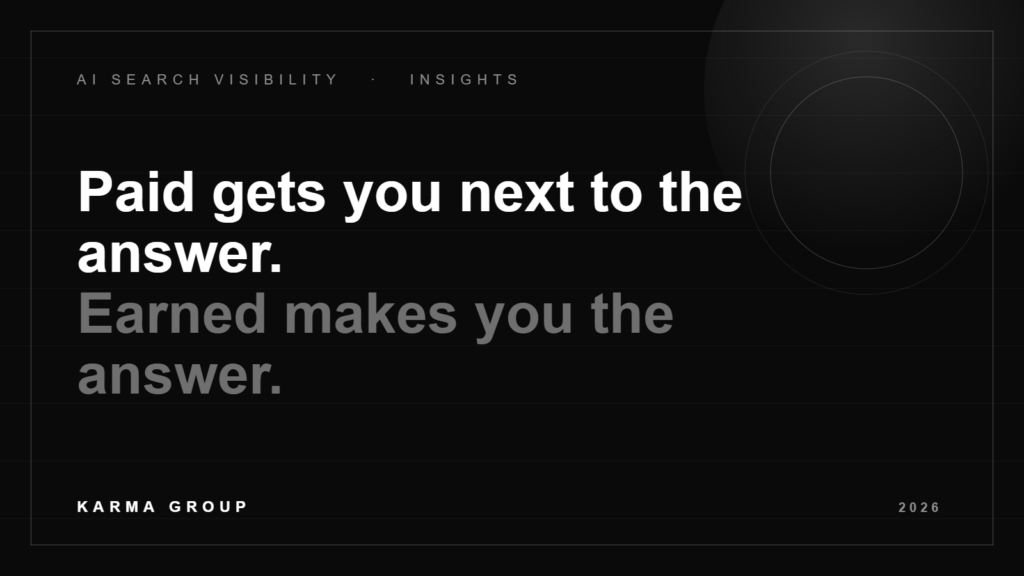
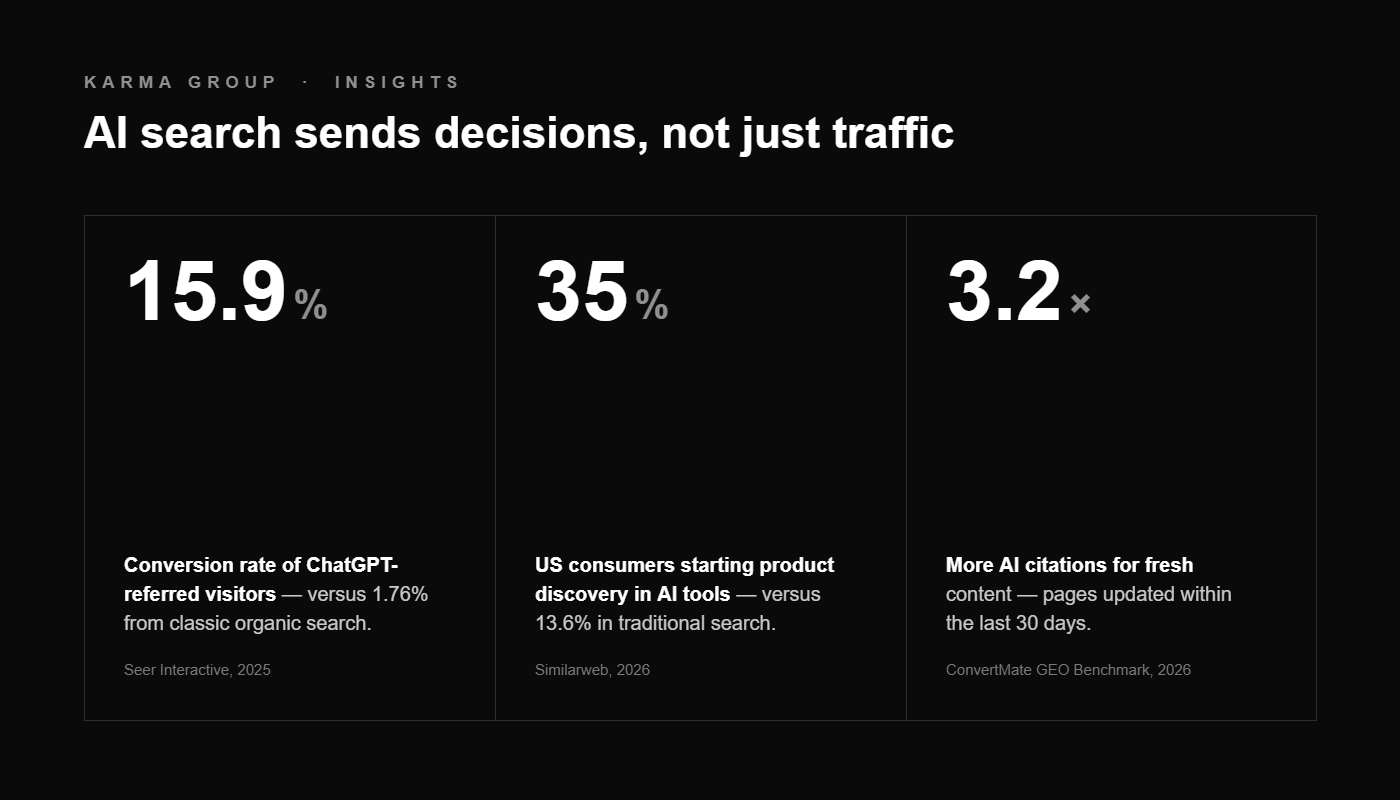
Your next client will probably ask an AI about you before they ever visit your website. In fact, 35% of US consumers now begin product discovery inside AI tools. Only 13.6% still start with a traditional search engine. That shift has created a new discipline: AI search visibility. In short, it measures whether your brand appears, and gets cited, when an assistant answers a buyer’s question.
This month delivered the clearest data yet on how AI search visibility actually works. Moreover, it exposed an uncomfortable truth for brands used to buying the top of the page. Paid placement and earned visibility have quietly split into two separate channels. Only one of them shapes the answer.
The quiet split: ads sit beside the answer, not inside it
A July 2026 study analyzed more than 50,000 commercial keywords. It found that 29.45% of them now trigger text ads inside Google’s AI Mode. Furthermore, 71% of those queries showed two competing ads at once. On the surface, that looks like business as usual: bid, appear, win.
However, the deeper finding changes everything. Among advertisers bidding on those keywords, 88% were never cited as a source in the AI-generated answer itself. Fewer than 2% appeared at the exact-URL level. The researchers described paid and earned as two separate channels wearing the same interface.
In practice, that means you can pay to stand next to the answer. You cannot pay to be the answer. The citation has to be earned. Consequently, AI search visibility follows a completely different set of rules than the ad auction ever did.
What actually earns AI search visibility
The research of the past twelve months is remarkably consistent. Large language models reward a specific kind of source. Above all, they reward brands that other people talk about.
Earned media does the heavy lifting
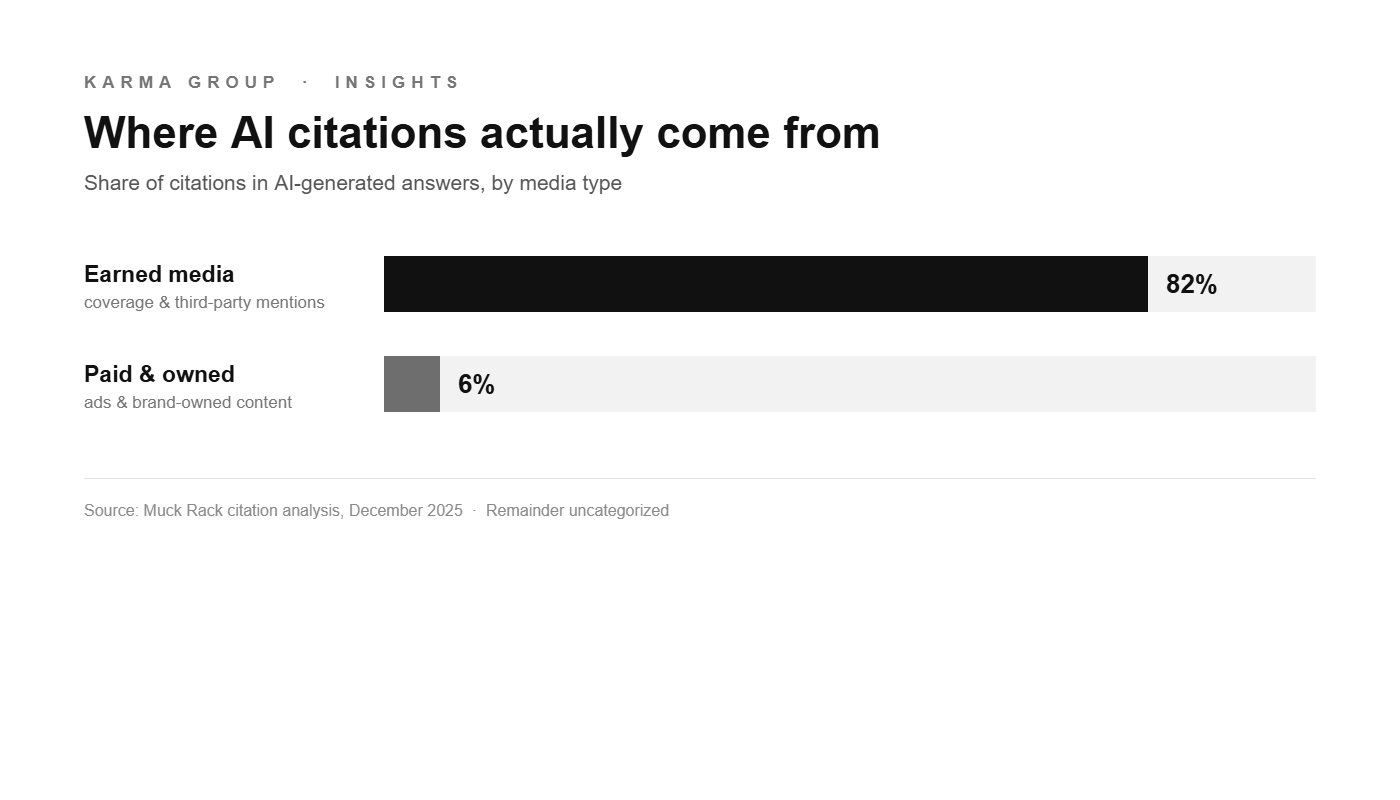
According to a Muck Rack analysis, 82% of AI citations originate from earned media. Paid and owned content combined account for just 6%. Similarly, Ahrefs found that brand mentions correlate three times more strongly with AI visibility than backlinks do. The currency of the last era was the link. The currency of this one is the mention: your brand named, in context, by sources the model trusts. Additionally, distribution multiplies the effect. Content syndicated across multiple outlets earns up to 325% more citations than content that lives only on your own domain.
Depth, data, and freshness now decide who gets cited
The models also have opinions about the content itself. For example, Princeton and Georgia Tech researchers found that adding credible statistics boosts a page’s AI visibility by 41%. Long, substantive pages earn 4.3 times more citations than thin ones. Meanwhile, freshness has become a signal in its own right. Content updated within the last 30 days generates 3.2 times more citations. Therefore, the 400-word post you refresh once a year is invisible to this generation of search.
Write for machines that read like people
None of this rewards keyword stuffing. Instead, AI engines cite content that answers questions directly and attributes its claims. They favor pages a machine can quote cleanly. So use a clear heading hierarchy, question-shaped subheadings, and paragraphs that stand on their own. Quotable is the new rankable.
How to measure AI search visibility in GA4
Until recently, AI-driven visits hid inside referral traffic, and marketers had to guess. That changed when Google Analytics 4 rolled out a dedicated AI Assistant channel. It now lives under Traffic Acquisition. As a result, you can finally see which pages ChatGPT, Gemini, and Claude actually send people to.
One caveat before you brief your team. Clicks from Google’s own AI Overviews and AI Mode still report as Organic Search. Consequently, your true AI-influenced number is larger than the new channel shows. Treat the AI Assistant line as the floor, not the ceiling.
Why this traffic is worth fighting for
If AI referrals were low-intent noise, none of this would matter. The opposite is true. Visitors arriving from ChatGPT convert at 15.9%, versus 1.76% for classic organic search. Likewise, Perplexity referrals convert at 10.5%. Adobe measured AI-driven revenue per visit growing 254% year over year. Admittedly, the volume is smaller than the old organic firehose. However, the visitor has already been advised, compared, and pre-sold before they arrive. AI search doesn’t send you traffic. It sends you decisions.
A 30-day plan to improve your AI search visibility
Becoming the answer is not a moonshot. Rather, it’s a sequence. Here is how we’d structure the first month.
Week 1: Audit your presence in the answers
First, ask the major assistants the questions your buyers ask. Think category queries, comparisons, and “best of” prompts. Then record who gets named and who gets cited. That map is your competitive baseline, because most brands have never drawn it. Also, turn on GA4’s AI Assistant view the same day so your floor metric starts collecting. Alternatively, take our free AI Visibility Checker, which scores all four factors in two minutes.
Week 2: Retrofit your highest-value pages
Next, rebuild the pages that carry your commercial weight. Put direct answers high on the page. Add verifiable statistics with attribution. Furthermore, use clean H2 and H3 structure and show a visible update date. This is the fastest lever you control outright.
Week 3: Invest in mentions, not just links
Then, pitch data, expertise, and perspective to the outlets the models treat as authoritative in your category. One earned mention in a trusted publication now outworks a page of directory backlinks. Moreover, syndicating your best thinking across several outlets compounds the effect.
Week 4: Build the refresh cadence
Finally, put your cornerstone content on a standing 30-day review cycle. Publish new, statistic-rich pieces on a fixed rhythm. Consistency teaches the models, and your buyers, that you are a living source.
The brands that win the answer, win the market
Every platform shift concentrates advantage in the brands that moved early. AI search visibility is following the same curve, only faster. Additionally, it carries a winner-take-most dynamic. An assistant’s answer has room for two or three names, not ten blue links. Earning one of those slots is strategic, editorial work. Because it can’t be bought at auction, it defends itself once you’ve done it.
That’s the standard we hold our own work to at Karma Group. You can see how we approach brand-building in our client work. If you want a candid read on your brand’s AI search visibility, and a plan to change it, book a 30-minute discovery call. Bespoke strategy, no scripts.

Written by
Founder and CEO, Karma Group
Brendan Cogbill is the founder and CEO of Karma Group. He has run paid media and search for trade show, experiential and industrial brands since 2019, and now focuses on how brands earn visibility inside AI search. He holds a BBA and an MBA from Grand Canyon University and works from Phoenix, Arizona.
More about Brendan Cogbill