
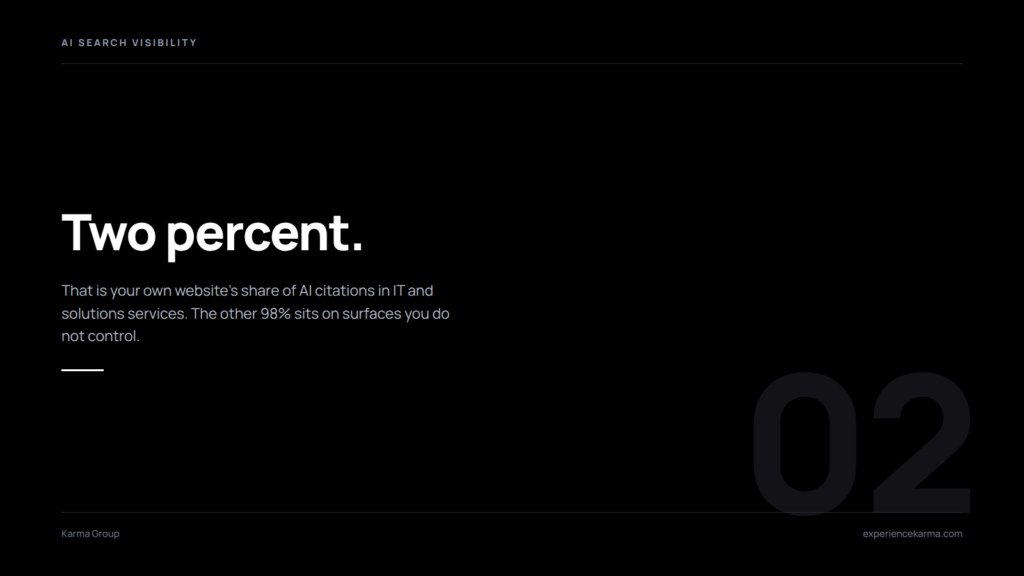
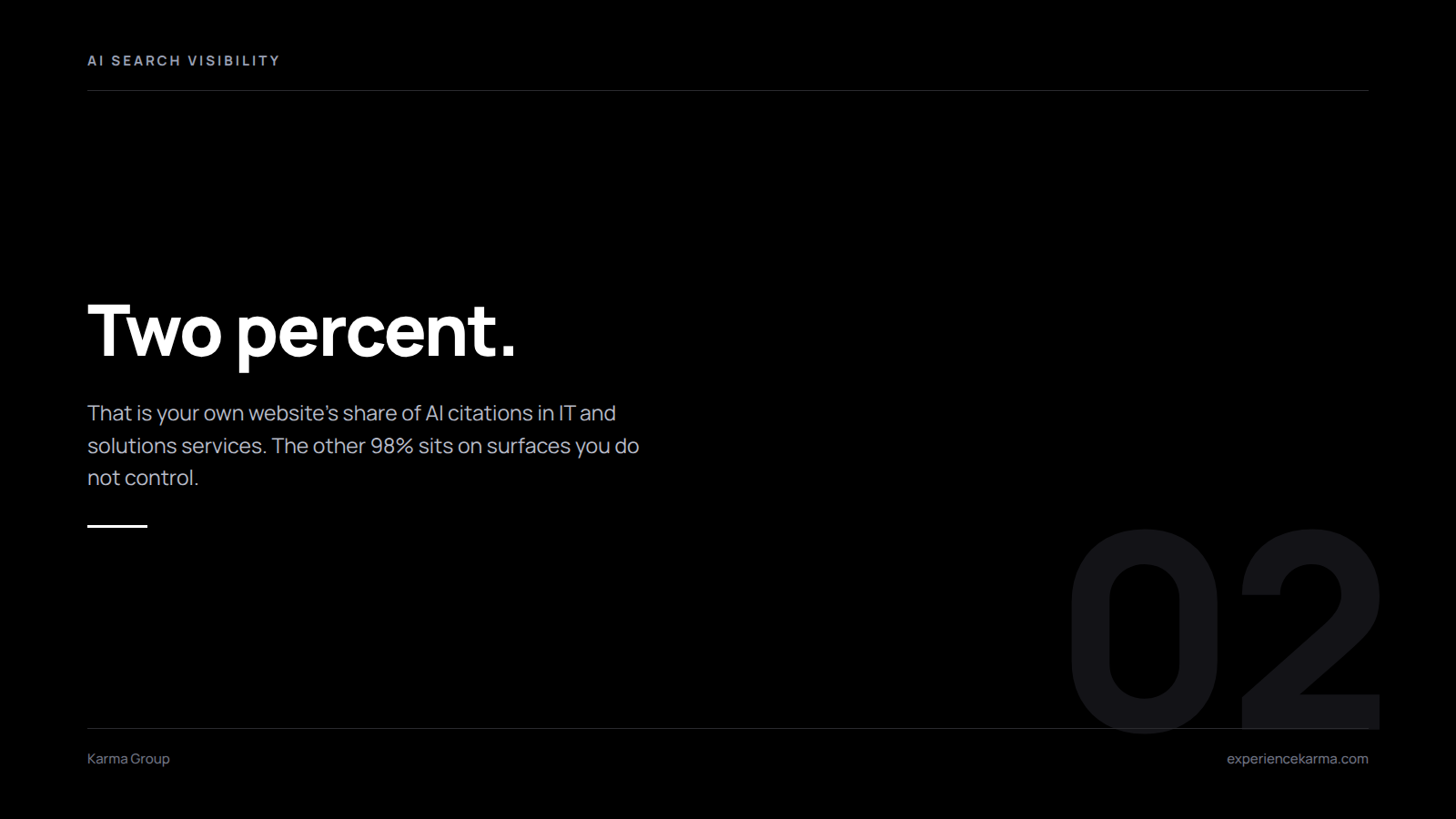
Trendos looked at 107 million AI answers this year. In the IT and solutions services category, pages a brand owns supply 2% of the citations. Two percent. So if your plan for B2B AI citations is a better blog, you are working the smallest lever you have. The other 98% sits on Reddit, on directories, and in editorial coverage you do not control. That is uncomfortable. But it is also useful, because it tells you where to spend the next quarter.
Your own website supplies 2% of B2B AI citations
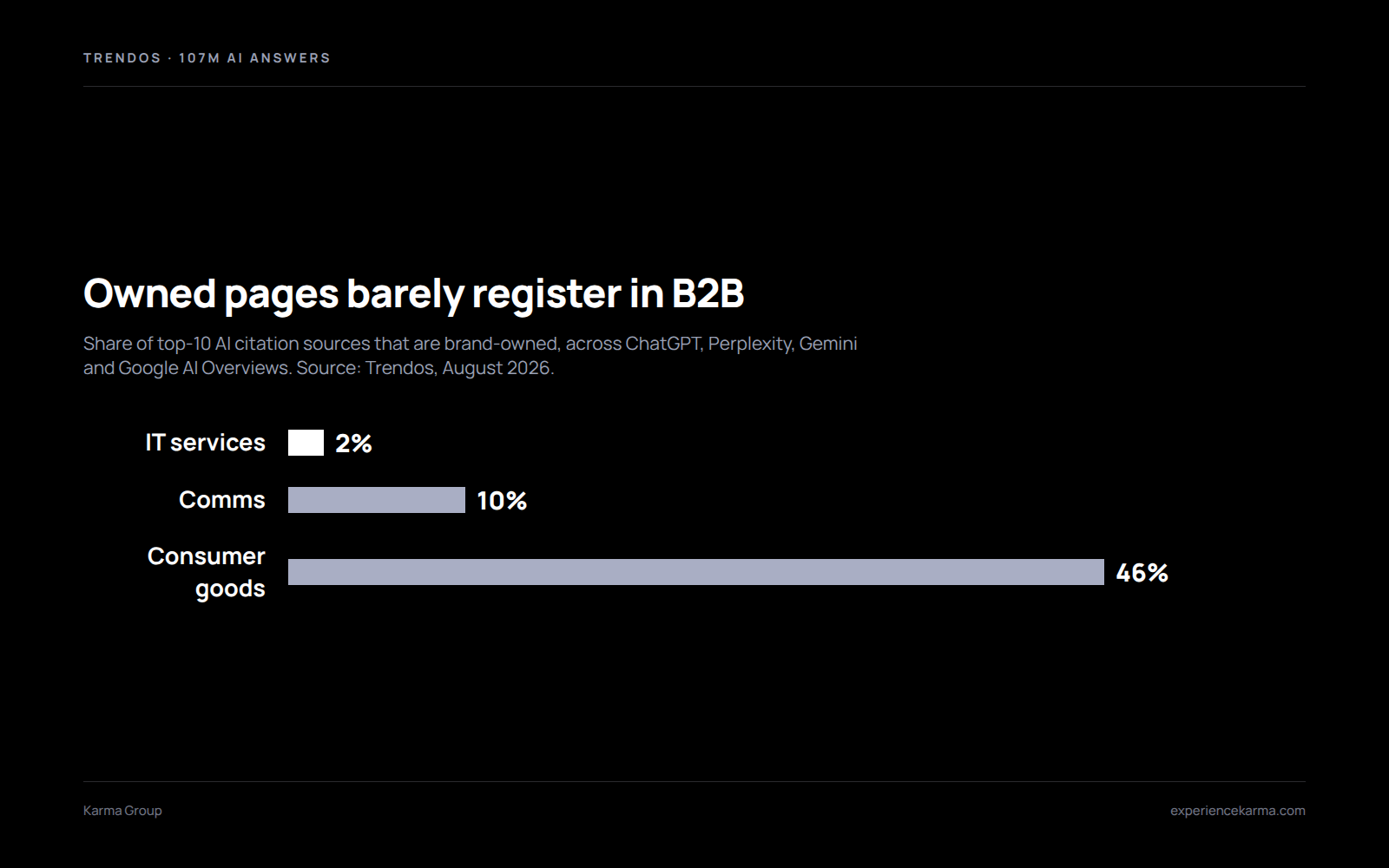
Trendos pulled the top 10 citation sources for three industries across ChatGPT, Perplexity, Gemini and Google AI Overviews. The split for IT and solutions services is stark. Community and user content takes 51%. Independent editorial and reference sites take 47%. Brand-owned pages take 2%.
Consumer goods looks nothing like that. There, brand and retail pages take 46%, because a product page really is the reference. Communication services sits between the two at 10%. So the lesson is not that owned content never gets cited. Rather, it is that B2B buying questions send the engines somewhere else.
Reddit is not a channel. It is the index.
Across all four engines, Reddit lands in the top three citation sources for every one of the three industries Trendos studied. In more than half of those cases it ranks first. Meanwhile Facebook and Quora fill out the rest of the community tier. So Reddit shapes B2B AI citations more than any site you own.
Most B2B teams treat Reddit as a place to avoid. That instinct made sense when Reddit was a traffic source. Now it works as a retrieval surface. When a model needs to know whether your product actually works, it reads what customers said in public, not what your homepage claims.
You cannot buy your way in there either. Moderators remove promotional accounts fast, so the only durable play is a real one. Have your engineers and support leads answer questions in the three or four subreddits your buyers already use. Give them a named account tied to your company. Then answer the threads where your product is the wrong fit, because that is what makes the rest credible.
Directories decide more B2B AI citations than your blog does
Omniscient Digital pulled 25,755 AI citations from 200 bottom-of-funnel B2B SaaS prompts in February 2026. G2 alone held 2.09% of citations on those prompts. Add Capterra, Software Advice and GetApp, which G2 now owns, and the modeled share climbs to 3.68%. That single group then outranks YouTube and LinkedIn on buying-intent questions.
Buying-intent prompts are only half of it. On proof and evidence questions, the kind where a buyer asks whether a tool really delivers, those same four properties model out at 12.69% of citations combined. That runs 93% ahead of the next domain on the list. So one company now sits astride the questions that close deals.
No single domain dominates. Still, the pattern holds: a handful of review platforms sit between you and the answer. So treat your review profile as content strategy. Fresh reviews, complete category listings and correct feature tags do more for B2B AI citations than another 2,000-word guide.
Your own pages still matter, just not the way you think
Here the datasets disagree, and you should know it. Citera analyzed roughly 350,000 B2B SaaS articles competing for 10,382 keywords in May 2026. In that set, brand-owned pages took 29% of AI citations. Trendos put the figure at 2%. Both numbers hold up. They simply measure different slices.
Trendos ranked the top 10 sources per industry, so it captures the head of the distribution. Citera scored every article in a large content set instead. The gap tells you something practical. Your pages can earn B2B AI citations, but they rarely crack the top sources for a category. So plan for the long tail, not the podium.
Evidence separates a cited page from an ignored one
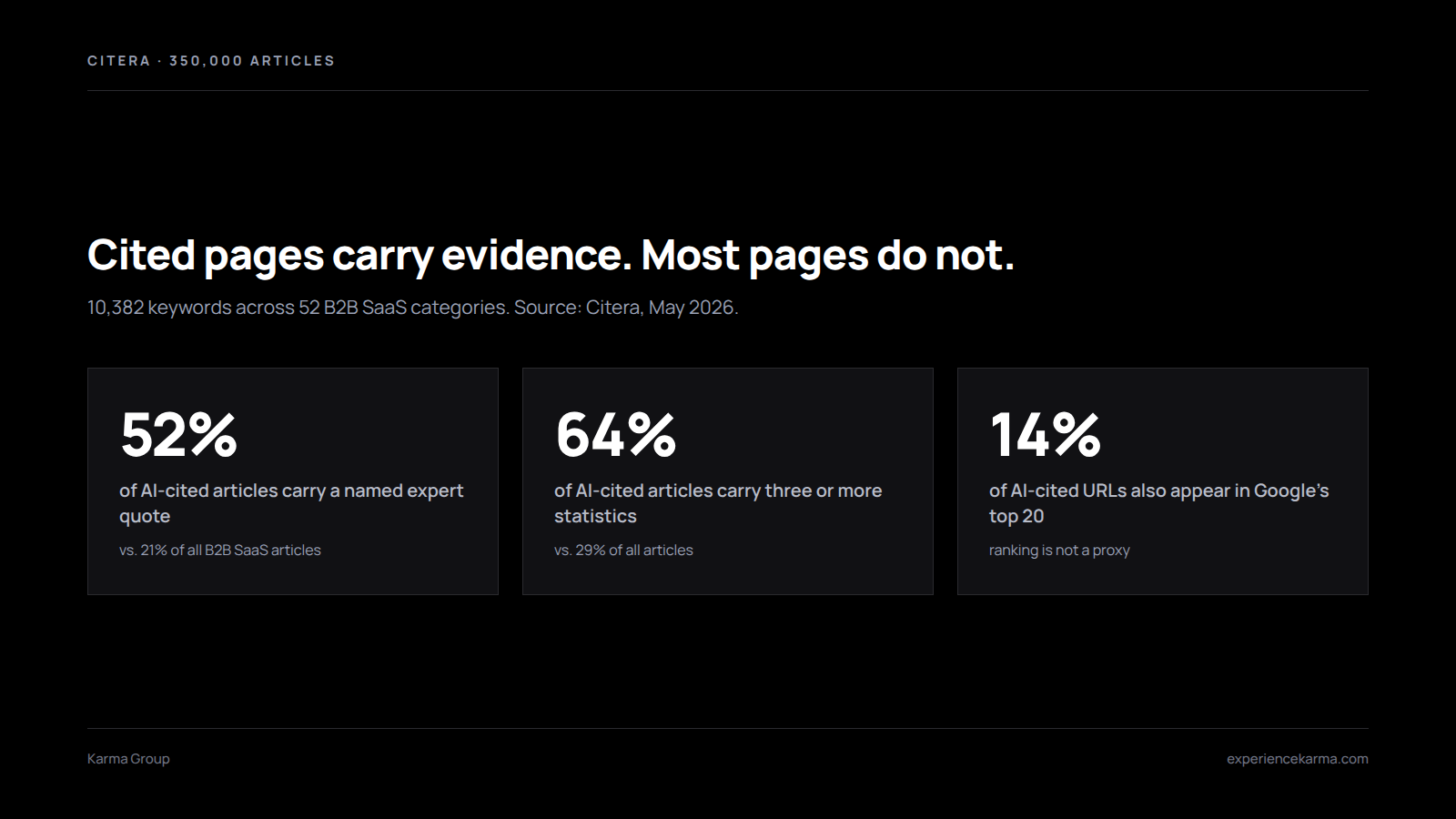
Citera isolated the difference, and it is not what vendors sell. Only 21% of B2B SaaS articles carry a named expert quote. Among AI-cited articles, 52% do. Only 29% carry three or more statistics. Among cited articles, 64% do. On average a cited piece runs 4.2 statistics and 1.6 expert quotes, against 1.2 and 0.2 for the rest.
Schema markup showed nothing. Citera found it on 69% to 72% of pages across every position bucket, with no gradient. So the pages that win B2B AI citations carry evidence: named people, hard numbers, first-hand data. Write fewer pages, then put something in them nobody else has.
Overlap with your Google rankings is thinner than you expect
Only 14% of AI-cited URLs also appear in Google’s top 20, Citera found. Going the other way, 30% of Google’s top-20 articles pick up an AI citation. Cross-engine overlap runs 8% to 17%. So a page can own position three and never reach an answer.
That kills a common assumption. Ranking well is not a proxy for B2B AI citations, and your rank tracker will not warn you. Instead, track the two separately and expect them to drift apart.
Comparison questions decide where you appear
Not every query produces an AI answer at all. Citera measured how often each query type triggers an AI Overview, and the spread is wide:
- Comparison queries: 87%
- Question-format queries: 83%
- Best-of queries: 72%
- Transactional queries: 8%
So comparison content wins more B2B AI citations than anything on your pricing page. That page will almost never surface. Meanwhile a clear “X vs Y” write-up, one that names both products honestly, gets pulled into answers again and again.
One caveat, because you will hear the opposite. Cited articles in the Citera set averaged 1,690 words against 1,305 for uncited ones. That gap looks real, yet Citera warns it is not causal. Domain authority explains much of it. So do not bolt 400 words onto a page and call it optimization.
Audit your B2B AI citations by surface, not by page
Start with the surfaces, since that is where the citations live. Pull the prompts your buyers actually ask. Run them across ChatGPT, Perplexity, Gemini and AI Overviews. Then record every cited domain, not just whether you showed up.
Sort the result into three buckets: community, third-party editorial and directories, and owned. Now you can see your real exposure. Most B2B brands find nothing of theirs in the first two buckets, while pouring the whole budget into the third.
Then weight each bucket by how often it appears, not by how much you like it. A directory listing you can fix this week may matter more than the pillar page you had planned for Q4.
Do these five things this month
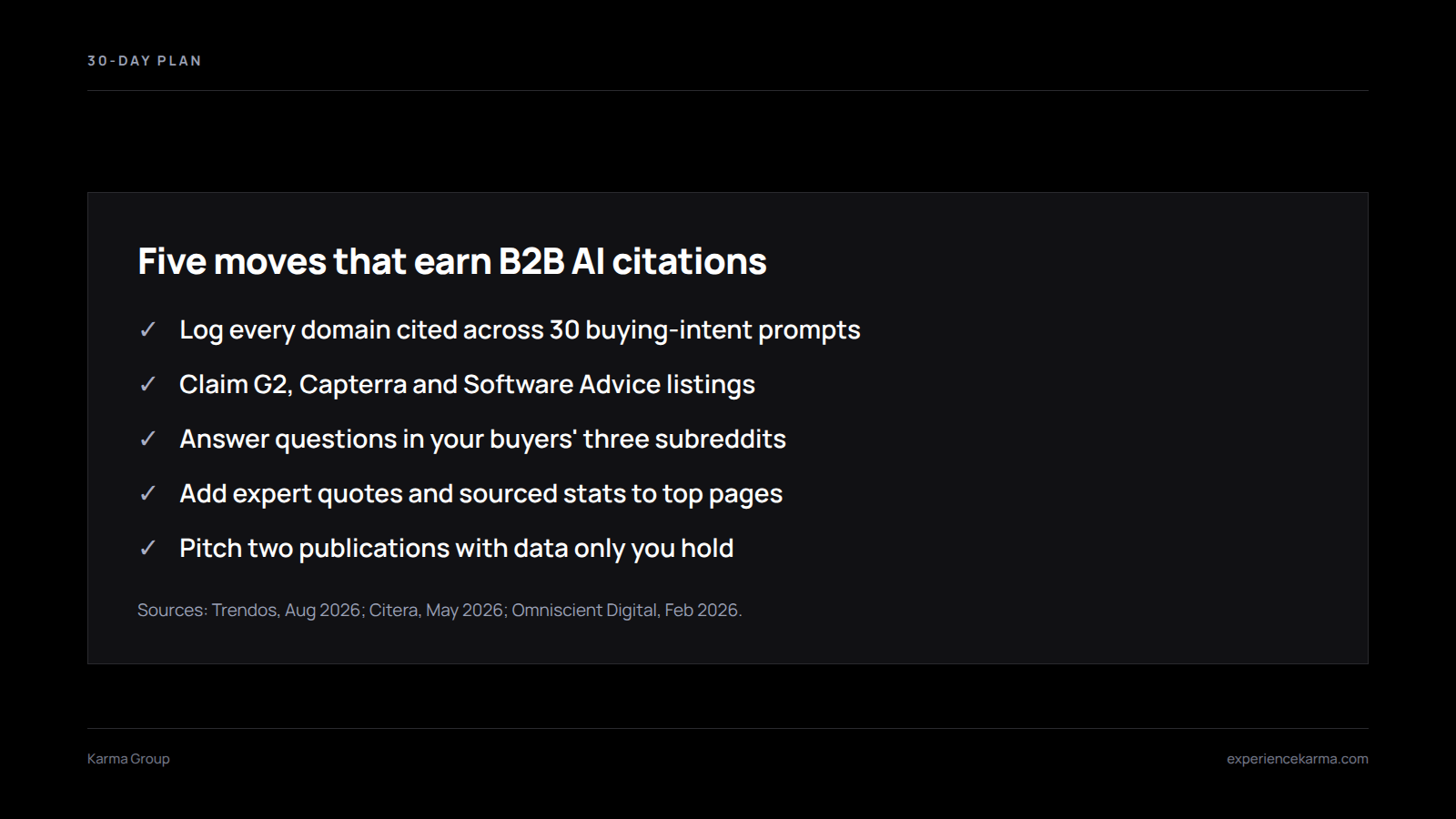
- Pull 30 buying-intent prompts, then log every domain the engines cite.
- Claim your G2, Capterra and Software Advice listings, then ask ten customers for fresh reviews.
- Find the three subreddits where your buyers argue about tools, then answer questions there under a real name.
- Also add a named expert quote and three sourced statistics to your ten highest-intent pages.
- Finally, pitch two independent publications in your category with data only you hold.
None of that needs a new content calendar. It needs about six weeks and someone who will actually do the work.
Want help earning B2B AI citations?
Karma Group builds AI search visibility programs for B2B teams. So if you want to know which surfaces decide your category, and what it takes to appear on them, talk to us.