
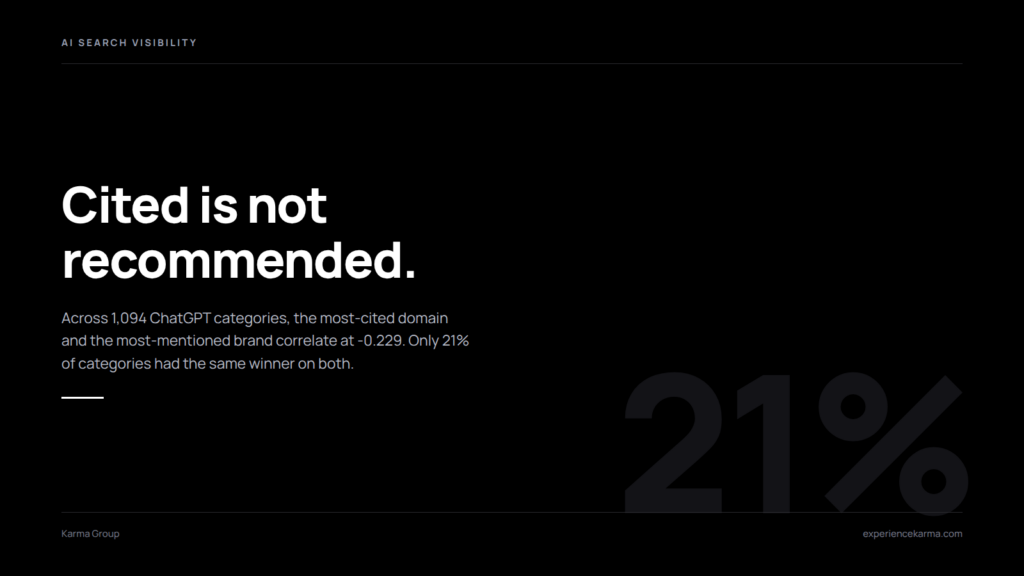
Across 1,094 US categories in ChatGPT, the most-cited domain and the most-mentioned brand correlate at -0.229. Semrush published that figure on 20 July 2026. So AI citations and brand mentions are not a single metric wearing two names. In fact they pull slightly apart. You can own every citation in your category and still watch the model recommend a competitor by name. Both signals matter, but you win them in different ways. Here is what three 2026 datasets show, and what to change in your reporting this week.
AI citations and brand mentions move in opposite directions
Semrush tracked 1,094 US categories monthly from January to June 2026, covering more than 220,000 domains, 50,000 brands and 600,000 citations. Only 21% of the most-cited domains in a category were also the most-mentioned brand. So four times out of five, the site ChatGPT reads is not the brand ChatGPT names.
That gap has a shape. Clear category owners, meaning brands leading on both signals, made up just 15.2% of categories. Another 31.2% had an emerging leader, while 53.7% stayed unsettled. Over half of every category studied still has no owner. Meanwhile the owners that do exist rarely slip: they held first place in 90.4% of month-over-month comparisons.
Your existing SEO metrics barely predict who wins. In the same Semrush topic authority study, category owners had higher branded search volume in 55.7% of comparisons, a higher Authority Score in 52.5%, and higher organic traffic in only 48.4%. Two of those three sit within a point or two of a coin flip. Traffic actually points the wrong way.
One caveat before you rebuild anything. All three studies here come from Semrush tooling with Kevin Indig. So this is one vendor and one method, not three separate checks. Treat the direction as solid and the decimals as rough.
ChatGPT cites you. Gemini names you.
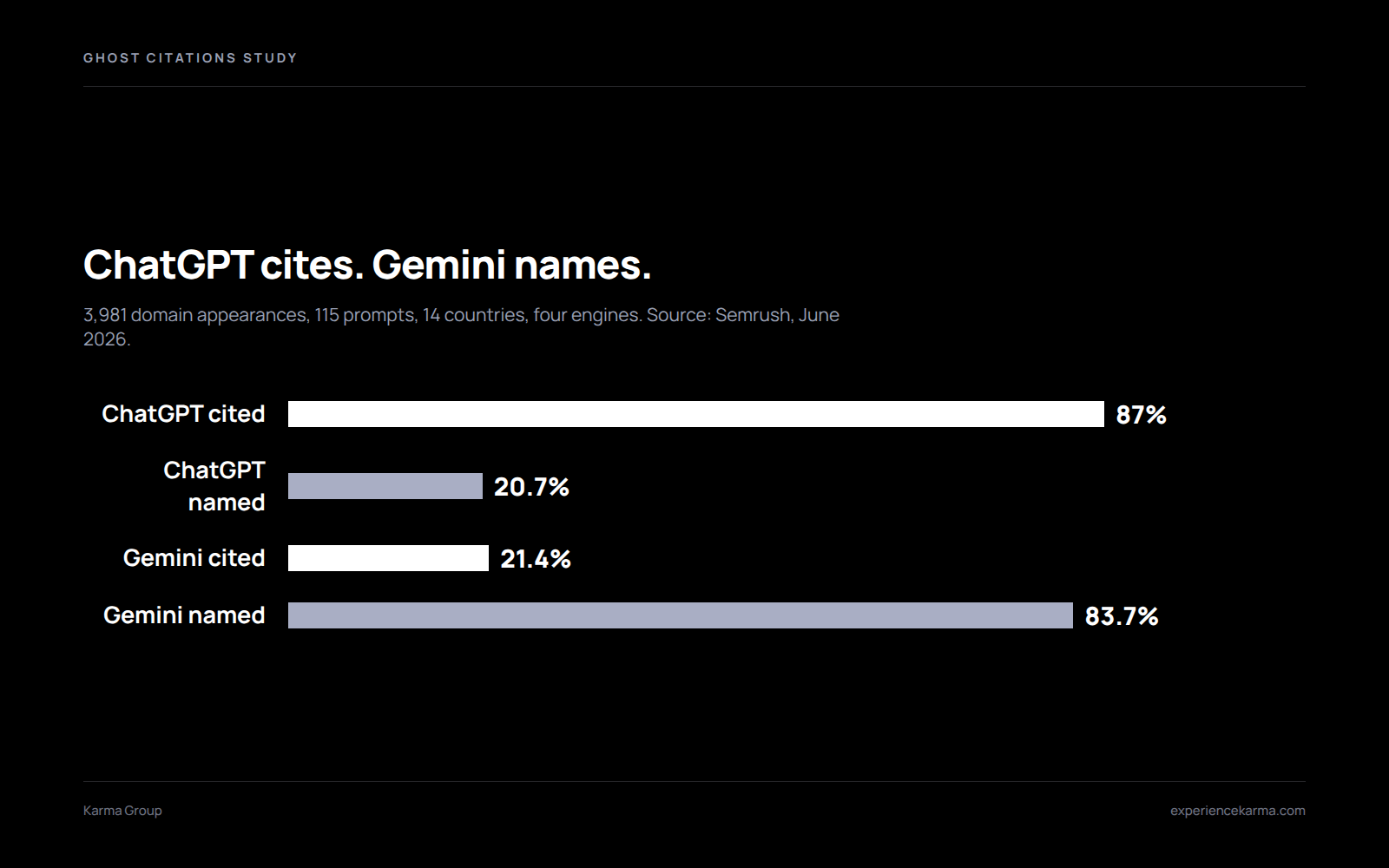
The engine split is the part most dashboards hide. Semrush’s ghost citations study, published 9 June 2026, looked at 3,981 domain appearances across 115 prompts, 14 countries and four engines. Overall, 74.9% of appearances earned a citation while only 38.3% earned a brand mention.
Split by engine, the numbers invert. ChatGPT cited domains 87% of the time but named the brand in just 20.7% of appearances. Gemini did the reverse: a 21.4% citation rate against an 83.7% mention rate. So a blended visibility score across engines averages away the only thing you can act on.
Same brand. Same week. Two wildly different scores, and both of them true.
So pick your engine, then pick your metric. If your buyers live in ChatGPT, chase the link and the page behind it. If they live in Gemini, chase the name in the answer text. Trying to win both at once, on one budget, is how teams end up winning neither.
Most AI citations never get you named
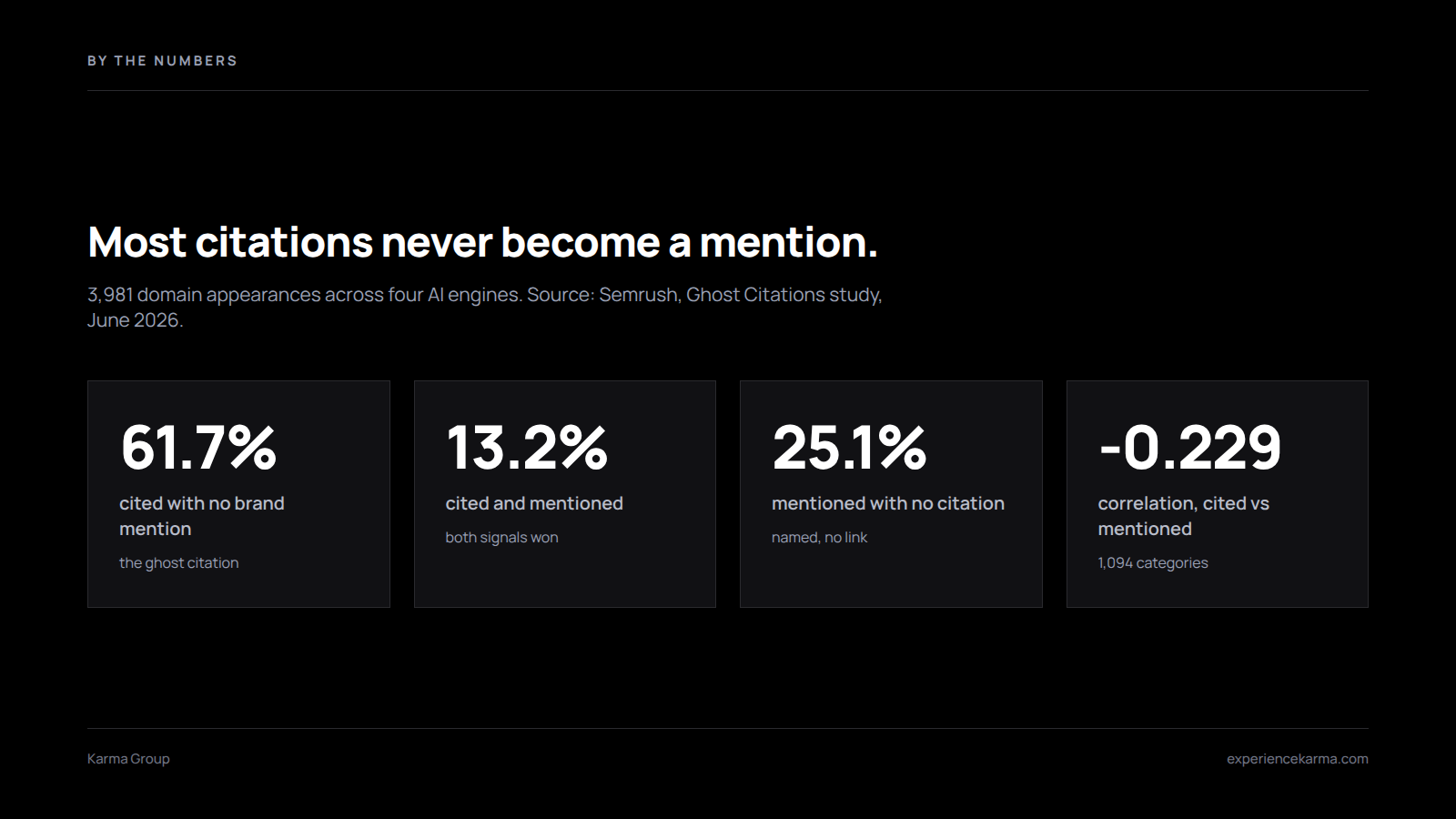
Here is the number that should change your reporting. Of those 3,981 appearances, 61.7% were citations carrying no brand mention at all. Only 13.2% earned both. Another 25.1% got a mention with no link back.
So the majority of your AI citations do work you get no credit for. The model reads your page, uses your analysis, and then recommends somebody else by name. Your content trains the answer while a competitor collects the buyer.
That matters because the shortlist tends to stick. In a Growth Memo study of 185 documented purchase tasks, published 7 April 2026, users accepted the AI’s final shortlist 74% of the time. Landing on the shortlist is the outcome you are paid for. Landing in the footnotes is not.
Check your own ghost rate before you argue with the average. Pull 20 prompts your buyers would actually type. Run them in ChatGPT and Gemini, then log two columns: did the answer link us, and did the answer name us. Most teams see the gap on the first pass. So you do not need a paid tool to learn where you stand, though you will need one to track it monthly.
The question people ask decides which one you get
Intent moves the ratio more than anything you do on the page. Informational prompts produced an 89.3% citation rate but just an 18% mention rate. Comparative prompts flipped that, reaching a 43.3% mention rate, or roughly 2.4 times the informational figure. How-to prompts landed at 42.8% mentions, while commercial prompts returned 35.6% mentions against an 84.4% citation rate.
Prompt length matters too. Short spoken-style queries produced 30 to 50 times more brand mentions than long structured prompts, which sat at a 2% to 3% mention rate. That has a blunt cost. If your agency tests with long, hand-built prompts, your mention numbers are close to junk. Test the way buyers type.
So go where the naming happens. Instead of shipping one more “what is” explainer, build for comparison and shortlist questions. Think “best”, “versus” and “what should I use for”. Explainers earn AI citations and almost no named picks.
Stray from your core and the mentions dry up first
The third study asked how far a brand can wander. Published 3 August 2026, the topical focus study covers 283,215 domain-category citation observations and 76,493 mention observations across 1,458 mapped brand entities.
Close to a brand’s core expertise, categories returned 74% citation, 44% mention and 34% both. Far from it, those numbers fall to 50%, 25% and 9%. Named-brand appearances dropped from 46% in the most relevant categories to 18% in the least related ones. Notice which signal collapses harder: the “both” number loses nearly three quarters of its value.
Depth changes the picture again. Brands appearing in only one of five prompt variants lost mention share, and that penalty vanished once they reached three of five. Citations carried no such penalty at any breadth. So a thin spread still earns links, though it will not earn recommendations.
Two sectors resisted the pattern. Legal and healthcare showed no reliable mention payoff even at full five-prompt coverage, while finance and real estate rewarded broader coverage with stronger citation leverage. If you sell in a regulated category, budget for a longer runway.
Report AI citations and brand mentions as two numbers
Split the column in your dashboard this week. It is a small change, but it ends a year of false reads. Then work the list.
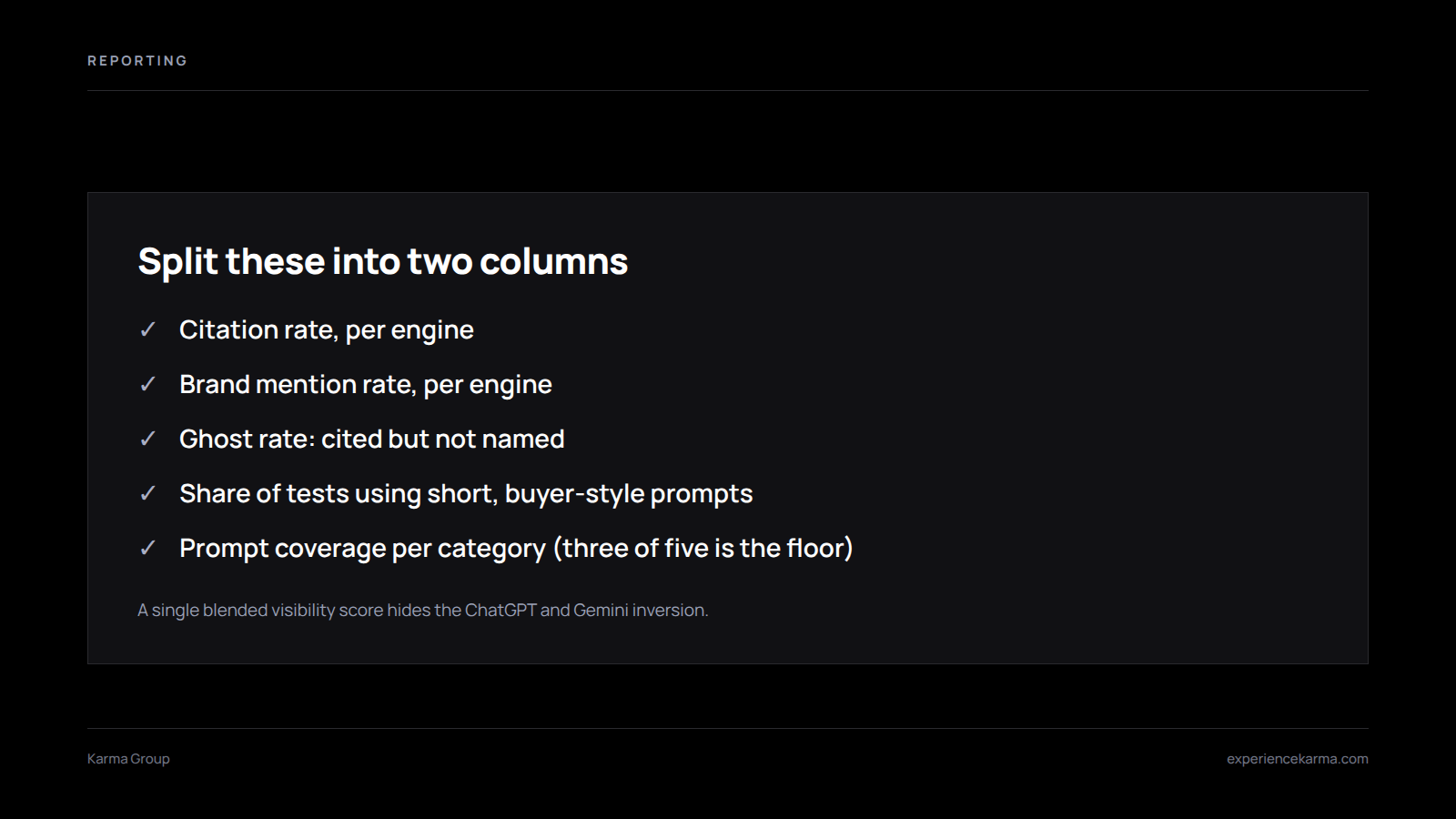
- Track citations and mentions separately, per engine. A blended score hides the ChatGPT and Gemini inversion completely.
- Audit your ghost rate. When most appearances cite you without naming you, your content is feeding answers that sell for somebody else.
- Shift budget toward comparison content. Comparative prompts return roughly 2.4 times the mention rate of informational ones.
- Shorten the prompts you test. Long structured prompts sit at a 2% to 3% mention rate, so they will understate how often models name you.
- Cover a category properly or leave it alone. Three of five prompt variants is the floor where mentions start to pay.
- Stop reporting a citation win as a recommendation win. Across 1,094 categories they correlate at -0.229.
None of this replaces the fundamentals we covered in our guide to AI search visibility in 2026. It sharpens them. The tactics that get your brand named in ChatGPT are simply not the tactics that get your pages cited, and one dashboard column has been hiding that from marketing teams all year.
Want help turning AI citations into brand mentions?
Karma Group builds AI visibility programs that report citations and mentions apart, per engine, so you can see which game you are actually winning. If your dashboard shows a single number, we can show you what it hides. Get in touch.

Written by
Founder and CEO, Karma Group
Brendan Cogbill is the founder and CEO of Karma Group. He has run paid media and search for trade show, experiential and industrial brands since 2019, and now focuses on how brands earn visibility inside AI search. He holds a BBA and an MBA from Grand Canyon University and works from Phoenix, Arizona.
More about Brendan Cogbill