
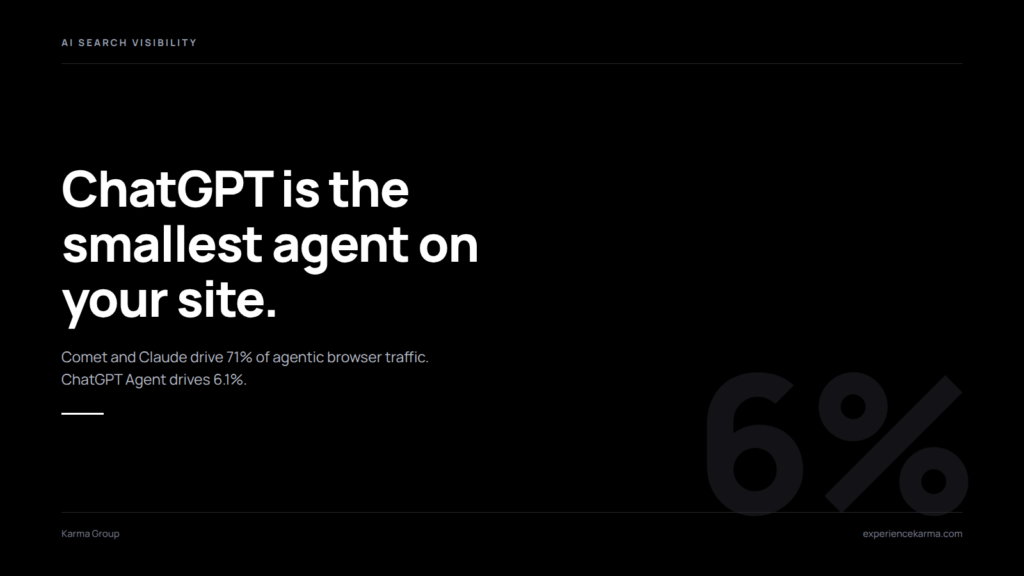
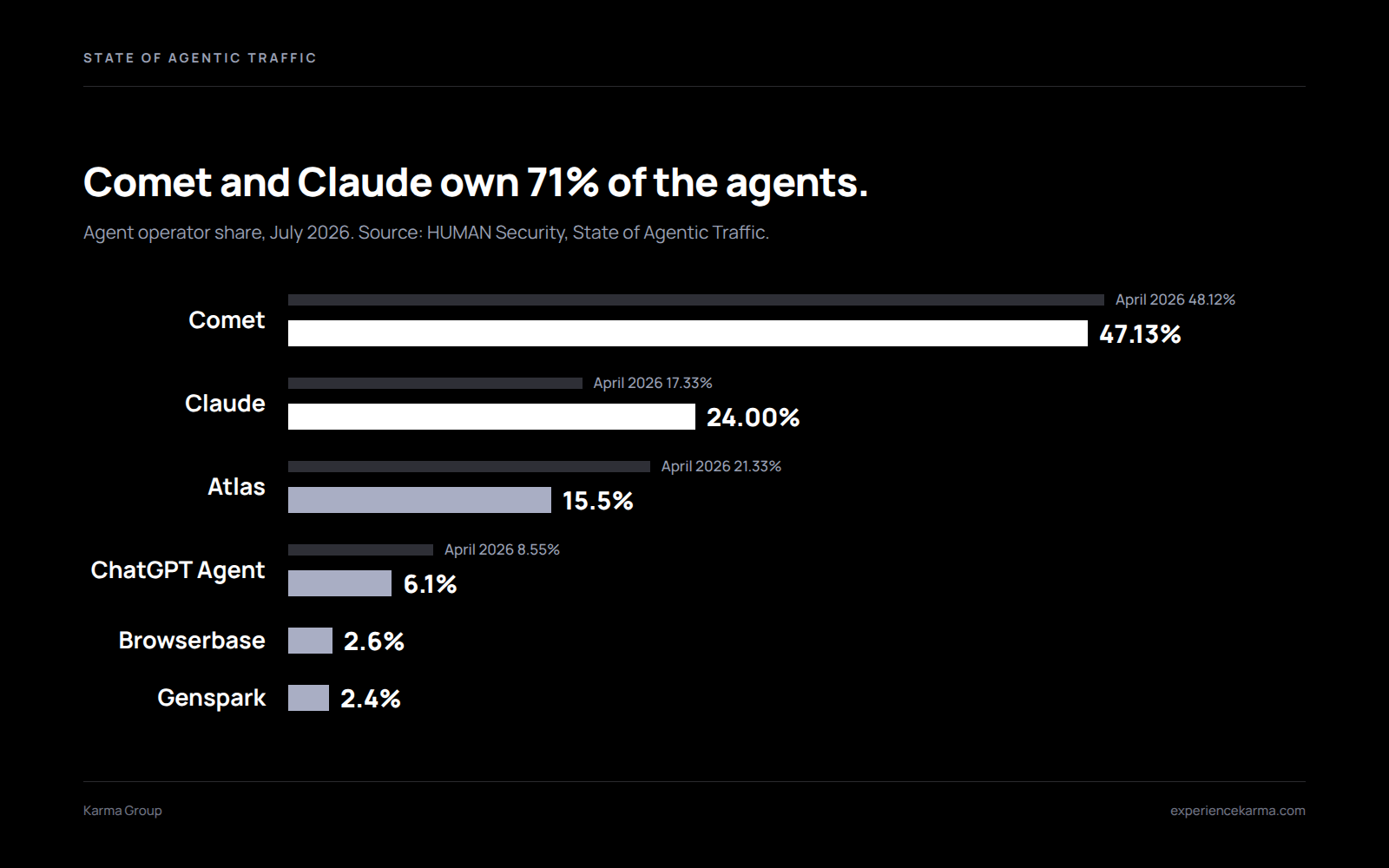
In July 2026, Perplexity’s Comet browser drove 47.13% of agentic browser traffic. Anthropic’s Claude Chrome extension took another 24.00%. Meanwhile ChatGPT Agent managed just 6.1%. Those shares come from HUMAN Security’s State of Agentic Traffic report for July 2026. So if you spent this year tuning your site for ChatGPT, you tuned for the smallest agent on the board. The agents reading your pages today are Comet and Claude.
That gap matters because these agents act nothing like a crawler. Each one arrives with a person behind it. They click, they read, and some of them log in.
Comet and Claude own your agentic browser traffic
Comet has held about half this market since spring. In April it drove 48.12% of the top ten agents’ traffic, and by July it still held 47.13%. Claude is the real mover, though. It climbed from 17.33% in April to 20.8% in June, then 24.00% in July. HUMAN logs it as the only agent in the top four that gained share last month.
OpenAI slid on both fronts over the same stretch. Atlas fell from 21.33% in April to 15.5% in July. ChatGPT Agent dropped from 8.55% to 6.1%. Add Comet and Claude together and you get roughly 71% of the agents hitting sites. That is not a rounding error. It is the whole market.
None of this shows up in the tools you already pay for. Most AI visibility platforms track citations inside chat answers. Agent sessions never touch that surface, so your dashboard reports nothing while the traffic keeps arriving.
Agents come to read, not to buy
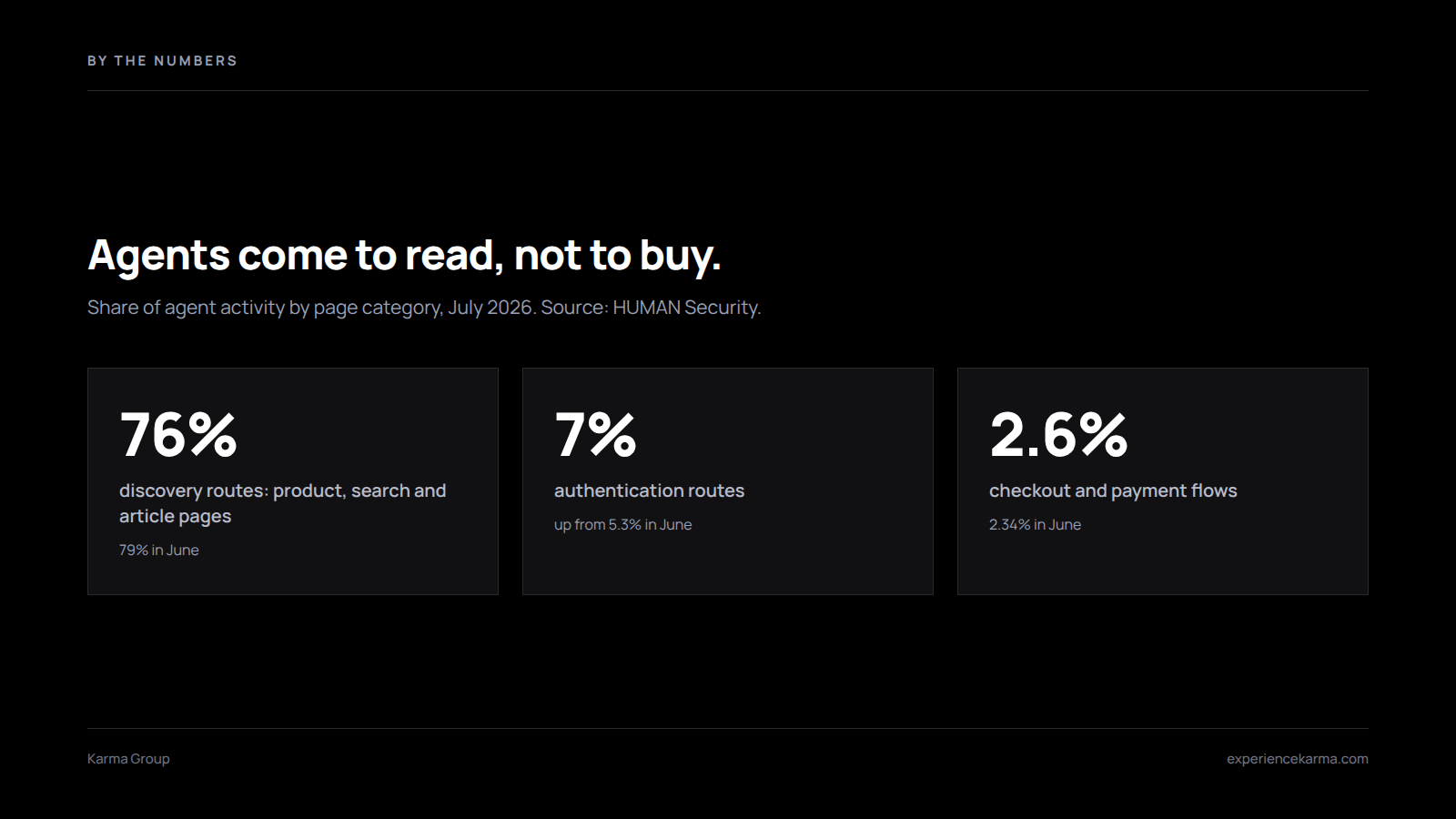
Here is the number most retailers get backwards. In July, 76% of agent activity landed on discovery routes: product pages, search results, and articles. Checkout and payment flows took 2.6%. So the agent does homework. It rarely spends money.
That split held all year. In June, discovery routes took 79% while checkout took 2.34%. The pattern barely moved between April and July.
Treat these visits as research sessions, then. Your job is to make the page answer a question cleanly, not to push a cart at a robot. Clear specs, plain comparisons, and a straight price beat a carousel every time.
This also reframes what a good agent visit looks like. A crawler wants your whole page. An agent wants one fact, and it wants that fact fast. So bury your pricing behind a form and the agent leaves with nothing to report. Publish it plainly and the agent carries your number back to a buyer.
Retailers tend to resist this. They built those pages to sell, after all. Yet the sale now happens in a chat window you do not control, using facts scraped off a page you do. Your page is the evidence, not the close.
Publishers just passed retail
For most of 2026, e-commerce led every month. In June it took 43.8% of agent traffic while media sat at 41.3%. July flipped the order. Media and publishers climbed to 43.5%, and e-commerce settled at 42.0%. Travel held near 13.4%.
So if you publish anything, you are now the single largest destination for these agents. Worth knowing before you decide how much of your archive to gate.
Agentic browser traffic is not crawler traffic
People keep filing this under bots. It does not belong there. A crawler like GPTBot fetches your page to build an index for later. An agentic browser loads your page because a person asked a question one second ago.
That difference changes what you should do about it. Blocking crawlers is a licensing call, and we covered why those numbers run smaller than people claim. Blocking agentic browser traffic does something else entirely. You would turn away a customer who happens to use a robot.
Your robots.txt does not govern this either. These sessions run through a real browser engine, so they render your JavaScript, accept your cookies, and look like Chrome. In short, the crawler playbook does not apply.
Practically, that flips your defensive instincts. Heavy interstitials, cookie walls, and slow client-side rendering all cost you here. A human waits through a modal. An agent frequently gives up and reports back that your competitor answered faster.
The long tail of agentic browser traffic will get louder
Four names cover roughly 93% of this traffic today. That concentration looks stable, but the tail underneath it moves fast. In June, Browserbase grew four times over in a single month, and nearly ten times since the end of the prior quarter. Browser Use and AgentCore each doubled.
The roster churns too. Cursor’s agentic browser entered the top ten in July while AgentCore dropped out of it. So any allowlist you write this quarter will be stale by the next one. Match on behaviour rather than on names, or plan to keep rewriting the list.
Your analytics counts agents as people
HUMAN identifies these sessions with behavioral signals, user-agent attribution, and publisher integrations. Your GA4 property does none of that. It sees a Chromium browser at a normal screen size, so it logs a human and moves on.
That is why direct traffic keeps swelling while your conversion rate quietly sags. You are not losing buyers. Instead, you are counting robots as buyers. Until you split them apart, every funnel number above the checkout step runs soft, and every optimisation you ship chases a ghost.
This is the same blind spot we flagged in AI visibility measurement, one layer down. Back then the gap sat between tools and action. Now it sits between traffic and truth.
Agents are starting to log in
This is the quiet one. Authentication routes took 7% of agent activity in July, up from 5.3% a month earlier. Account pages took 6.4%, up from 5.7%. Both climbed while checkout fell.
So agents are getting past your front door. Some of that is a person handing their browser a chore. Still, your login flow, your rate limits, and your session rules all assume a human sits there. That assumption now breaks, and it breaks quietly.
The vertical mix moves fast as well. Education sat at just 0.03% of agent traffic in July, yet its volume grew 62.3% in a month. Small bases move in big percentages, obviously. Even so, a sector can go from noise to real load in two quarters, and yours might be next.
Measure your agentic browser traffic this week
- Pull server logs, not GA4. Agents show up there with real user-agent strings.
- Search first for Comet, Atlas, and the Claude extension. Together they cover most of the volume.
- Tag those sessions into a separate GA4 segment so your human conversion rate stops lying.
- Check which routes they hit. If most land on product and article pages, answer quality matters more than your cart.
- Watch authentication logs. Rising agent logins change your rate-limit math.
- Re-run this monthly. The mix shifted three times between April and July.
None of that needs new software. It needs one afternoon with your logs, and a willingness to accept that a chunk of your traffic never had a pulse.
Do it before the next planning cycle. Otherwise you will set targets against a conversion rate that mixes people with agentic browser traffic, and you will miss those targets for reasons no one can name.
Want help reading your agentic browser traffic?
We help brands separate agent sessions from human ones, then fix the pages the agents actually read. If your direct traffic climbed this year while conversions did not, that is the place to start. Get in touch.