

Shopify’s AI referral growth fell from nearly 13x year over year to 3x in a single quarter. Same publisher, same metric, one quarter apart. Your strategy probably does not need to change. Your numbers do. Most AI visibility decks still quote the Q1 multiples, so most decks are now a quarter stale. Here is what the two Shopify reports actually say, what the compression does and does not prove, and what to fix in your reporting this week.

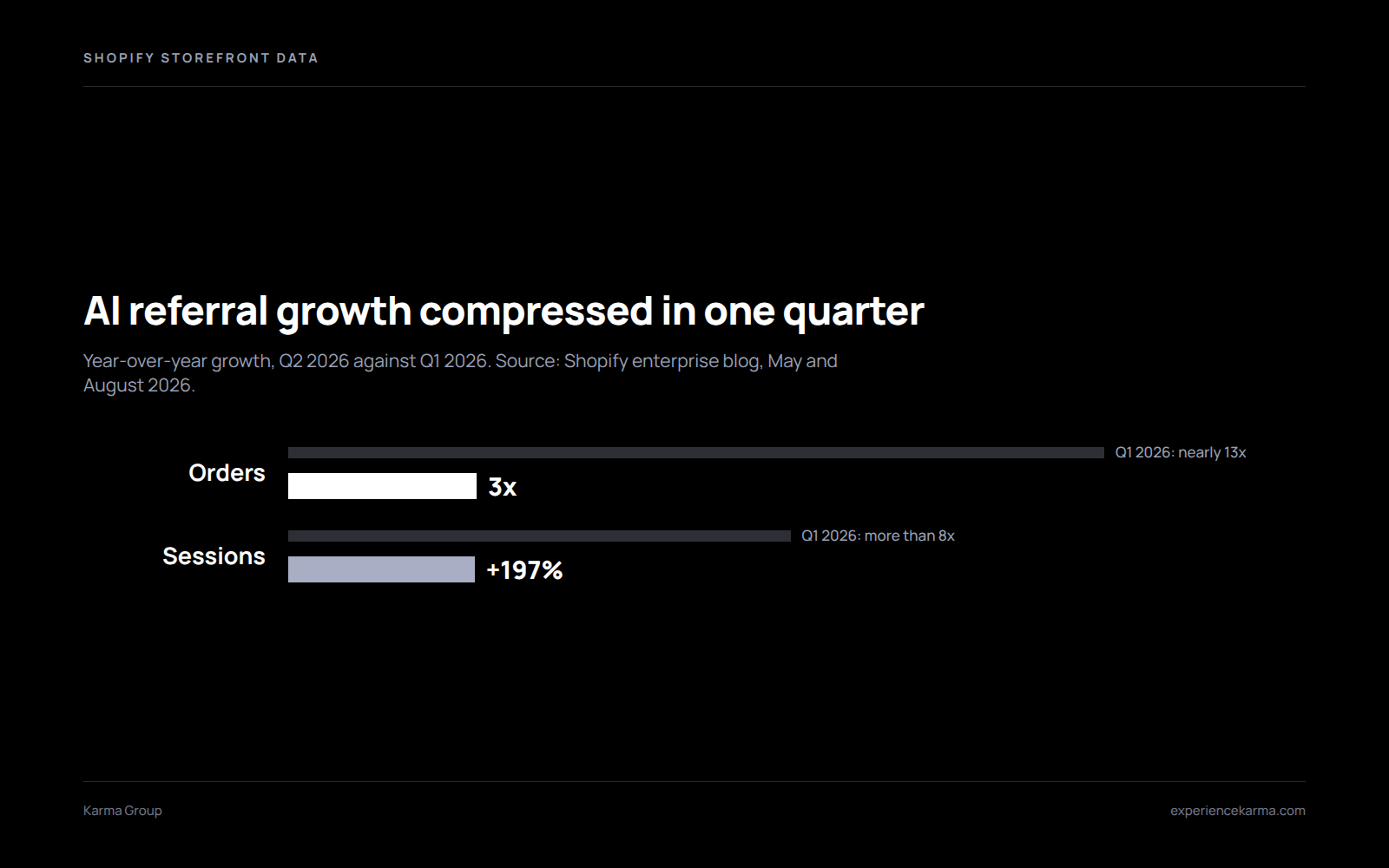
AI referral growth fell from 13x to 3x in one quarter
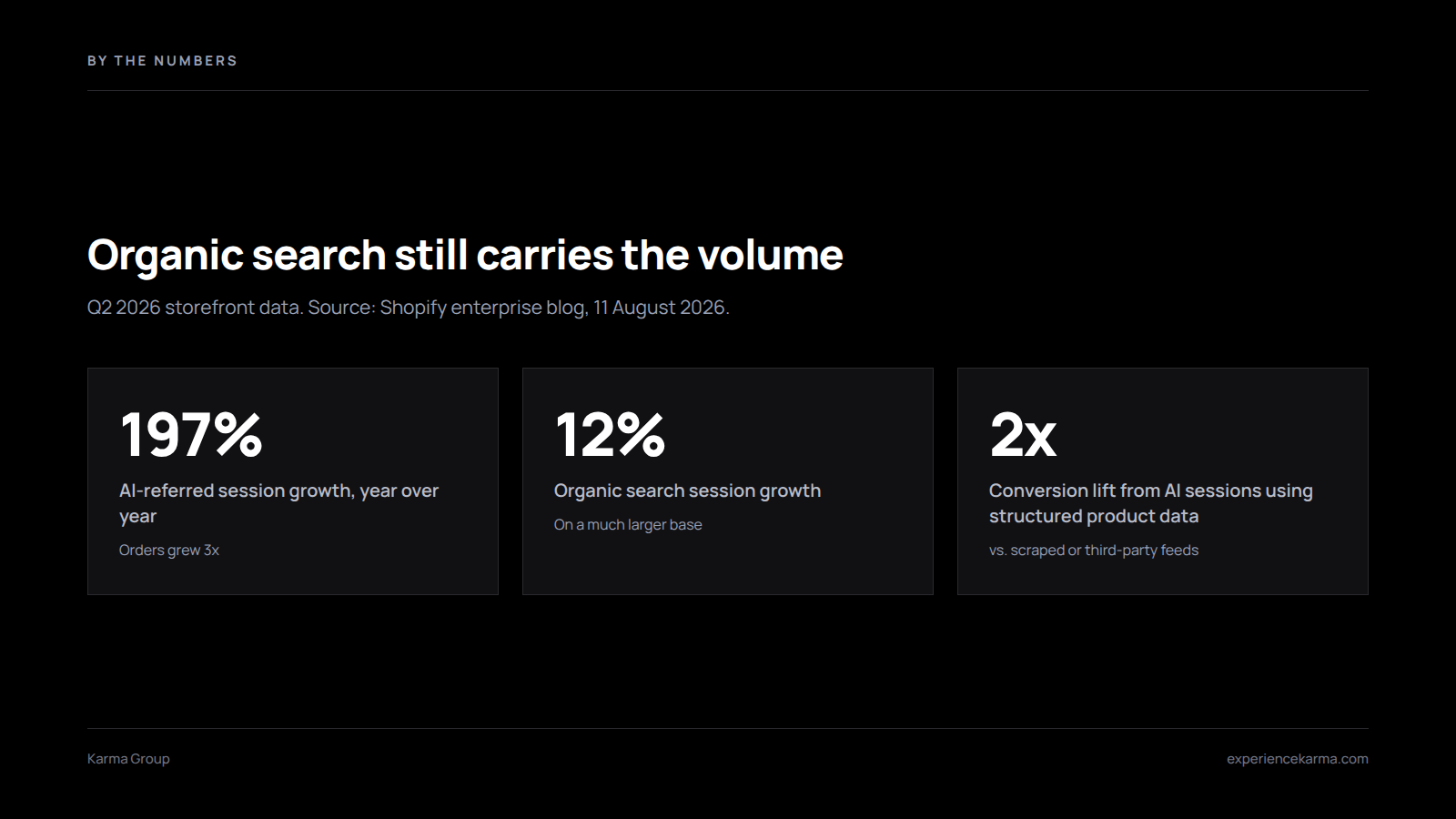
Kyle Risley published Shopify’s Q2 2026 storefront figures on 11 August 2026. AI-referred sessions grew 197% year over year. Orders grew 3x. Three months earlier the same author published Q1 2026 numbers on the same blog: AI-referred orders grew nearly 13x year over year, and AI chatbot referral sessions grew more than 8x.
So the multiple compressed hard. Order growth went from roughly 13x to 3x. Session growth went from more than 8x to just under 3x. Shopifreaks flagged the drop on 13 August. Search Engine Land covered the same post the same day and framed it as AI up, organic still ahead. Nobody put the two quarters next to each other.
Slowing AI referral growth is not falling AI traffic
Read the compression carefully, because it is easy to misread. A shrinking year-over-year multiple does not mean traffic dropped. It means the base you compare against grew. Q2 2025 already carried more AI referrals than Q1 2025 did, so part of this move is arithmetic rather than slowdown.
How much of it? Nobody outside Shopify can say. Neither post publishes absolute session or order counts. Without those denominators you cannot separate the base effect from a real slowdown. Still, 13x to 3x is a big move for three months. The honest read sits somewhere between pure arithmetic and the end of the land grab.
Organic search still moves more traffic than every AI platform combined
Shopify says it plainly in the Q2 post: organic search referred more sessions to Shopify merchants than all tracked AI platforms combined. Organic sessions grew 12% in the quarter, on a much larger base. Put that sentence in front of anyone who wants to move budget out of search this month.
We have made the enthusiastic case ourselves. In July we called AI referral traffic the best-converting channel of 2026. On conversion that still holds. But conversion rate is not volume, and a channel can convert beautifully while carrying a small slice of your sessions.
The two quarters do not measure conversion the same way
Here is where the summaries go wrong. The Q1 post said AI-referred visitors convert at nearly 50% higher rates than organic search on product detail pages. The Q2 post says that once AI-referred shoppers reach a product page, they convert about 80% better than organic-referred shoppers.
Those look like one measure improving. Treat them as two measures instead. The wording differs, neither post shows its method, and Shopify never states that the figures are built the same way. So do not put “50% to 80%” on a slide as a trend line. Report each quarter’s number with its own quarter attached.
The Q1 post did give the edge a useful shape. AI-referred session conversion beat organic in 23 of 25 merchant categories, by an average of 56%. Orders carried 14% higher average order value. More than half of AI-referred sessions started on a product detail page, against roughly 20% for organic. In Q2 the figure was 50% landing directly on product pages, which is close enough to call it steady.
That last number matters more than the growth rate. AI referral growth may be decelerating, but the arrival pattern has not changed. These visitors skip your homepage and your category pages. They land on the product, having already done the comparison somewhere you cannot see.
Spec-led categories convert best from AI referrals
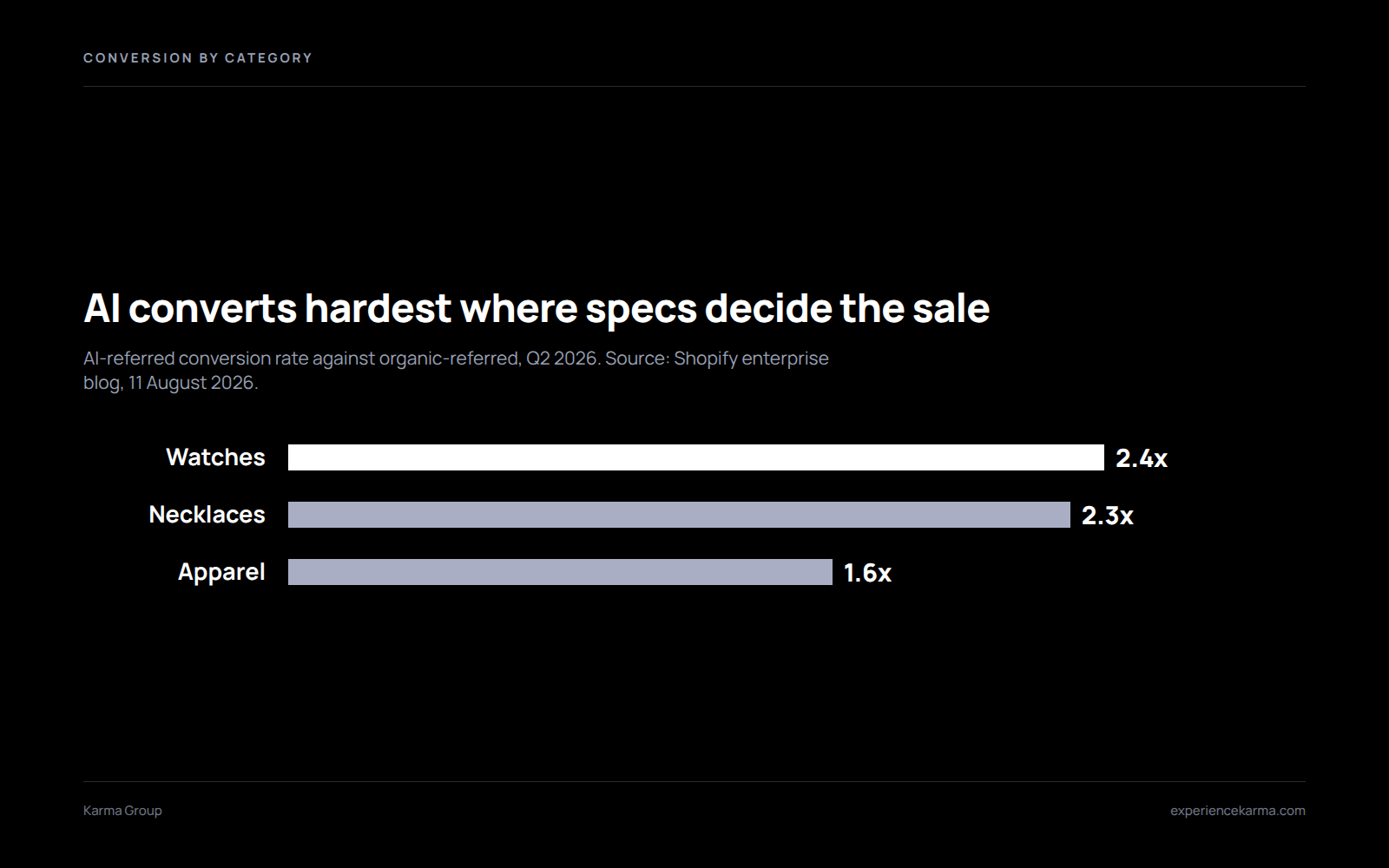
The Q2 data breaks the conversion edge down by category, and the pattern is clean. In spec-led categories, AI-referred shoppers converted at roughly twice the rate of organic-referred shoppers. Watches ran 2.4x better. Necklaces came in at about 2.3x. Apparel overall managed 1.6x.
Notice what separates the top from the bottom. Watches have movements, case sizes, water ratings and model numbers. Apparel has fit, feel and taste. A model can compare the first set confidently and cannot really compare the second. So the categories where AI converts hardest are the ones where the buying decision comes down to specs a model can read.
Take that as a targeting rule, not a Shopify fact. If your products carry specs, standards, part numbers, sizes or ratings, AI assistants can already do most of the comparison work for a buyer. If your products sell on feel, expect a smaller edge and plan accordingly.
Structured product data doubled conversion from AI sessions
One Q2 finding travels well past e-commerce. Sessions from AI surfaces that used Shopify’s structured product data converted at 2x the rate of AI sessions that leaned on scraped or third-party feeds. Same shoppers, same surfaces. What changed was where the model got its facts.
So the lesson is not “sell on Shopify”. It is that models describe your products second-hand unless you publish the specs first-hand. When a reseller listing or an aggregator is the best available source, you inherit their errors and their stale pricing. Meanwhile the competitor who publishes clean structured data gets described accurately, and converts better for it.
These AI referral growth numbers arrive without their denominators
Take all of this at the confidence the source supports. Shopify discloses no sample size, no absolute volumes and no method in either post. This is first-party data from a company with a commercial interest in AI commerce looking healthy. Because Shopify sees the checkout, the direction is credible. You cannot check the precision, so treat every figure here as directional.
That caution is not theoretical. Earlier this month we walked back our own reading of the widely quoted 49% ChatGPT lead rate after reading the second stage of the funnel. See what the 49% really measures. Headline AI numbers keep needing their footnotes read.
What to do with AI referral growth this quarter
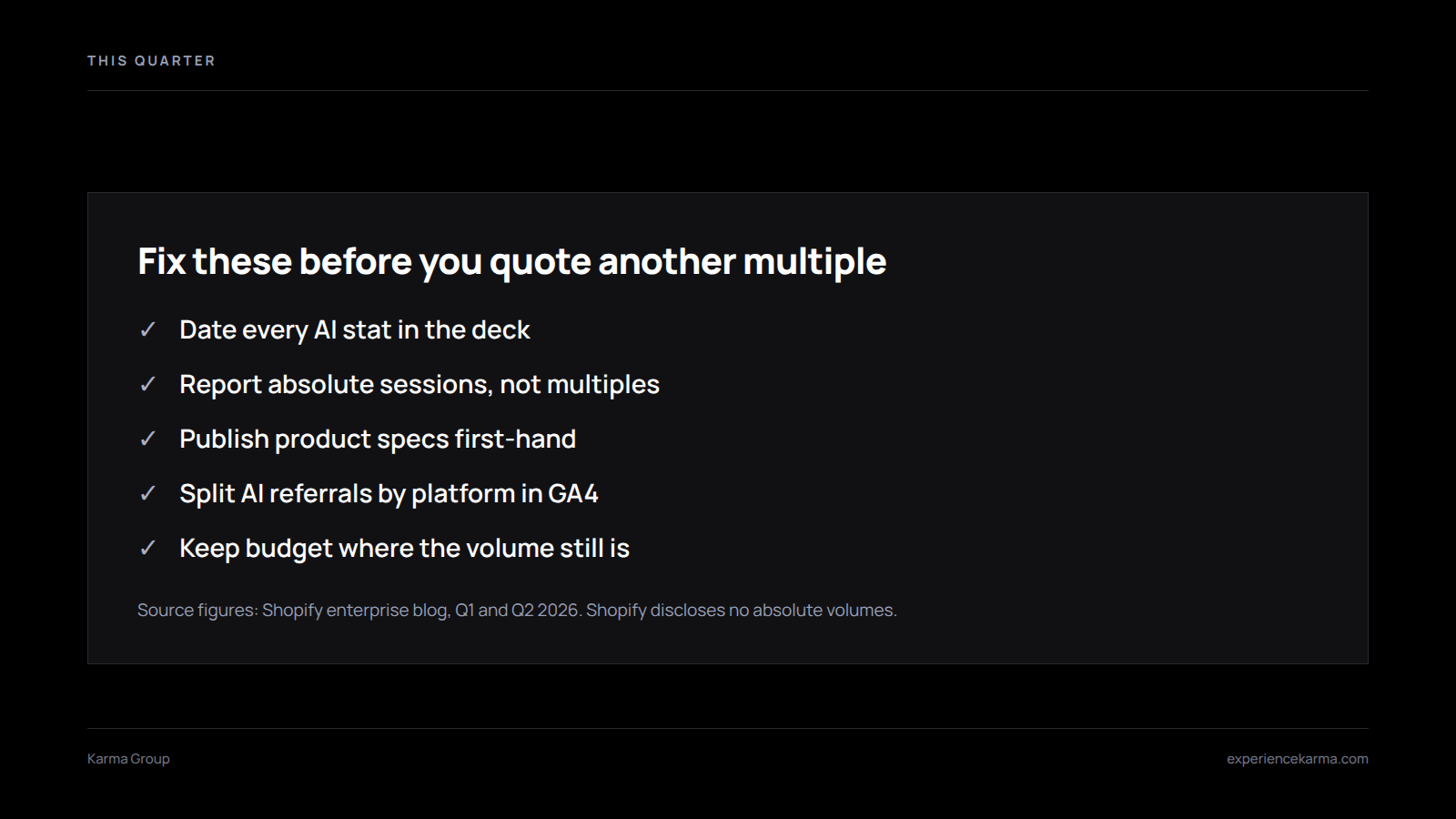
- Date every AI statistic in your deck. If a number has no quarter attached, it is probably the Q1 multiple, and it is wrong now.
- Report absolute sessions and orders, not multiples. Multiples flatter small bases and then collapse. Your board wants the count.
- Split AI referrals by platform in GA4. Track chatgpt.com, perplexity.ai, copilot.microsoft.com and gemini.google.com separately, because they behave differently.
- Publish your product specs first-hand. Structured, current, on your own domain. That is the one Shopify finding you can act on without being a Shopify merchant.
- Leave organic budget where the volume is. Organic still out-refers every AI platform combined, and it grew 12% while you were watching the AI line.
None of this argues against AI search work. It argues against pricing that work off a multiple that has already halved twice. Build the case on conversion quality and on owning your own product facts, because those held steady across both quarters.
Want help auditing your AI referral growth?
We audit how AI assistants find, read and describe brands, then fix what they get wrong. If your reporting still runs on last quarter’s multiples, or you are unsure which AI platforms actually send you buyers, talk to Karma Group. We will start with the numbers you already have.

Written by
Founder and CEO, Karma Group
Brendan Cogbill is the founder and CEO of Karma Group. He has run paid media and search for trade show, experiential and industrial brands since 2019, and now focuses on how brands earn visibility inside AI search. He holds a BBA and an MBA from Grand Canyon University and works from Phoenix, Arizona.
More about Brendan Cogbill