
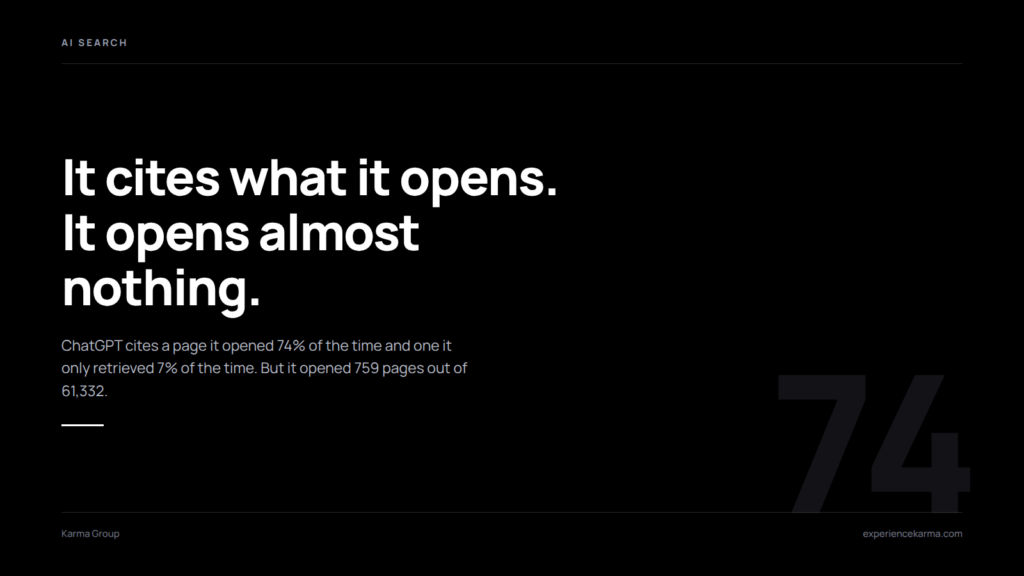
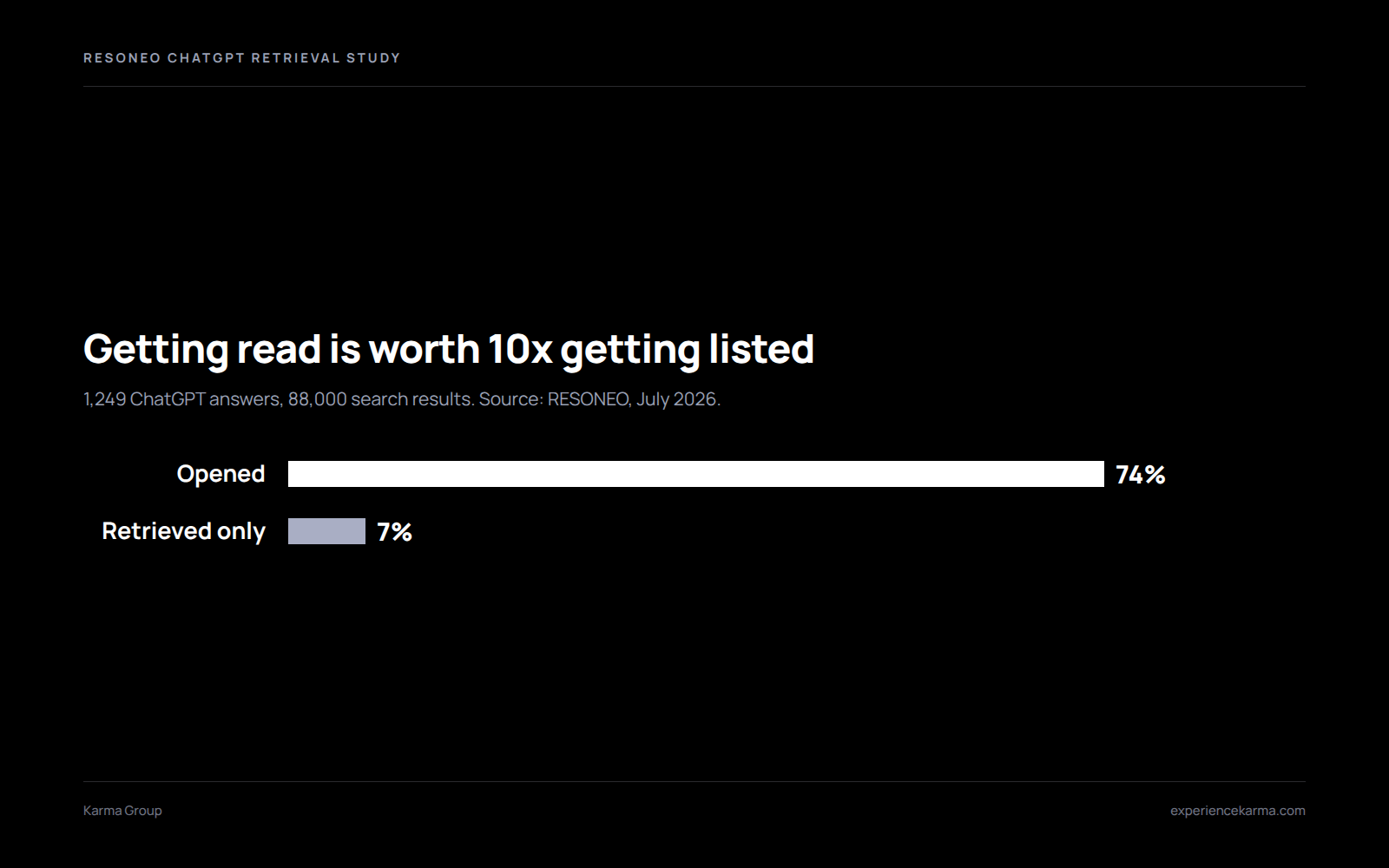
A page ChatGPT opens and reads earns a citation 74% of the time. A page it merely retrieves earns one 7% of the time. So the obvious goal is to get opened. But the same study shows that ChatGPT retrieval opened only 759 pages out of the 61,332 it surfaced, and nine in ten answers open nothing at all (RESONEO, July 2026). Chasing the 74% is therefore a losing game. Instead, win the 202 characters that decide whether the other 99% ever gets quoted.
ChatGPT retrieval opens almost nothing
RESONEO captured 1,249 real ChatGPT answers, 88,000 search results, 26,900 distinct pages and 6,400 domains. Then it tracked what happened to each page. Of 61,332 URLs pulled into the sources panel, 7,616 reached a citation tooltip. Only 5,032 became the lead source. Just 759 were ever read in full.
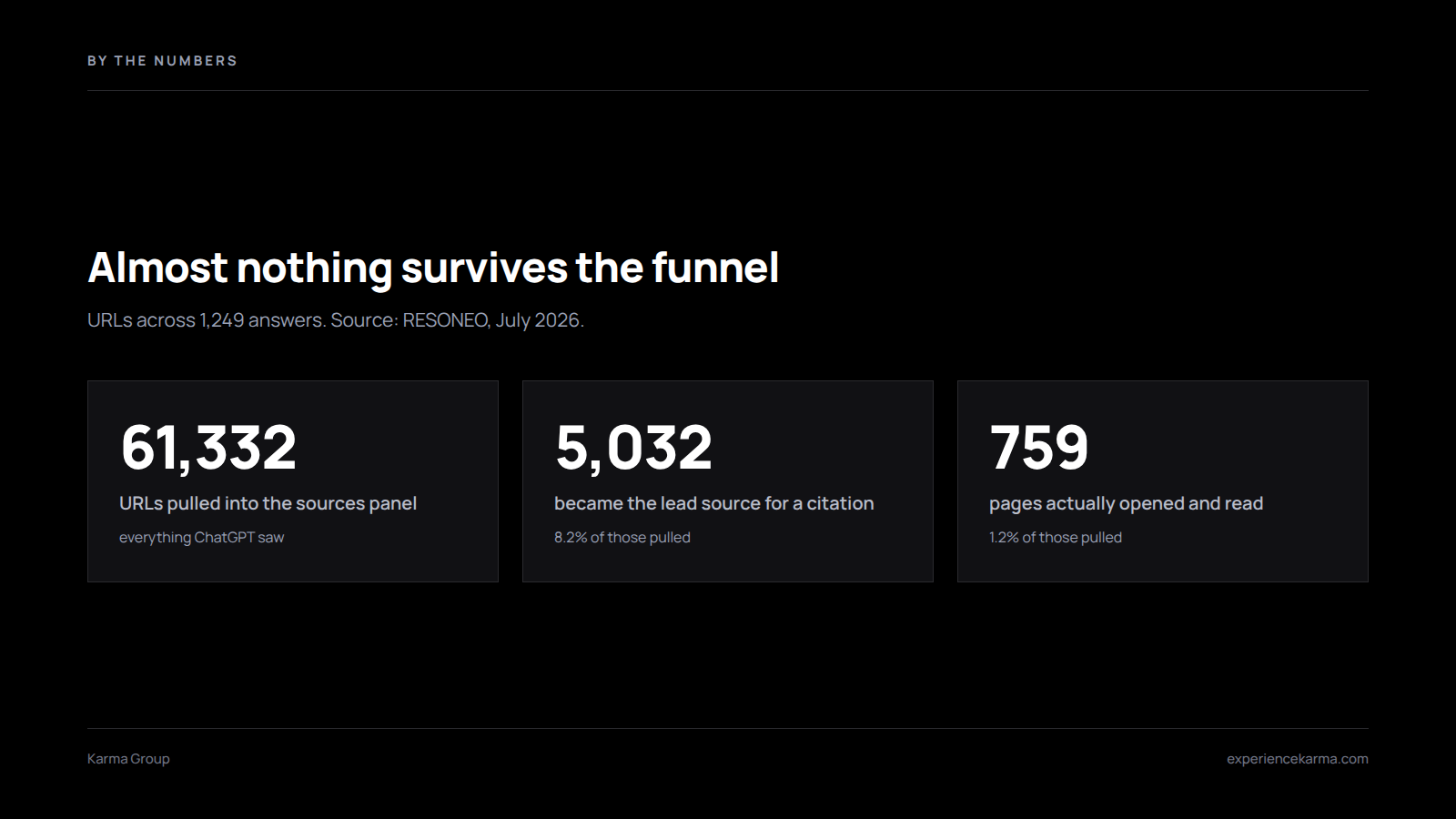
The medians tell the same story faster. A typical answer lists about 20 pages, promotes five, cites three and opens zero. So your page almost never gets read. It gets judged on a fragment, and that fragment is cut long before anyone asks a question.
Volume of retrieval is not visibility either. The study found arXiv pulled more than 2,600 times across the corpus and cited roughly ten times. Reddit showed a similar pattern. So a dashboard counting how often ChatGPT retrieval touches your domain can climb while your actual citations sit flat.
The snippet is cut before the question is asked
OpenAI runs its own index, which the study calls labrador. Snippets from labrador carry a hard cap of 202 characters. More importantly, they are query-independent: the text is cut at index time, so it does not adapt to what the user asked.
That single fact changes the work. In classic SEO you write a page and trust the engine to pull a relevant passage. Here there is no relevant passage. There is one fixed fragment, taken from the top of your page body, and it either sells you or it does not. Google-scraped results behave differently, with a median snippet of 159 characters.
Your H1 is doing the work your title tag used to do
Labrador builds that fragment from the rendered body, not from your metadata. The H1 lands inside the snippet in 80% of cases, and it is the very first character 77% of the time. Median H1 length runs 51 characters. After an average seven-character prefix, that leaves roughly 146 characters of actual explanation.
So your H1 is no longer a design element. It is the opening clause of your pitch, and one in seven pages does not have one at all. If your H1 reads “Services” or “Welcome”, you have spent a quarter of your budget saying nothing.
Everything above your H1 is stealing characters
The study measured what sits between the top of the body and the H1, because every one of those characters comes out of the same 202. The costs are specific:
- First image alt text: appears 9% of the time, costs 50 characters
- Author byline: 3% of the time, costs 45 characters
- Site or brand name: 7% of the time, costs 44 characters
- Publication date: 11% of the time, costs 25 characters
- Kicker or section label: 29% of the time, costs 18 characters

A page carrying a decorative hero image, a brand name and a date can lose 119 characters before the H1 even starts. That is more than half the budget, spent on things no reader needed.
Two users get two different ChatGPT retrieval corpora
Here the study gets genuinely awkward for anyone reporting on AI visibility. Free accounts using the Think button draw 74.7% of results from labrador and only 3.1% from scraped Google. Paid thinking accounts invert it, drawing 75.3% from scraped Google and 24.7% from labrador.
Two people asking an identical question therefore get answers built from different corpora. Ranking well in Google covers one of them. Meanwhile, only 1.5% of labrador URLs appear anywhere in Bing’s top 20, and 24% of labrador titles run past Bing’s 75-character display cap. That is how the author argues the index is OpenAI’s own rather than a Bing feed.
The ChatGPT retrieval cache keeps one bad version for months
When ChatGPT does read a page, it stores a Markdown copy. That copy stays fresh for about 30 minutes, and it is shared across users and countries. Copies have been served 90 days after the original fetch. Notably, a Cache-Control: no-store header does not prevent this.
Two mechanical limits matter too. Pages above 4 MB are rejected outright with an HTTP 400, not truncated, so a heavy page returns nothing at all. The robot also does not execute JavaScript. So if your content assembles client-side, there is no content to cache.
Your analytics undercount ChatGPT retrieval
One measurement quirk deserves a line in your reporting. Roughly 95% of the links ChatGPT displays carry a utm_source=chatgpt.com parameter, and in instant mode every one does. Yet the pages the model actually opened never carry it.
So a UTM filter captures the cheap traffic and misses the expensive kind. The pages that earned the 74% citation rate arrive unlabelled. Judging ChatGPT retrieval on that one filter will therefore flatter the wrong pages. Read it beside referrer data and branded search volume instead, as we argued in our piece on AI visibility measurement.
This will keep changing, so fix the durable parts
Worth saying plainly: the author himself warns against building around these details. The result_source field vanished overnight during the study, and shopping providers were anonymised the same week. Retrieval volumes moved sharply between July and August too, with URLs per paid conversation falling 28%.
Some findings also rest on one researcher. Suganthan Mohanadasan independently identified the same pipeline architecture in June 2026, but the cache, no-store and 4 MB findings remain single-source. Treat the pipeline split as solid and the mechanics as strong signal rather than settled law.
Fix your ChatGPT retrieval snippet this week
None of the durable work here is exotic. Do it in this order:
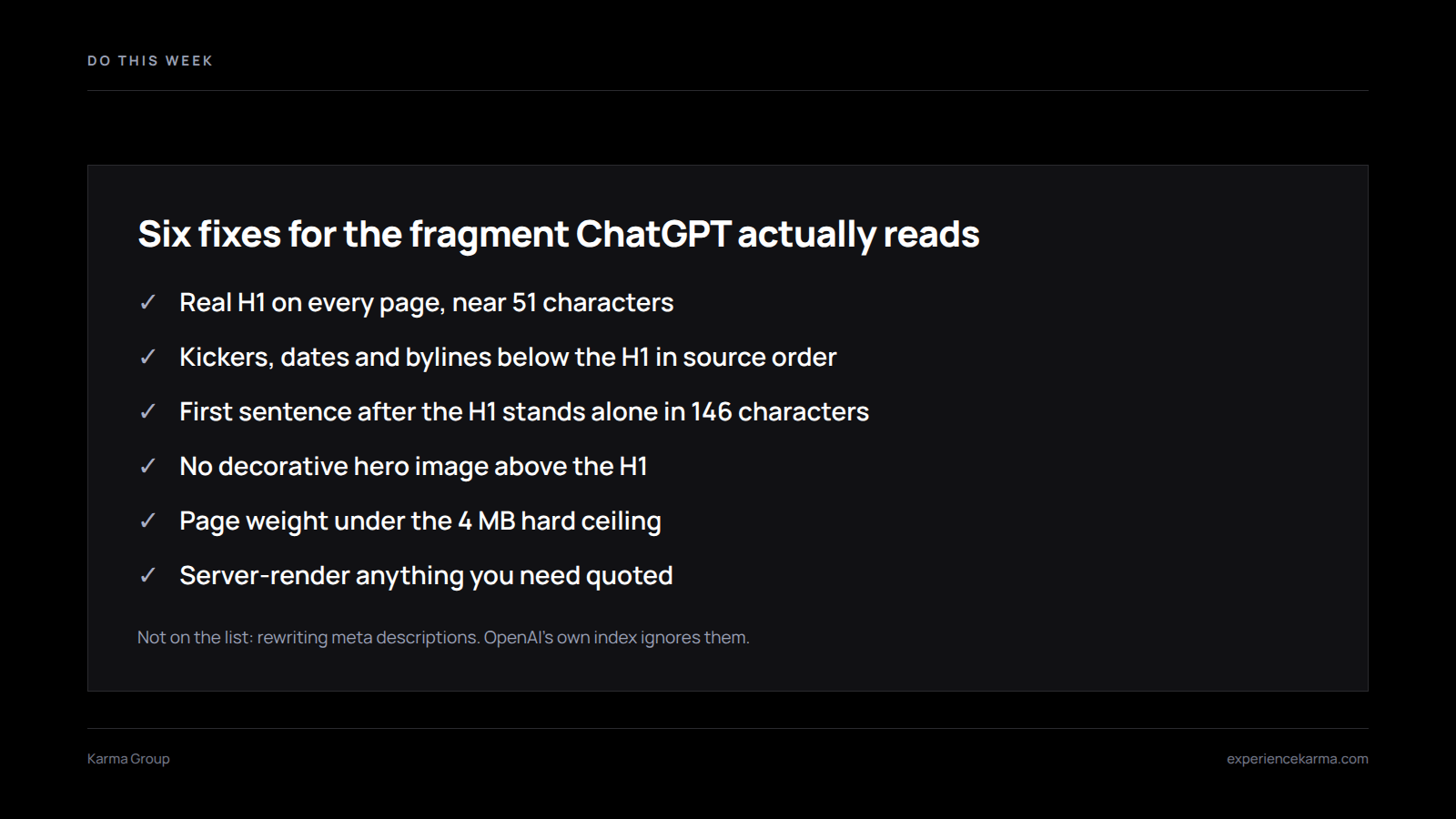
- Put a real H1 on every page that matters, and keep it near 51 characters. Say what the page is, not what the company is.
- Move kickers, dates, bylines and brand marks below the H1 in source order. Visual position can stay; source position is what counts.
- Write the first sentence after the H1 to stand alone in roughly 146 characters. It should make sense to somebody who never clicks.
- Drop decorative hero images above the H1, or strip their alt text if they are purely decorative.
- Check page weight against the 4 MB ceiling, and server-render anything you need quoted.
- Stop rewriting meta descriptions for AI search. Labrador ignores them entirely.
That last one is the money-saver. Plenty of teams are still buying “AEO audits” whose main deliverable is rewritten meta descriptions. On this evidence, that work does nothing for ChatGPT retrieval. Our earlier piece on why llms.txt does not work found the same pattern: a tidy, technical-looking artifact that no machine ever requests.
Want help auditing what AI actually sees?
We audit the fragment, not the page. The H1, the first 200 characters of body copy, source order and render path. Then we check what the assistants return for your real customer questions. If you want that done on your site, get in touch.
Sources: RESONEO, “What ChatGPT pulls, what it shows, what it cites,” July 2026, updated August 2026; Olivier de Segonzac, Search Engine Land, 17 August 2026.

Written by
Founder and CEO, Karma Group
Brendan Cogbill is the founder and CEO of Karma Group. He has run paid media and search for trade show, experiential and industrial brands since 2019, and now focuses on how brands earn visibility inside AI search. He holds a BBA and an MBA from Grand Canyon University and works from Phoenix, Arizona.
More about Brendan Cogbill