
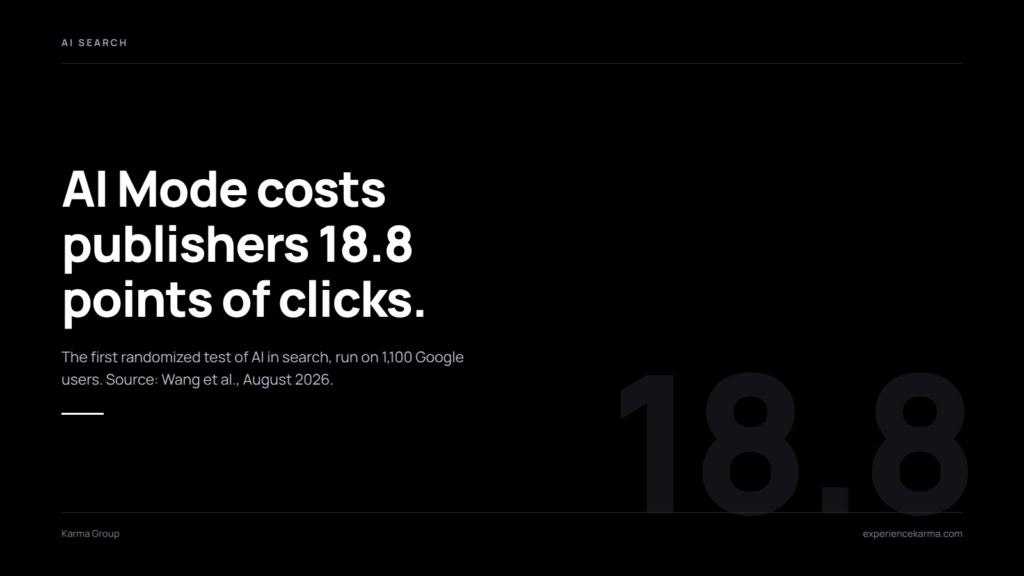
A randomized experiment run on 1,100 Google users found that AI Mode cut click-through to publishers by 18.8 percentage points. That figure comes from Wang, Gleason, Bart, Wilson and Metaxa, posted 18 August 2026. So the answer to “how much does AI Mode cost publishers” now has a real number behind it. Every other figure you have seen on this question was observational. This one was not.
The distinction matters more than the number. Until now the AI Mode debate ran on correlations, and correlations could always be explained away. Now they cannot.
AI Mode cost publishers 18.8 points of click-through
The team recruited participants in waves between 17 and 19 March 2026. Everyone ran three days on normal Google Search first, so the study had a within-person baseline. Then a browser extension split them three ways for seven days: normal Search, Search with AI Overviews and AI Mode stripped out, or an AI Mode-only build.
Assignment to the AI Mode condition reduced click-through rate by 18.8 percentage points (95% CI: −22.2 to −15.3, p<0.001). The authors defined click-through rate as the fraction of searches producing at least one click to an external site during the treatment period. In other words, this measures your traffic, not a snippet impression.
The numbers everyone quotes cannot prove cause
Two figures dominate this conversation, and both get stretched past what they can carry.
Ahrefs reported a 34.5% CTR drop across 300,000 keywords, comparing March 2024 with March 2025. Look at the control group, though. Keywords without AI Overviews also fell, from 0.056 to 0.031. So the headline is a residual between two declining lines, not an observed drop. Ahrefs says plainly that “there is still no way to disambiguate AI Overview clicks and impressions from the rest of your Search Console data.”
Pew found 8% versus 15% — the share of results-page visits producing a click, with and without an AI summary. That came from 900 US adults and 68,879 searches during March 2025. Pew describes a pattern, because that is all browsing data can show. AI summaries appear on longer, question-shaped queries that already clicked less.
Neither study is wrong. Still, neither can separate the effect of the feature from the effect of the queries that trigger it. A randomized design can, and that is the whole point of this one.
One caveat travels with the new paper too. It tests AI Mode, the conversational tab, not the AI Overview block sitting above ordinary results. Those are different surfaces with different click behavior, so do not merge the two in a client deck.
Switch the AI off and clicks come back
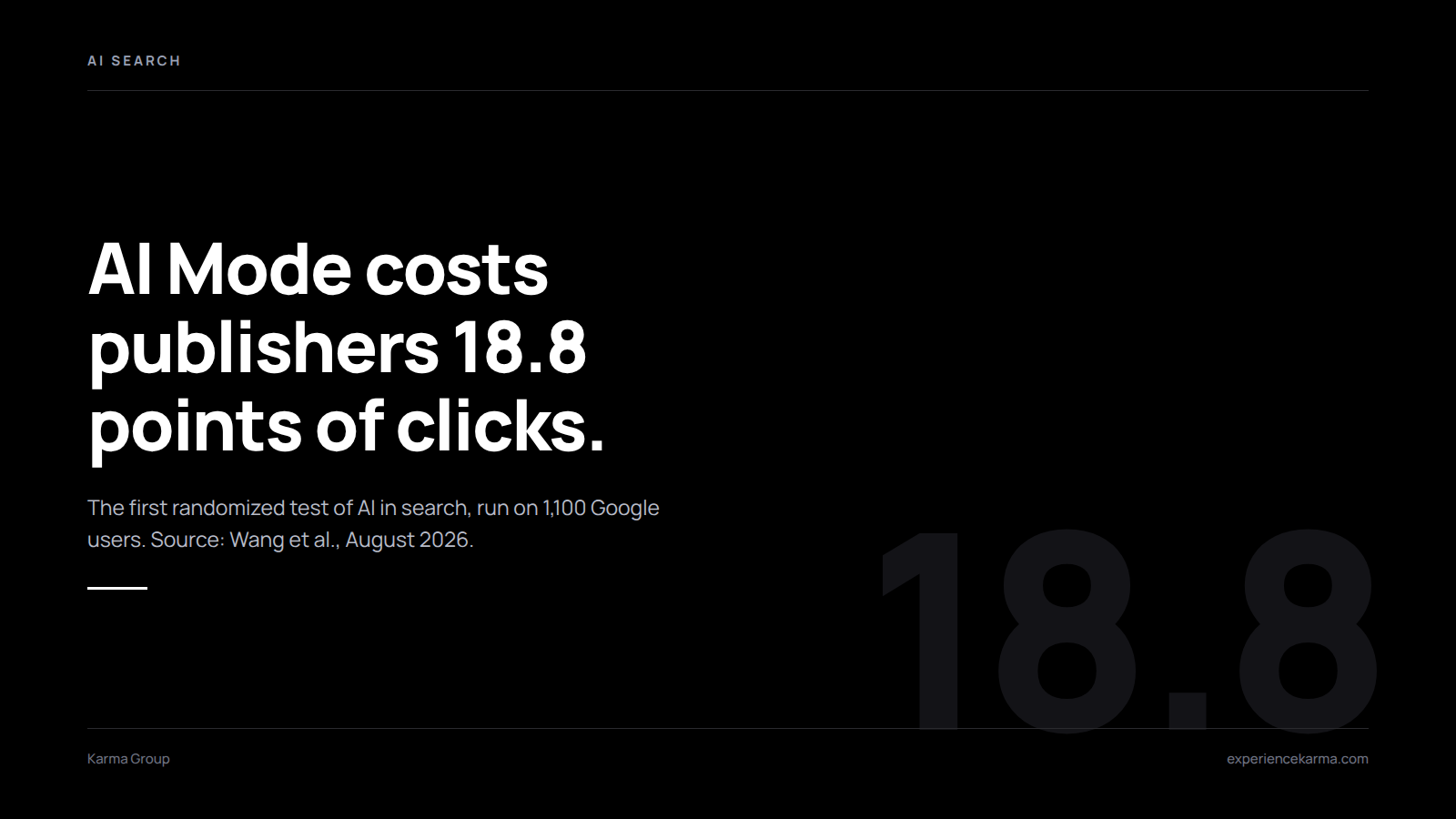
The strongest evidence sits in the mirror condition. Exposure to the no-AI build raised click-through by 8.8 percentage points (95% CI: 2.3 to 15.3, p=0.008).
Read those two results together. Adding AI Mode pushed clicks down, and removing AI features pushed them up. Both arms moved in the direction the theory predicts, so the finding is not an artifact of one odd condition.
AI Mode made search worse for the people using it
Here is the part nobody expected. AI Mode did not trade publisher traffic for a better user experience. It lost on both.
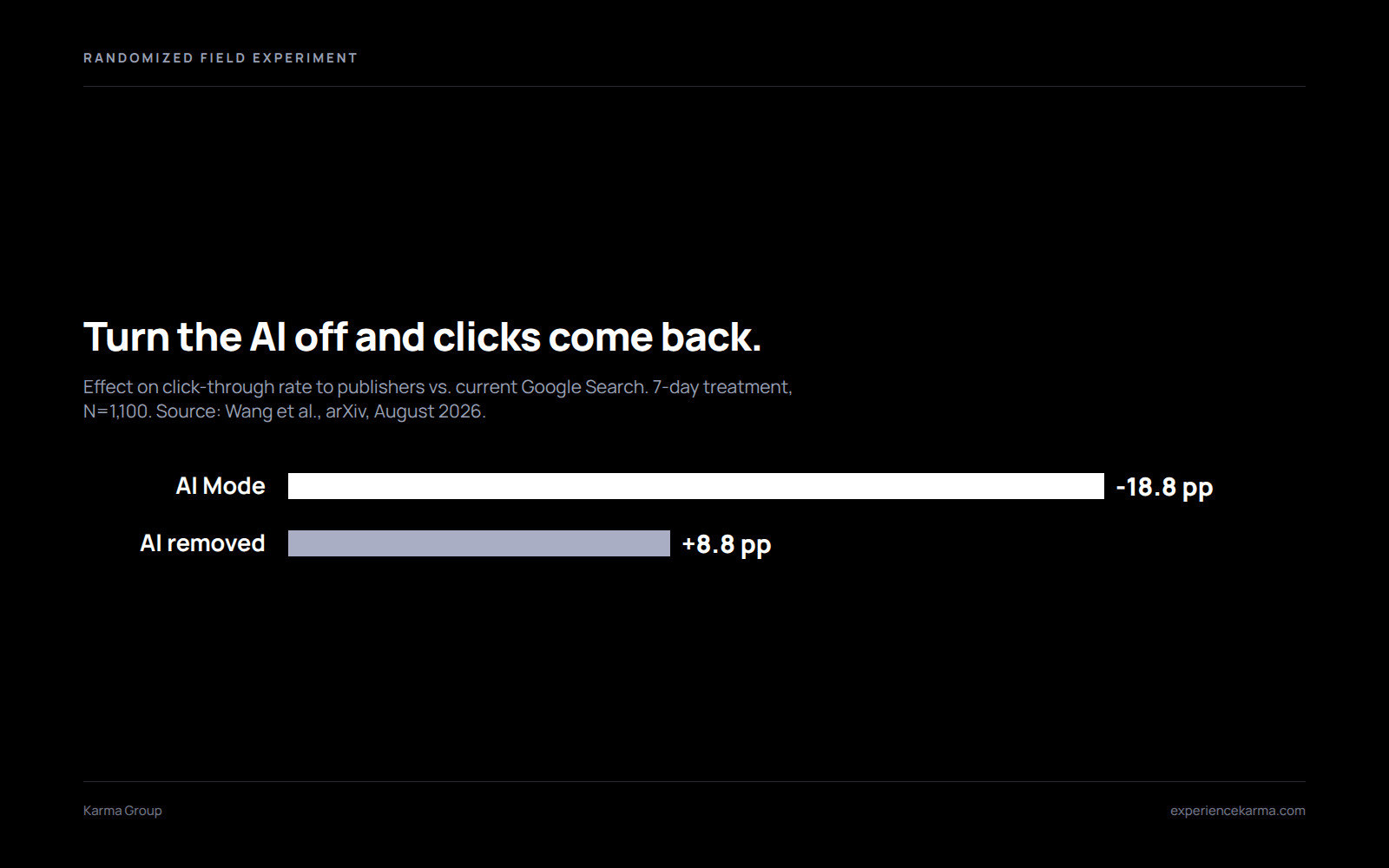
Of the 1,100 participants, 956 finished the post-experiment survey: 343 in the no-AI condition, 304 in normal Search and 309 in AI Mode. Trust in search dropped 0.34 points on a seven-point scale (p<0.001). Usefulness fell 0.59 standard deviations, satisfaction 0.73, and sense of agency 0.66 — each at p<0.001. Meanwhile the no-AI group showed no significant change on any of them.
So the usual defense of AI answers, that users prefer them, did not hold up when someone tested it properly.
Fewer searches means fewer chances to appear
One more result deserves your attention. The AI Mode group ran 0.92 fewer search sessions per day (95% CI: −1.30 to −0.55, p<0.001).
That compounds badly. A lower click rate on a smaller number of searches hits your traffic twice. Yet most AI visibility dashboards track only citation share, so they would miss this entirely.
Think about why the sessions vanish. A good AI answer ends the task in one turn, so the follow-up searches never happen. Those follow-ups were often the commercial ones: the comparison, the review check, the “near me” query. Losing them costs more than the raw session count suggests.
Search Console will not confirm this for you
You cannot check this against your own data, and that is worth saying out loud.
Google’s Generative AI performance report covers AI Overviews and AI Mode together. Yet it reports impressions only. There are no clicks, no queries and no average position, and the dimensions stop at pages, countries, dates and devices. Google also notes the report is still rolling out, so not every property has it.
So the one number you need most, clicks from AI surfaces, is the number Google withholds. Anyone selling you a precise AI Mode click figure from Search Console is guessing. Say that to clients before they read it somewhere else.
What this changes about your AI Mode plan
Not as much as the headline suggests, and that is the honest read.
The study measures what happens to clicks when AI answers appear. It does not measure how to get cited, nor does it say your GEO work is wasted. Being the source an AI answer draws on still shapes what people believe about you, and we covered that gap in citations versus brand mentions.
What it does kill is the planning assumption that AI search is traffic-neutral. Budget as if a chunk of informational click volume is gone for good. Then judge AI visibility work on influence and conversion quality instead, because the click math no longer rewards volume.
Two cautions before you quote this. The experiment ran in March 2026, so both products have shipped changes since. And the AI Mode arm forced participants into a build most people do not use by default, which makes it a clean causal test rather than a market-wide estimate.
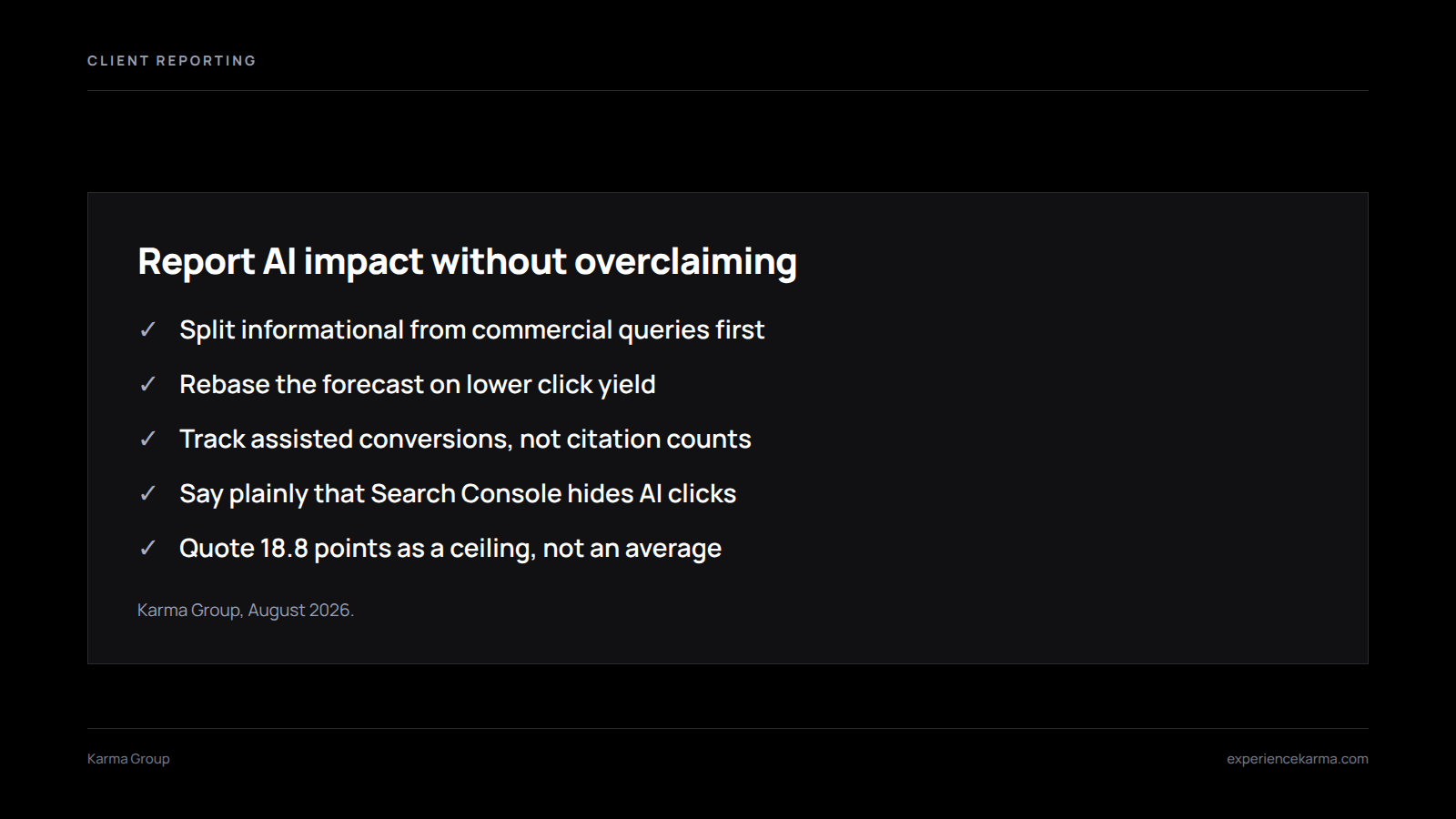
Treat 18.8 points as a ceiling, then. It shows what happens when every search runs through AI Mode. Your actual exposure depends on how many of your queries surface AI answers at all, and that varies wildly by sector. Informational and how-to terms get hit hardest, while transactional terms mostly still behave.
Do this in the next two weeks
- Pull your informational queries in Search Console and compare click yield year over year. Separate them from your commercial queries first, because the two behave differently.
- Rebase your traffic forecast on the lower click yield. Do not present last year’s curve as the plan.
- Move your AI reporting off citation counts alone. Track assisted conversions and branded search volume too, since those survive the click collapse.
- Stop paying for tactics sold on the promise of AI Overview clicks. The clicks inside AI answers are thin, and no study yet shows a reliable way to grow them.
- Put your best evidence — original data, named sources, real numbers — where a model can retrieve it. Influence is the payoff now, not sessions.
Want help reading your own AI Mode numbers?
Most of the AI search advice circulating right now rests on studies that cannot support it. We read the methods before we bill anyone for a tactic. If you want your own click data checked against what the evidence actually shows, talk to us.