
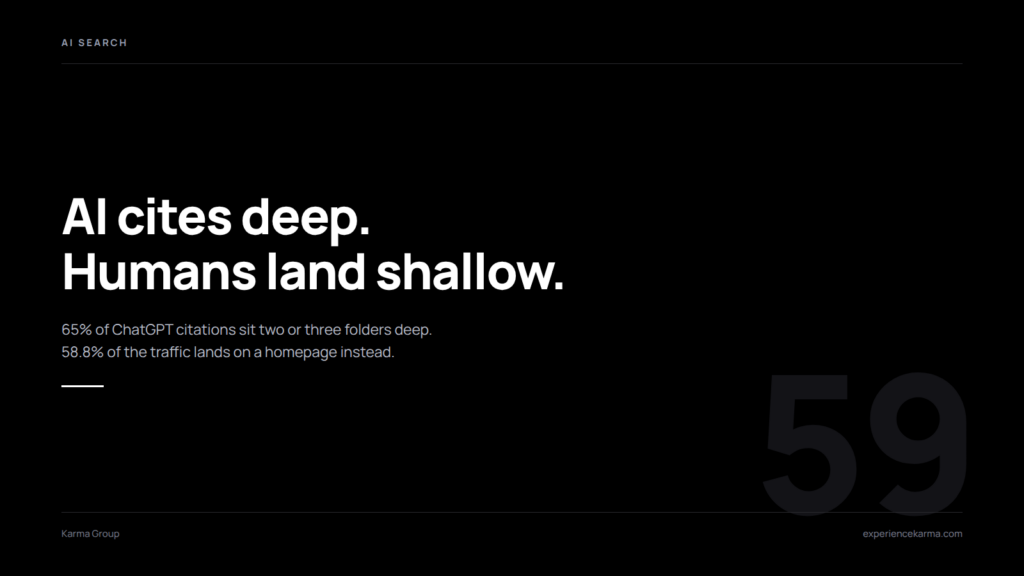
Similarweb tracked where AI answers actually send people, and the split is stark. 65% of the URLs ChatGPT cites sit two or three folders deep. Yet 58.8% of the referral traffic lands on a homepage instead. So AI homepage traffic is now your largest AI landing surface, and the page the model read is not the page your buyer opens. Most sites are built for the opposite. Fix the homepage first, then worry about the cited page.
AI homepage traffic doubled after one ChatGPT change
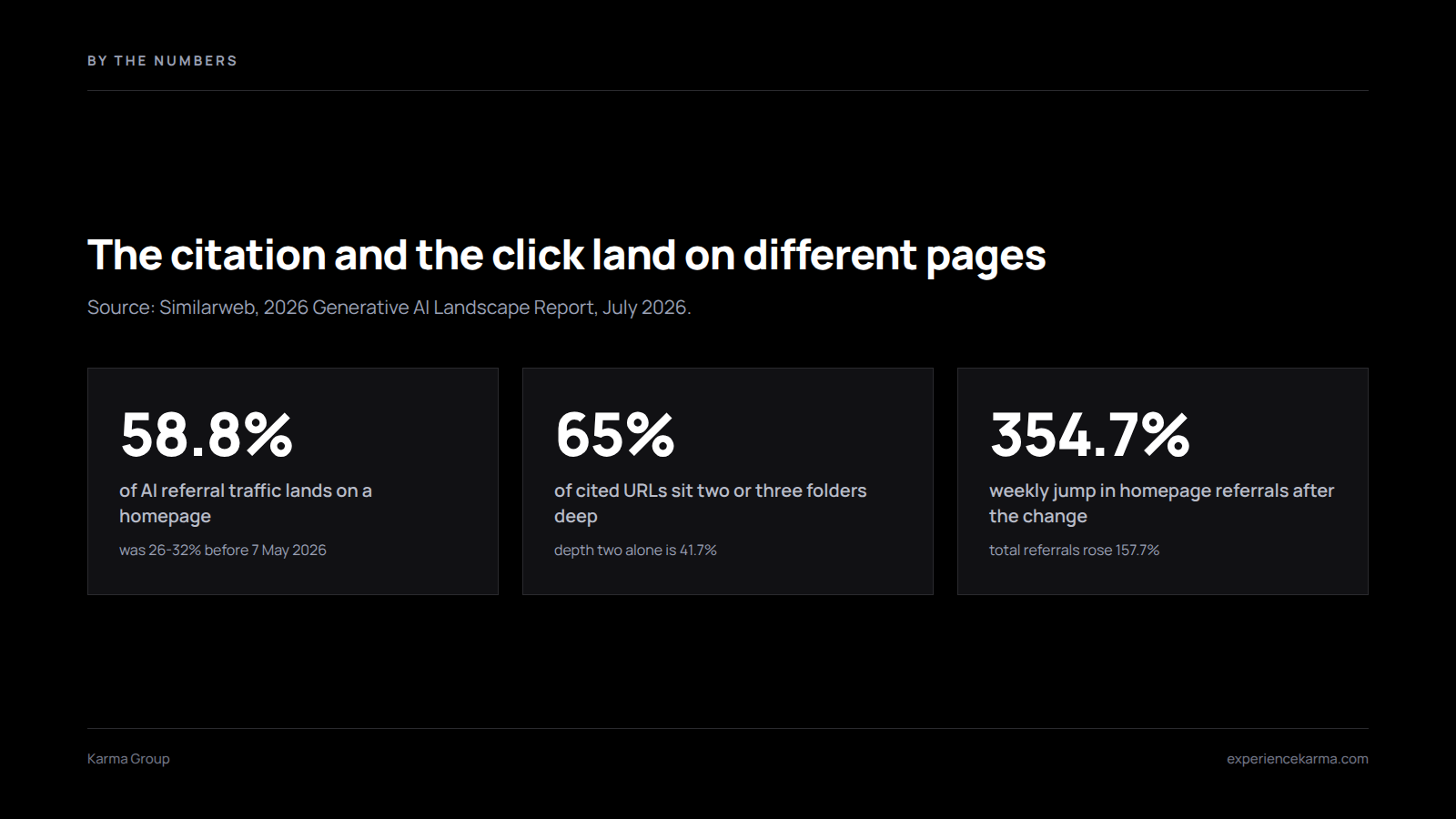
The shift has a date on it. Before 7 May 2026, roughly 26% to 32% of ChatGPT referrals landed on a homepage. After that update the share jumped to about 60%, and it has held there since (Similarweb, 9 August 2026). In the week that followed, homepage referrals rose 354.7% while total ChatGPT referrals rose 157.7%.
So homepage landings grew more than twice as fast as the traffic itself. That is not a seasonal wobble. Instead it is a product decision: ChatGPT started surfacing prominent brand links inside answers. Consequently the model now hands people a brand rather than a document.
The page ChatGPT cites is not the page it sends people to
Similarweb’s 2026 Generative AI Landscape Report puts numbers on the gap. 65% of cited URLs sit two or three folders deep. Folder depth two alone accounts for 41.7% of citations. Meanwhile 58.8% of the resulting traffic arrives at the homepage.
Read that as two separate events. The citation is a machine reading a narrow page. The click is a person arriving at your front door, often minutes later. Because those two events rarely meet on the same URL, your best-performing AI asset and your busiest AI landing page are different pages. Very few analytics setups connect them.
The mechanics behind this are simple enough. To build an answer, a model needs a page that resolves one specific question, and those pages live deep in a site. To send a person somewhere useful, the interface offers the brand. So the deep page does the work and the homepage takes the visit.
This breaks your attribution before it breaks your funnel
Most teams still report AI performance by landing page. Under that model the homepage looks like the hero and the deep page looks like dead weight. But the deep page earned the mention. Kill it in a content audit and the citations go with it.
The fix is not complicated, though it does take discipline. Track two lists side by side: pages that get cited, and pages that receive AI homepage traffic and its deeper cousins. Neither list explains the other. Judged alone, each one will point you at the wrong page to invest in next quarter.
The click itself is also rare. Pew Research Center logged 68,879 Google searches from 900 US adults in March 2025. Links inside an AI summary drew clicks on just 1% of visits, against 8% for standard results on the same pages (Pew Research Center, 22 July 2025). That study covers Google AI summaries rather than ChatGPT, so do not read it as a ChatGPT click rate. Still, it sets expectations. Few people click, so the ones who do deserve a page built for them.
Your homepage has to answer the question now
Homepages are usually written as lobbies. They announce the company, lay out three service tiles, and push everyone deeper. That design assumes the visitor already knows why they came.
AI homepage traffic arrives differently. The visitor just read an answer that named you, and they came to check whether the answer holds up. So the homepage has one job: confirm the claim quickly. State what you do, who you do it for, and the proof. Then offer one obvious next step. Anything that delays that check costs you the visit.
Be specific about the proof. A named client beats a logo wall, because the visitor is verifying a claim rather than browsing. A number beats an adjective for the same reason. Meanwhile the hero video, the mission statement, and the rotating carousel all sit between the visitor and the answer they came for. Cut them or move them down.
AI homepage traffic behaves nothing like your Google traffic
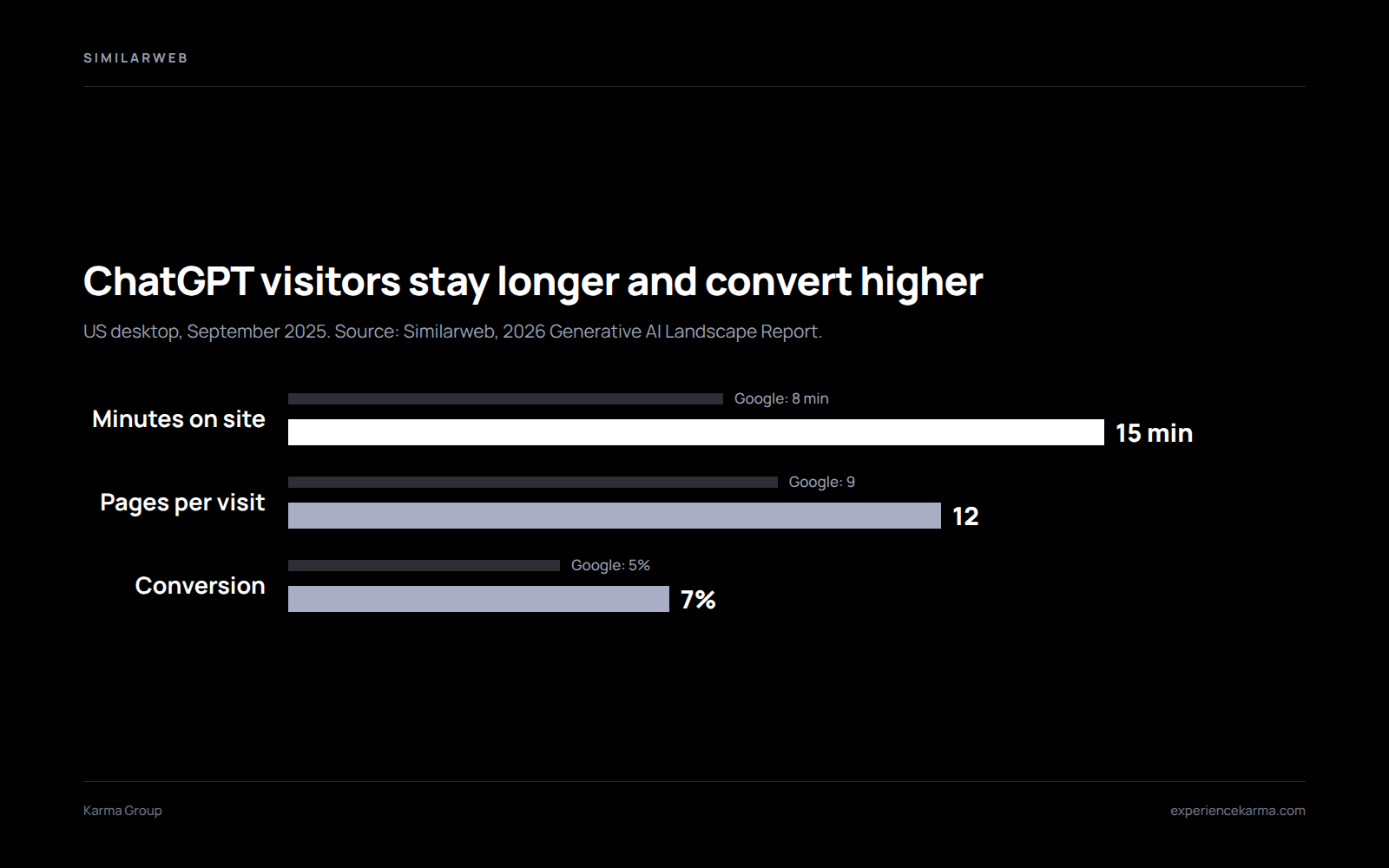
Similarweb measured US desktop sessions in September 2025 and found a wide gap between the two sources. ChatGPT-referred visitors spent roughly 15 minutes on site and viewed 12 pages. Google-referred visitors spent 8 minutes and viewed 9 pages. Conversion ran 7% against 5%.
Those visitors are patient, and they explore. But that measurement predates the May 2026 link change, so treat it as directional rather than a current benchmark. Even so, it argues against the usual instinct. Do not strip the homepage down to one conversion funnel. Instead give a researching buyer real routes to follow, because that is what they came to do.
Where the click lands depends on your industry
Previsible analyzed 6.77 million LLM-driven sessions across 166 GA4 properties, covering November 2024 through May 2026. ChatGPT drove 92.4% of them. Yet the landing surface varied sharply by sector (Previsible, 6 July 2026).
- E-commerce: product pages take 43% of landings.
- SaaS: internal search pages dominate at 34.6%.
- Education: course pages take 52%.
- Publishers: news pages take 54%.
- Health: about pages take 42.1%.
Look hard at the SaaS number. Roughly a third of those visitors land on an internal search results page, which almost nobody designs or owns. So pull your own split before you assume the homepage is the whole story. The answer differs by sector, and sometimes by product line.
These two datasets also cover different windows, which explains part of the spread. Previsible’s numbers run through May 2026, so they only partly reflect the change that pushed AI homepage traffic upward. Treat the sector pattern as the durable finding. Then treat the exact share as something to measure yourself, monthly.
Stop rebuilding the cited page for conversion
Here is the mistake we keep seeing. A team finds the page ChatGPT cites, then rewrites it with hard calls to action and a gated form. Nothing improves, because that page was never receiving the humans in the first place.
Leave it alone. It earns citations precisely because it answers one narrow question cleanly. Adding sales pressure can cost you the citation without winning the click. We made a version of this error ourselves in our July piece on AI referral traffic, and corrected the conversion math in the follow-up. Spend the effort where people actually land.
Fix your AI homepage traffic this week
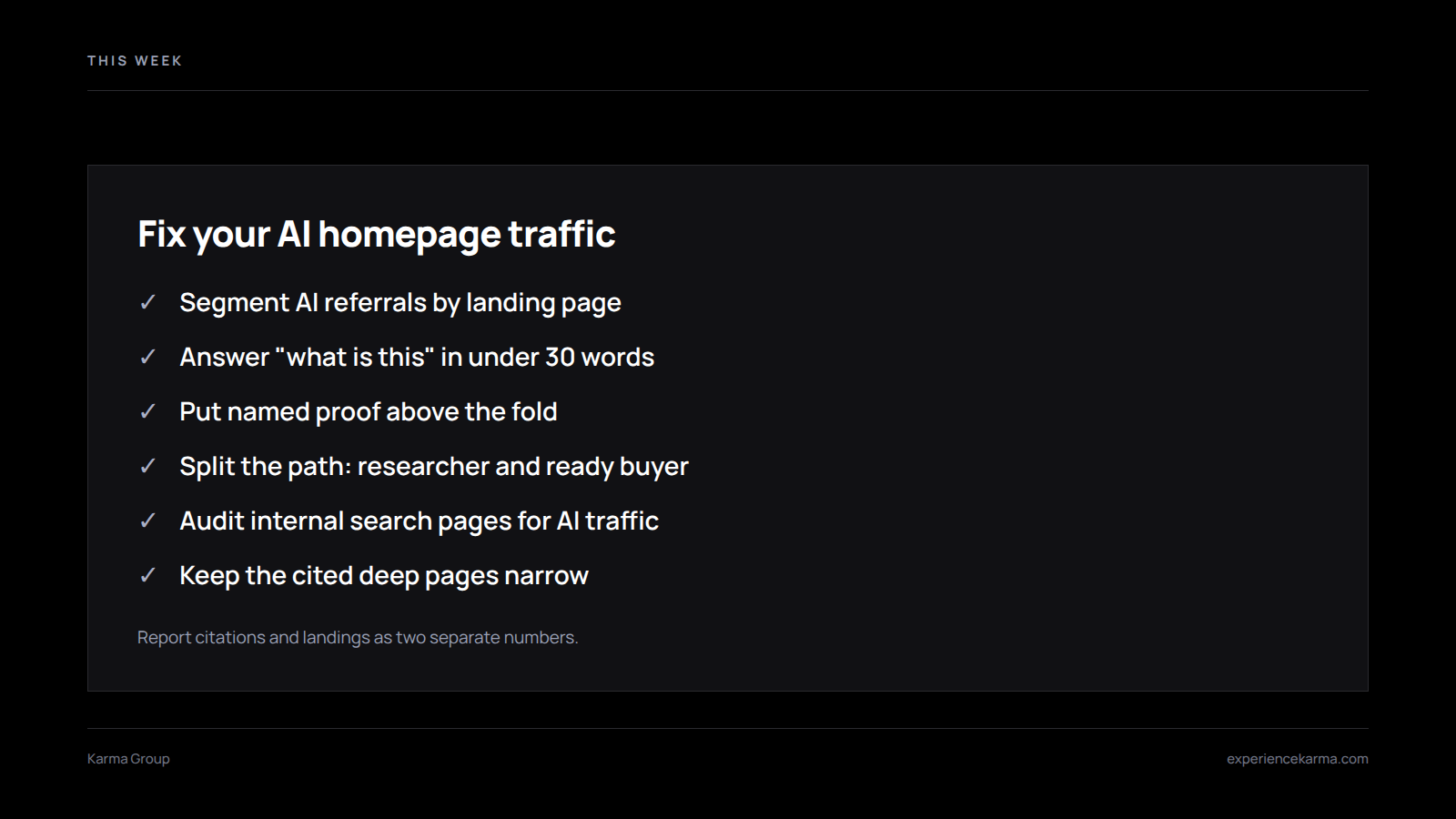
- Segment AI referrals in GA4 by landing page, not only by source. Then compare cited URLs against landed URLs.
- Rewrite the homepage opening so it answers “what is this and is it for me” in under 30 words.
- Move your strongest proof above the fold: a named client, a number, a result.
- Give researching visitors one clear path and ready buyers another. Do not force everyone into a demo form.
- Check whether internal search pages take AI traffic. If they do, give them real titles and useful defaults.
- Keep the deep cited pages narrow and factual. Never convert them into sales pages.
- Report citations and landings as two numbers, because they measure different things.
Want help with your AI homepage traffic?
Karma Group builds the pages that AI answers point at, and we measure what happens after the click. If your citations are climbing while your pipeline is flat, the gap is usually the landing surface. Talk to us and we will pull your split first.

Written by
Founder and CEO, Karma Group
Brendan Cogbill is the founder and CEO of Karma Group. He has run paid media and search for trade show, experiential and industrial brands since 2019, and now focuses on how brands earn visibility inside AI search. He holds a BBA and an MBA from Grand Canyon University and works from Phoenix, Arizona.
More about Brendan Cogbill