
In July we called AI referral traffic the best-converting channel of 2026. We built that on one figure from Invoca: 49% of ChatGPT-referred phone calls become qualified leads. The number is real. But the AI referral conversion rate you should care about sits two lines below it, and it points the other way.
We have since read the rest of the report. The 49% is a lead rate, not a sales rate. The full AI referral conversion rate runs across two stages, and almost every summary drops the second one. So if you are about to move budget on the strength of that headline, read the footnote first.
The AI referral conversion rate measures qualification, not revenue
Invoca’s Lead Conversion Benchmarks Report 2026 landed on 13 July 2026. It covers more than 70 million calls and 600 million minutes of conversation. The data spans ten industries and seven channels, from 1 March 2025 to 1 March 2026. So this is a serious dataset.
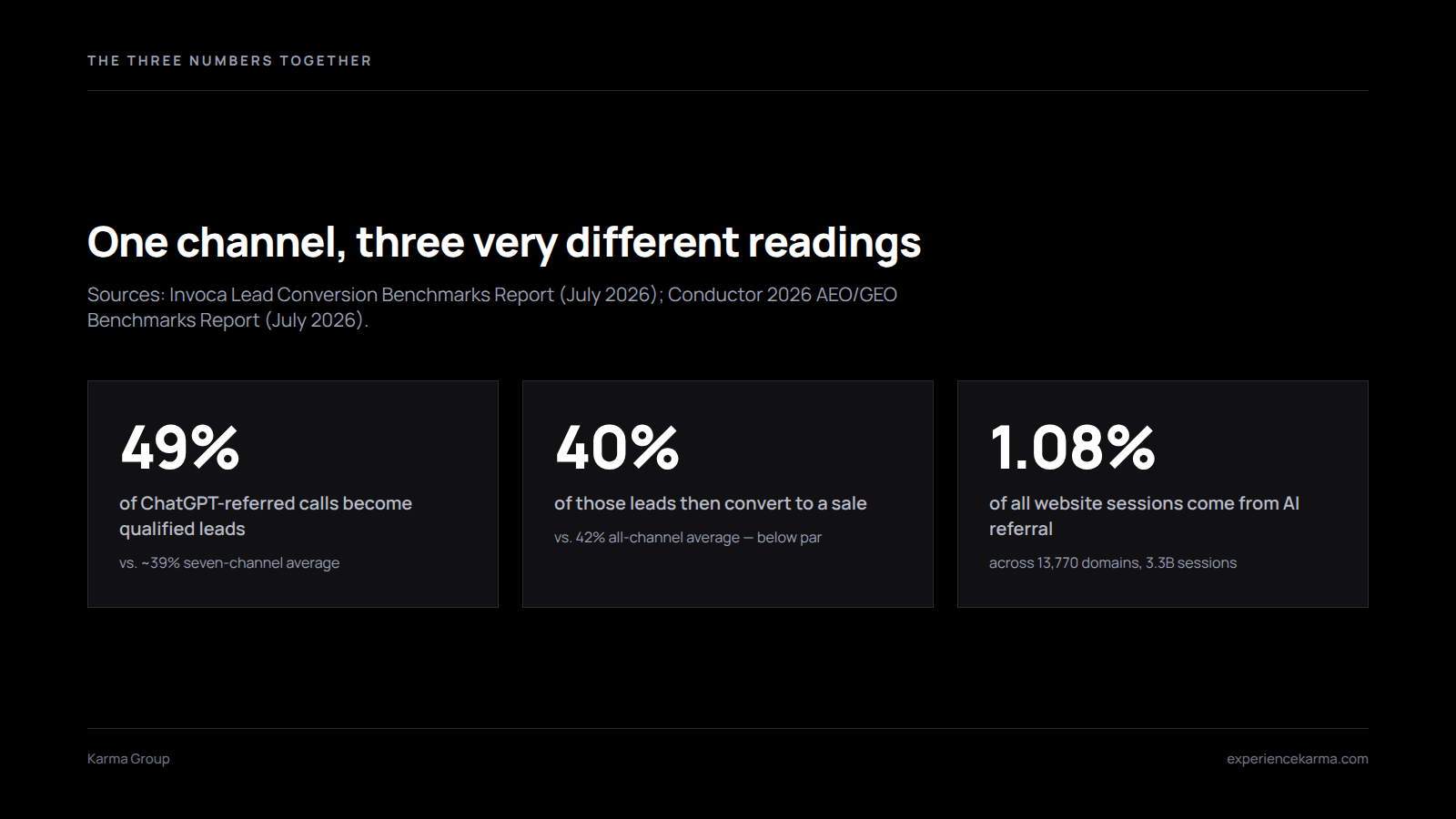
Inside it, ChatGPT-referred calls become qualified leads 49% of the time. That sits about ten points above the seven-channel average of roughly 39%. Google Business Profiles comes next at 43%. The gap is real, and it makes sense. Someone who arrives after a chat with an AI assistant has already done the research a salesperson would otherwise walk them through.
Then the edge disappears. Those same ChatGPT-sourced leads convert to a sale at 40%. Meanwhile, the all-channel average is 42%. That is not a disaster. Still, it runs opposite to the headline, and it is the half of the AI referral conversion rate that nobody quotes.
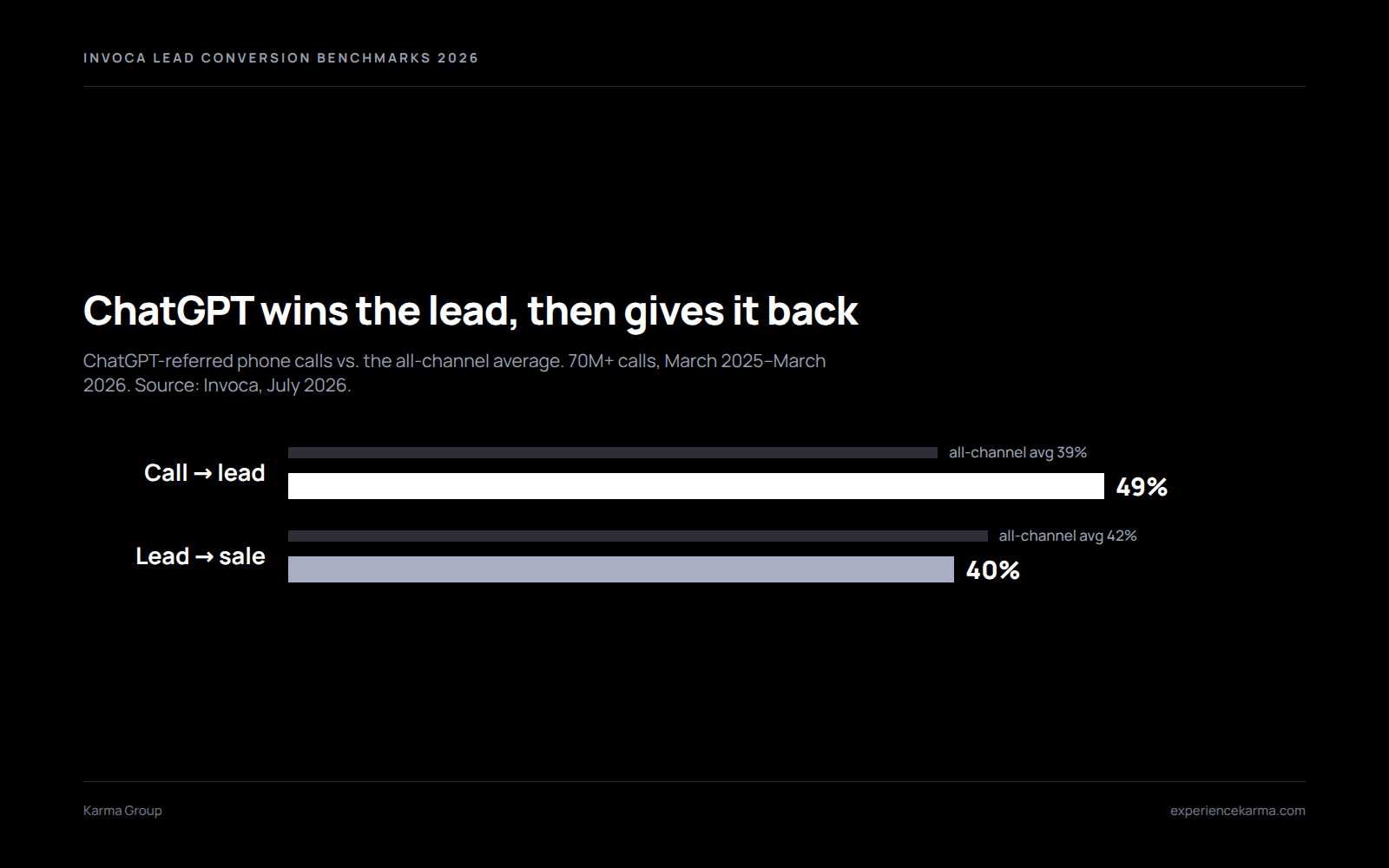
Multiply the two stages and the picture stays positive, though far less dramatic. A ChatGPT-referred call ends in a sale 19.6% of the time. The all-channel average is 16.4%. So the real edge is about 20%. That is not the category-defining advantage the 49% implies on its own.
Invoca withholds the number that matters most
Invoca did not publish how many ChatGPT-referred calls sit behind the 49%. It noted only that volume attributable to generative AI “remains very low.”
That omission is the whole story. A 20% efficiency premium on a channel delivering 1% of your pipeline is a rounding error. The same premium on 30% of your pipeline would rewrite your media plan. So without the denominator, the AI referral conversion rate cannot tell you which case you are in.
Conductor’s 2026 AEO/GEO Benchmarks Report supplies that denominator from the other side. It covers 13,770 domains and 3.3 billion sessions. AI referral accounted for 35.7 million of them, or 1.08% of all website traffic. Information Technology led at 2.80%. Communication Services trailed at 0.25%. Growth is averaging roughly 1% month over month.
One more figure from that report sharpens the point. ChatGPT alone drives 87.4% of all AI referral traffic. So when people say “AI traffic,” they mostly mean one product. That concentration cuts both ways. It makes the channel easy to instrument. Yet it also leaves you exposed to a single company’s product decisions.
What the AI referral conversion rate is worth today
Put the two datasets together and you can size the channel instead of guessing. AI referral is 1.08% of sessions. It converts through to a sale about 1.2 times as efficiently as the average channel. So it is producing roughly 1.3% of your closed business.
That number looks small on a slide. Read it as a rate, though, and it changes shape. A channel at 1% of sessions that closes better than average is not the same thing as a dead channel. It is an early position in something worth watching closely.
One caveat, because it changes how much weight that carries. Invoca measures inbound phone calls in call-driven verticals. Conductor measures web sessions across enterprise domains. These are different populations. Therefore the combination gives you an order of magnitude, not a precise figure. Treat 1.3% as a sanity check on your own analytics, rather than a benchmark to report upward.
Even as an estimate, it settles the practical question. AI referral traffic is a high-quality channel at very small scale. So it does not yet justify moving real budget away from what is working. But it absolutely justifies measuring it properly, because the growth curve is the argument, not today’s volume.
The reason to care is substitution, not referral
Chasing AI referral volume also misreads where the pressure comes from. The traffic AI assistants send you is small. The traffic they take is not.
Ahrefs compared 300,000 keywords in Google Search Console, March 2024 against March 2025. Half had AI Overviews present, half did not. Where an AI Overview appeared, the top-ranking page lost about 34.5% of its click-through rate. Pew Research Center then tracked real behaviour among 900 US adults in March 2025. Users clicked a traditional result 8% of the time when an AI Overview was present, against 15% when it was not.
Conductor puts a number on the exposure. Of 21.9 million Google searches it analysed, 5.5 million triggered an AI Overview. That is 25.11% of searches. Pew measured the after-effect too. Users abandoned browsing 26% of the time after landing on a page with a summary, against 16% without one.
So here is the honest framing. AI search is not yet a meaningful acquisition channel. Yet it is already a real subtraction from your existing one. Earning citations is defensive work before it is offensive work. That is a duller pitch than “the best-converting channel of 2026.” It is also the one that survives contact with your analytics.
How to measure your own AI referral conversion rate
- Build the channel group first. Create a custom channel group in GA4 for AI assistant referrers: chatgpt.com, chat.openai.com, perplexity.ai, gemini.google.com, copilot.microsoft.com, claude.ai. Without it, this traffic hides inside Direct and Referral.
- Get your own two rates. Pull session share and conversion rate for that group against your site average. Your numbers matter. The benchmarks only tell you whether yours look strange.
- Measure through to revenue, not to lead. Stopping at the lead stage produced a misleading conclusion for a whole industry. So do not repeat it inside your own reporting.
- Track the trend line, not the level. At roughly 1% growth a month, the level stays unimpressive for a while. A sustained acceleration in your own data is the signal worth acting on.
- Audit what AI assistants already say about you. Substitution is the near-term risk. Whether you are named in the answers replacing your clicks has budget consequences this year.
Correct the record, then act on it
We got the framing wrong in July, and the correction is more useful than the original claim. AI referral traffic converts unusually well at the top of the funnel. Then it gives some of that back at the bottom. Meanwhile it stays near 1% of sessions for most businesses. So read the AI referral conversion rate as a signal about quality, never as a signal about scale.
The broader lesson applies to every AI search number you will read this quarter. Most of them are real. Most of them also measure one stage of a funnel. Usually, the stage they skip is the one you get paid on.
Want help sizing this for your business?
We build the measurement first and the strategy second. That means GA4 channel groups that truly separate AI traffic, visibility audits that show where you are named, and content built to be cited rather than to fill a calendar. Talk to Karma Group about what your own numbers look like.

Written by
Founder and CEO, Karma Group
Brendan Cogbill is the founder and CEO of Karma Group. He has run paid media and search for trade show, experiential and industrial brands since 2019, and now focuses on how brands earn visibility inside AI search. He holds a BBA and an MBA from Grand Canyon University and works from Phoenix, Arizona.
More about Brendan Cogbill