

A July 2026 experiment ran 300 trials against two versions of the same online store. The agent-ready website finished 89.3% of the tasks. The plain version managed 49.3%. So agent readiness matters, and the gap runs 40 points wide. An agent-ready website means no rebuild, though. It means structured data, labeled controls and a few evidence signals added to pages you already have.
An agent-ready website doubled the pass rate
Said Elnaffar and Farzad Rashidi published the study on July 13, 2026. They built one e-commerce prototype twice. One version stayed ordinary. The other got structured data, semantic labels and explicit action attributes. Then they ran five tasks past GPT-4.1, Gemini 2.5 Flash and Grok-4 Fast, ten times each, on both builds. That comes to 300 independent runs.
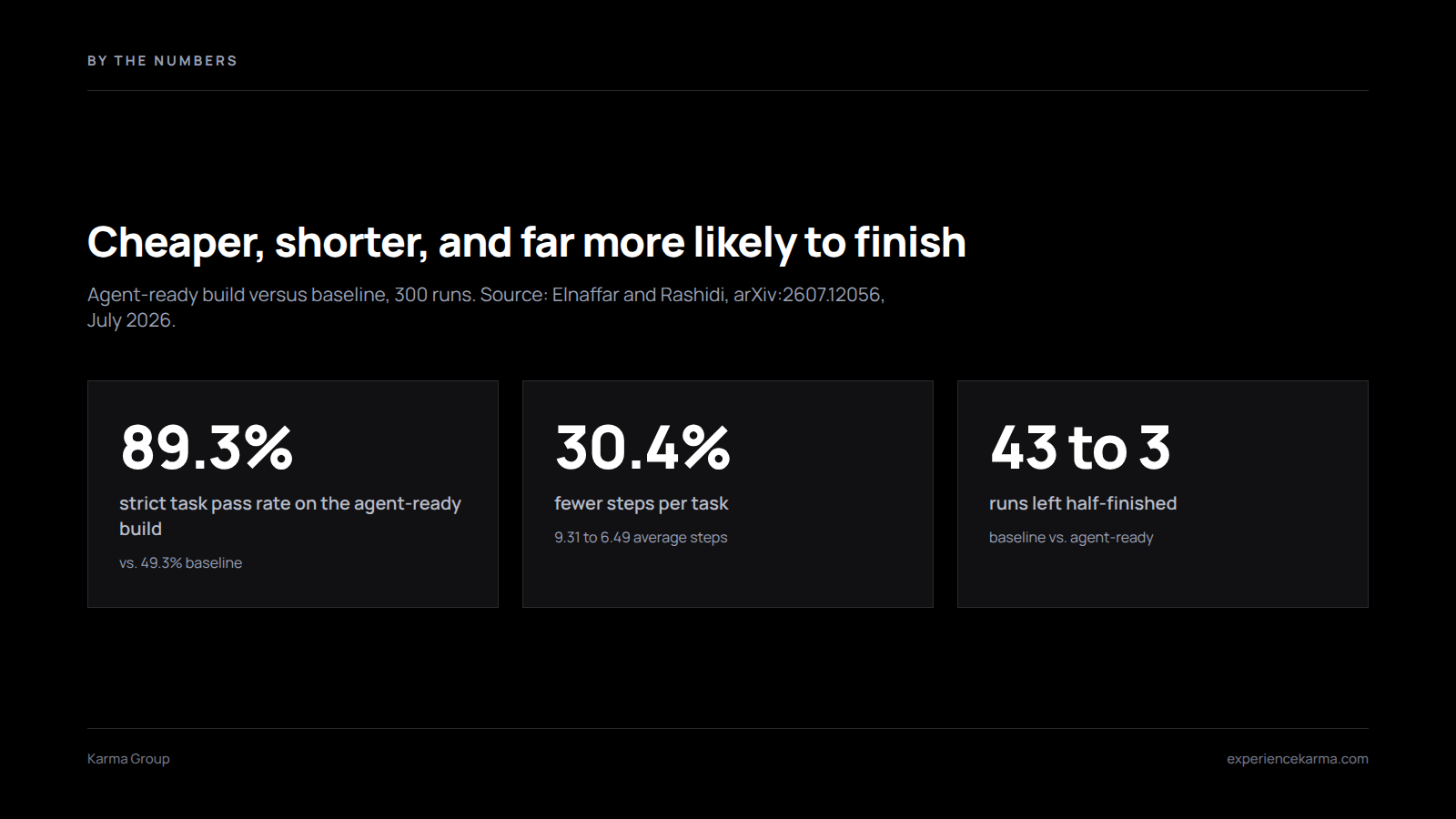
The tuned build passed 134 of 150 runs, or 89.3%. The plain build passed 74 of 150, or 49.3%. A chi-square test put the difference below p<0.001, so this was not noise. Partial results tell the same story. The plain site left 43 runs half-finished, while the tuned site left 3.
Agents also worked faster. Average steps fell from 9.31 to 6.49, a 30.4% cut. Token use dropped 37.43% for GPT-4.1, 18.72% for Gemini and 40.47% for Grok. In other words the same job cost roughly a third less to run.
Two tasks went from near-failure to near-perfect
The average hides the interesting part. Task 2 climbed from 23.3% to 100%. Task 3 climbed from 16.7% to 93.3%. Both of those asked an agent to weigh products against several constraints at once.
Now look at the tasks that barely moved. Task 5 gained 6.7 points, from 73.3% to 80.0%. Task 4 gained 16.7 points. Those covered the simpler jobs, and agents already handled them well enough.
Live testing shows the same shape. In the Online-Mind2Web benchmark, average success falls 31.6% moving from easy tasks to medium ones, then drops another 15.4% on hard ones. Difficulty drives the failures, not subject matter.
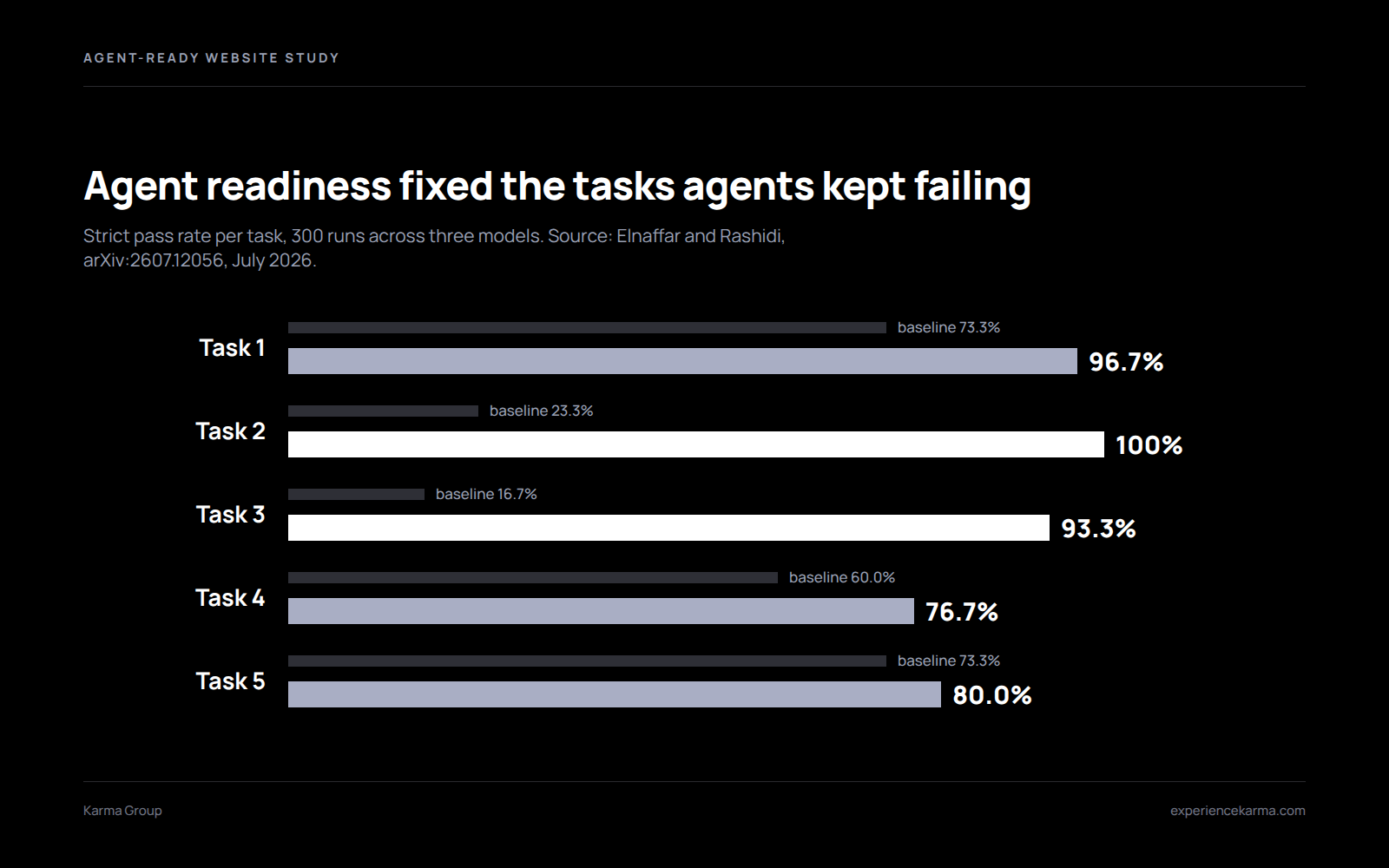
So the payoff concentrates where the work gets hard. If your page only asks a visitor to read one screen, agent readiness buys you little. But if it asks them to filter, compare or match a spec, it buys you a great deal.
Structured data does the work that pretty markup cannot
The tuned build exposed product data as JSON-LD and plain JSON files, not just rendered JavaScript. It leaned on real semantic HTML, clear headings and full descriptions rather than clever layout.
That sounds obvious. Still, most sites fail it, because the data a shopper reads on screen never exists as data. A price drawn by a script reads as a picture to an agent. A spec buried in a tab reads as nothing at all.
So write the facts into the markup. Product attributes, stock status, price and dates all belong in JSON-LD, and they belong there even when a human sees them somewhere else on the page.
Your agent-ready website lives or dies on forms and filters
Ohio State’s Online-Mind2Web benchmark makes the same point from the other direction. It runs 300 tasks across 136 live websites. When researchers scored OpenAI’s Operator by hand, filter and sorting mistakes caused 57.7% of its failures. Navigation errors caused another 19.6%.
So agents rarely fail because your copy reads badly. They fail because a filter never applied, a sort order quietly reset, or a submit button did nothing. Those count as build problems, not content problems.
Give every control an explicit label. Add data attributes carrying the product ID, the stock state and the availability. Then keep the path from list to detail to cart short and obvious, because every extra step gives an agent one more chance to wander off.
An agent-ready website is not an llms.txt file
Plenty of teams answer the agent question by dropping a text file at the root and calling it finished. We looked at that tactic already, and llms.txt mostly goes unread. Nothing in this study touches llms.txt either.
Every feature that moved the numbers sat inside the pages themselves. JSON-LD, semantic HTML, labeled controls, timestamps. Those live where the agent already works, so they get used instead of ignored.
So skip the manifest for now. Fix the pages first, then revisit the extras once agents actually ask for them.
An agent-ready website still has to prove its facts
The third leg of the framework gets less attention than it deserves. Elnaffar and Rashidi call it decision reliability. An agent choosing between two products needs a reason to trust one, so the tuned prototype carried reviews, certifications and timestamps.
Timestamps matter most. An agent cannot tell last year’s price from this morning’s price unless you say so. Add a visible last-updated date, then put the same date in the markup.
Reviews and third-party certifications work the same way. They give an agent evidence it can hand back to the person who asked, which beats an unsupported claim every time.
One prototype is not the whole web
Be careful with that 40-point number. The authors tested one prototype store, five tasks and three models. They say so themselves, and they call for work on real sites across more agent systems.
Real-world scores look messier too. The Online-Mind2Web leaderboard, last updated June 29, 2026, shows top agents claiming 97.0% on live sites. Meanwhile the April 2025 paper behind that benchmark measured OpenAI’s Operator at 61.3% under human review. The leaderboard itself warns that different judges produce different scores for the same agent.
So treat 89.3% as a direction, not a promise. The mechanism holds either way, because agents do better when the facts sit in the markup and the controls carry labels.
Schema earns you actions, not citations
Two claims deserve separating here. Our own test found that schema markup does not buy AI citations. That finding still stands.
This study measures something else entirely. It asks whether an agent can finish a job on your page, not whether a chatbot names you in an answer. Schema loses the first argument and wins the second.
So stop selling structured data as a citation tactic. Sell it as the thing that lets software buy from you, because that is the job it actually does.
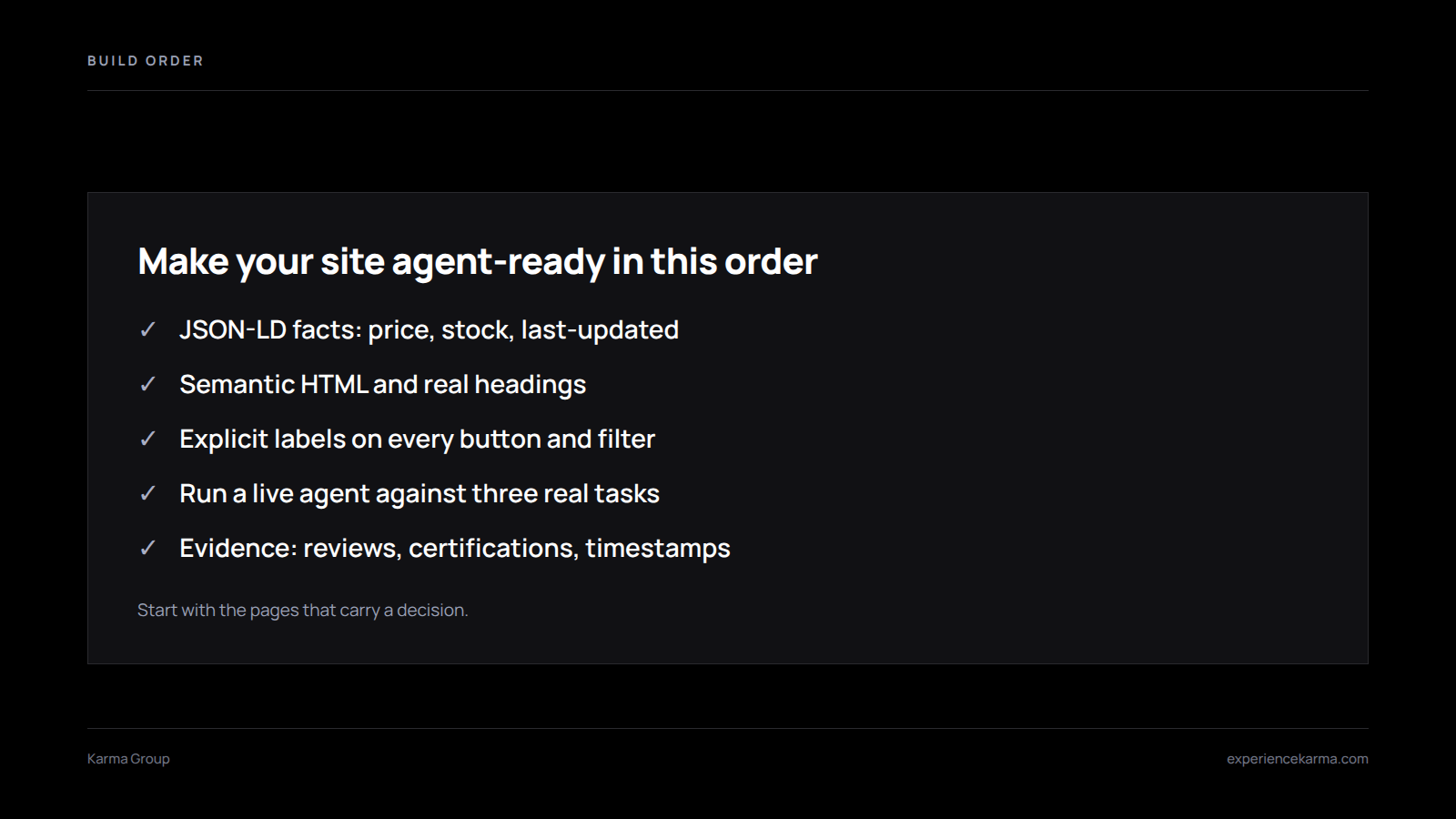
Build your agent-ready website in this order
Start with pages that carry a decision. Product pages, service pages, pricing and anything with a filter come first.
- Put your product or service facts in JSON-LD, including price, availability and a last-updated date.
- Swap div soup for semantic HTML, real headings and full descriptions.
- Label every control, because buttons, filters and form fields all need explicit names and data attributes.
- Test the path an agent takes. Ask a browsing agent to finish a real task, then watch where it stalls.
- Add evidence. Reviews, certifications and timestamps give an agent a reason to pick you.
Then run that test again next quarter, because the agents move faster than your site does.
Measurement stays the hard part. No analytics tool reports whether an agent-ready website finished the job or gave up halfway, so you have to watch a real agent try. Pick your three highest-value tasks, run them monthly, and log where the agent stops. That log tells you more than any visibility score, because it names the exact control that broke.
Want help making your site agent-ready?
Karma Group audits and builds sites for AI search and AI agents. So if you want to know where an agent stalls on yours, get in touch.